"What a US online store really costs in 2026, priced three ways: a hosted plan you set up yourself, an agency build on Shopify, WooCommerce or BigCommerce, and a custom or headless build. Every number links to its source."
Key Takeaways
- 1Setting up a store yourself on a hosted platform starts at $29 a month: Shopify Basic or BigCommerce Core, billed yearly. WooCommerce software is free, but WooCommerce says hosting runs $25 to $350 a month for most stores.
- 2An agency build on Shopify, WooCommerce or BigCommerce usually costs $2,000 to $25,000, based on Shopify's and BigCommerce's own 2026 cost guides. Custom and headless builds start around $25,000 and can pass $250,000.
- 3Card fees usually cost more than the platform. At 2.9% plus 30 cents per order, a store doing $100,000 a year across 2,000 orders pays $3,500 in card fees, about ten times a $348 yearly Basic plan.
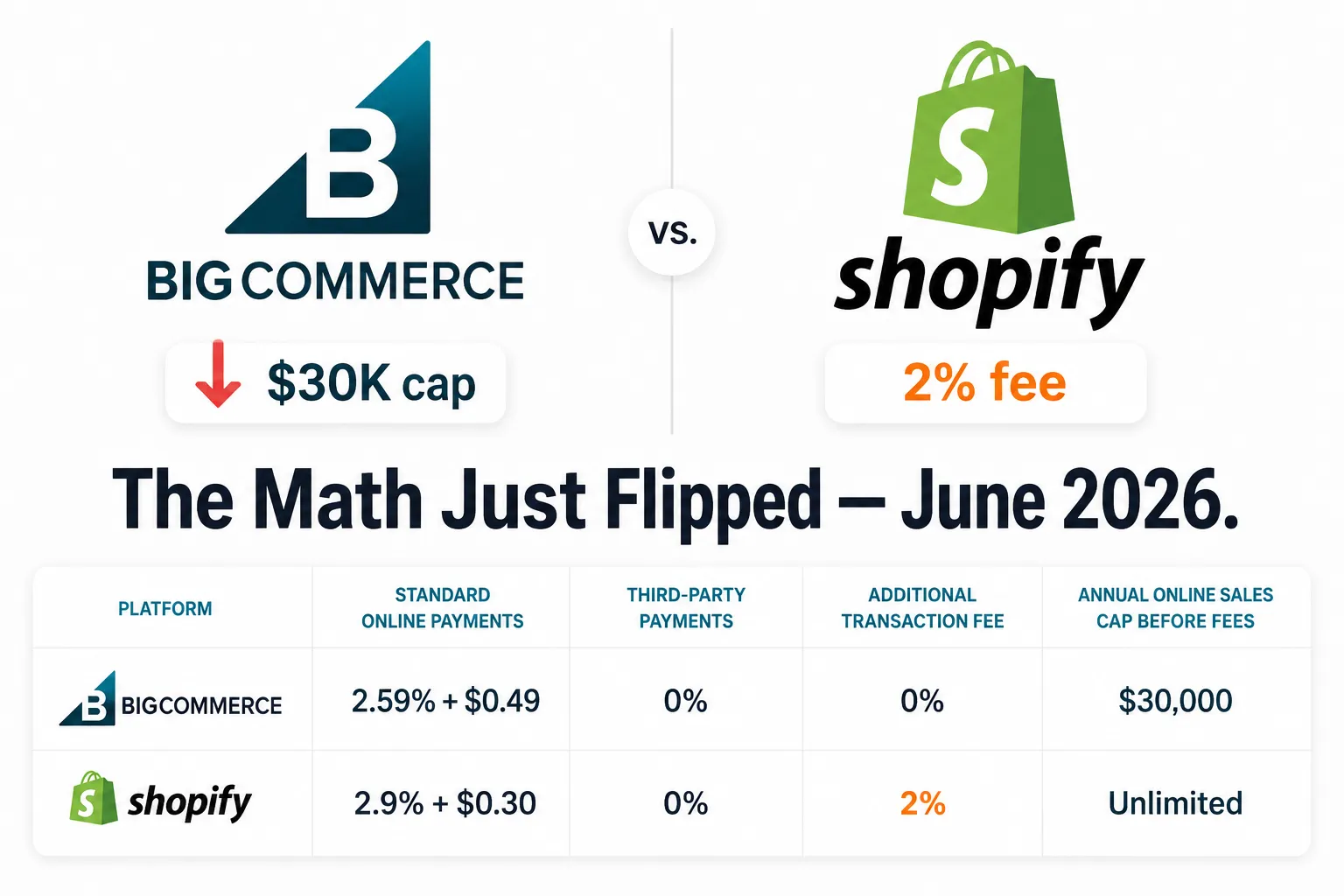
- 4Your plan can change as you grow. BigCommerce moves you up a plan past $30,000 and then $100,000 in yearly sales, and Shopify adds up to 2% per sale when you use a payment provider other than Shopify Payments.
- 5In our experience, B2B and wholesale features, ERP connections and big migrations are what push a build into the higher price brackets, on every platform.
- 6Go headless only when a theme is blocking how you sell. Shopify hosts Hydrogen headless storefronts on Oxygen at no extra charge on paid plans, but its own developer docs warn about the added costs and complexity.
- 7Ecommerce is still growing: online sales were 17.1% of US retail sales in the second quarter of 2026 and grew 12.2% year over year, according to the US Census Bureau.
By Bhavesh Barot | Prices checked on September 17, 2026 | 17 min read
Quick Answer
A US ecommerce website costs about $29 a month if you set it up yourself on Shopify Basic or BigCommerce Core, billed yearly. Paying an agency to build on Shopify, WooCommerce or BigCommerce usually costs $2,000 to $25,000, based on Shopify's and BigCommerce's own 2026 cost guides. Custom and headless builds start around $25,000 and can pass $250,000. Card fees, apps and upkeep come on top of all three.
Most ecommerce cost guides hand you one giant range and stop. BigCommerce's own 2026 guide puts it at $0 to $250,000+. That range is real, but it hides the question that decides your budget: which of the three build paths are you on?
This guide prices each path line by line, using the platforms' own published pricing (checked September 17, 2026) and US government data. Every number links to where it came from, and anything that is our opinion is labeled as opinion. Here is the first one, from building websites for 500+ businesses: the monthly platform fee is almost never the line that hurts. Payment fees, apps and paid work after launch usually cost more.
Ecommerce Website Cost by Build Path (2026)
Every online store gets built one of three ways:
- Hosted platform, set up yourself.You rent a ready-made store from a company like Shopify or BigCommerce. “Hosted” means they run the servers, security and checkout for you. You pick a theme (a ready-made design), add products and start selling.
- Platform plus an agency build. Same kind of platform, but you pay a developer or agency to design the store, set it up, connect your other tools and load your products. WooCommerce usually belongs in this path: the software is free, but someone has to install it on WordPress hosting you pay for and keep it updated.
- Custom or headless build.Developers build the store to your spec. “Headless” means the storefront shoppers see is a separate app from the commerce engine that holds products, carts and orders. The two talk through an API, which is a way for software to pass data back and forth.
Here is what each path costs across the seven lines that make up almost every ecommerce budget:
| Cost driver | Hosted platform, DIY | Platform + agency build | Custom or headless |
|---|---|---|---|
| Platform plan | $29/month billed yearly on Shopify Basic or BigCommerce Core. WooCommerce software is free, but hosting runs $25 to $350/month for most stores. | Same plans. BigCommerce moves you to Growth ($79/month yearly), then Scale ($299/month yearly), as sales grow. | Shopify Plus: $2,300/month on a three-year term. BigCommerce Performance: from $1,499/month billed yearly. Fully custom: you pay for your own hosting. |
| Theme and design | Free themes, or $0 to $500 for a ready-made theme (Shopify's guide). | A paid theme customized to your brand, or a custom design, priced into the build. | Fully custom design for every page type, priced into the build. |
| Apps and plugins | Plenty of free options. Shopify lists 13,000+ apps. WooCommerce extensions cost $29 to $299/year each. | A paid stack for email, reviews, search and subscriptions, billed monthly or yearly. | Custom integrations replace some apps, and you maintain that code. |
| Payments | Shopify Payments: 2.5% to 2.9% + 30 cents per online sale, by plan. WooPayments: 2.9% + 30 cents on US cards. | Same rates. BigCommerce adds no fee with its embedded payment providers, or 0.6% to 2.0% with others. | Negotiated processor rates become possible at high volume. |
| Development | $0 in cash. You pay with your own time. | $2,000 to $20,000+ (Shopify's guide). $5,000 to $25,000 for small and medium business builds (BigCommerce's guide). | $25,000 to $80,000+ for custom builds. $80,000 to $250,000+ for complex or enterprise builds (BigCommerce's guide). |
| Migration | Usually none when you start fresh. | Priced by how many products, customer accounts and old URLs have to move, including redirects. | Often a large line on a replatform: data mapping, integrations and redirects. Get it scoped. |
| Ongoing upkeep | Shopify puts a solo seller at $30 to $100/month for the plan, a free theme, a domain and essential apps. | Shopify puts a growing business at $100 to $500/month, with paid apps and marketing tools. | $500 to $2,500+/month for established merchants (Shopify). Sample custom stores on WooCommerce's pricing page spend $20,000 to $100,000/year on changes and maintenance. |
Prices in US dollars, checked September 17, 2026. Sources: Shopify's ecommerce website cost guide (updated September 3, 2026), Shopify's credit card fees guide (updated January 13, 2026), BigCommerce's pricing page, BigCommerce's 2026 cost guide, WooCommerce's pricing page and the WooPayments fee schedule. Build ranges are what those guides publish, not FactoryJet quotes.
Why the development line is so wide
Development is mostly paid hours, and the hours swing with scope. The median US web developer earned $92,650 a year in May 2025, according to the US Bureau of Labor Statistics, and an agency adds design, project management and testing on top of that. A theme setup with 50 products and a store that syncs every order with an ERP are both called “an ecommerce website”. They are not the same project, and they should not cost the same.
Platform Pricing Side by Side: Shopify, BigCommerce and WooCommerce
If you are comparing platforms, these are the published prices as of September 17, 2026. Plans change, so open the source links before you commit.
| Platform | Plan prices | Hosting | Extra fee with an outside payment provider |
|---|---|---|---|
| Shopify | Basic $29, Grow $79, Advanced $299 a month, paid yearly. Plus $2,300 a month on a three-year term. | Included in every plan | 2% on Basic, 1% on Grow, 0.6% on Advanced, 0.2% on Plus |
| BigCommerce | Core $39, Growth $105, Scale $399 a month ($29, $79 and $299 billed yearly). Performance from $1,499 a month, billed yearly. | Included | None with its 20+ embedded providers, such as Stripe and PayPal. With other providers: 2.0% on Core, 1.0% on Growth, 0.6% on Scale. |
| WooCommerce | Free software. Paid extensions cost $29 to $299 a year each. | You buy it: $25 to $350 a month for most stores | None charged by WooCommerce |
Sources: Shopify cost guide (plan prices), Shopify pricing (outside provider fees), BigCommerce pricing, WooCommerce pricing.
BigCommerce ties plans to sales. Core covers up to $30,000 and Growth up to $100,000 in sales over the last 12 months, which BigCommerce measures as gross order value minus 10%. Go past the limit and you are moved up a plan. Scale covers $33,333 a month in sales and charges 0.9% on anything above that, and a store that reaches $2 million a year moves to Performance.
Shopify's extra fee works the other way. It applies when you skip Shopify Payments for another provider. If you want to keep a processor you already use, price that fee in before you choose. Our BigCommerce vs Shopify fee change breakdown runs the math in more detail, and our guide to the best ecommerce platforms compares the wider field.
The Cost Most Budgets Miss: Payment Fees
Platform fees are fixed. Card fees grow with every order, so once a store has real sales, they usually cost more than the platform. Current US rates:
- Shopify Payments: 2.5% to 2.9% plus 30 cents per online card sale, depending on your plan (Shopify).
- WooPayments: 2.9% plus 30 cents on US cards, plus 1.5% for international cards and 1% when currency conversion applies (WooCommerce).
- BigCommerce with PayPal Braintree: card processing starts at 2.89% plus 29 cents on every BigCommerce plan (BigCommerce).
- Square: 3.3% plus 30 cents per online card sale on the free plan, and 2.9% plus 30 cents on the paid plans (Square).
The math on a $100,000-a-year store
Say you sell $100,000 a year online with an average order of $50. That is 2,000 orders.
- Card fees at 2.9% plus 30 cents: $2,900 plus $600, or $3,500 a year.
- Shopify Basic or BigCommerce Core billed yearly: 12 months at $29, or $348 a year.
- The same Shopify Basic store paying through an outside provider: another 2% of sales, or $2,000 a year, on top of that provider's own fees.
The card fees come to about ten times the plan. Our advice: settle your payment setup before you fall in love with a theme.
8 Things That Push an Ecommerce Website's Price Up
- B2B and wholesale features. Business buyers expect their own price lists, net payment terms (paying 30 or 60 days after ordering), quote requests, bulk order forms and approvals for company accounts. Platforms give you a head start. Shopify includes up to three B2B catalogs on standard plans and unlimited catalogs on Plus. BigCommerce offers price lists that set custom prices per SKU (the code for each product version you stock) for groups of customers. The cost comes from fitting those features to how your sales team already works. Here is how we approach B2B ecommerce builds.
- ERP, inventory and accounting connections.An ERP is the software that runs orders, stock and invoices behind the scenes, such as NetSuite or Microsoft Dynamics. Syncing it with your store is backend work, which BigCommerce's guide prices from under $5,000 for simple setups to $50,000+ for complex ones.
- Custom design instead of a theme. A theme gives you tested page layouts on day one. Custom design means paying to design, build and test every template: home, category, product, cart and account pages.
- Product options and configurators. Build-your-own bundles, made-to-order options and prices that change as shoppers pick options usually need custom code or paid apps.
- A big migration. Moving thousands of products, customer accounts and years of orders takes mapping and cleanup. Google's site move guide says to map every old URL to its new one and redirect it. It also warns that rankings can go up and down while Google catches up, which takes a few weeks or more on a medium-sized site.
- Going headless. You build, host and maintain two systems instead of one. Shopify's developer docs tell merchants to be comfortable with the added costs and complexity first, and to keep development resources on hand after launch.
- Growing past a plan's limits. BigCommerce moves you up a plan as sales grow and charges 0.9% on Scale-plan sales above $33,333 a month. At the top end, Shopify Plus runs $2,300 a month on a three-year term.
- Extra storefronts, subscriptions and international selling. Each adds apps, settings or fees. BigCommerce, for example, charges $30 to $100 a month per extra storefront, depending on your plan.
// Scope before you spend
Want your number instead of a range?
Every range in this guide is wide because scope moves the price. FactoryJet builds stores on Shopify, WooCommerce and BigCommerce, plus custom and headless storefronts. We scope your build on a short call and put the figure in writing before any work starts.
Which Build Path Fits Your Store?
This part is our opinion, based on the stores we build and fix.
Set it up yourself if you are testing a product idea, your catalog is simple, and you have more time than budget. Shopify and BigCommerce both let you launch on a free theme without writing code.
Pay for a platform build once the store is selling and the theme is holding it back: sections you cannot build, messy product data, or tracking you do not trust. For most small businesses with steady sales, this is the right path. We build on Shopify, WooCommerce and BigCommerce.
Choose WooCommerce if your business already runs on WordPress and you have someone to handle hosting, backups, updates and security. The software is free. That work is not.
Go custom or headlessonly when a theme is costing you sales or blocking how you sell, such as a complex B2B buying flow, a product configurator, or content and commerce that must run as one system. Shopify's developer docs make the same call: consider a custom storefront when its themes, apps and sales channels cannot deliver what you need. See how we plan headless commerce builds.
Is an Ecommerce Website Worth the Cost?
The demand is there. The US Census Bureau estimates online sales made up 17.1% of all US retail sales in the second quarter of 2026. Online sales grew 12.2% from a year earlier, while total retail grew 6.7%.
Whether it is worth it for you comes down to one order. Take your average order and subtract the product cost, card fees, shipping, packaging, likely returns and the ad spend it took to win the sale. If that order still makes money, a better website multiplies the profit. If it does not, a better website multiplies the loss, so fix the margin first.
6 Ways to Keep Your Ecommerce Website Cost Down
- Pay yearly.BigCommerce advertises 25% off for annual billing, and Shopify's $29 Basic price is its paid-yearly rate.
- Launch on a theme. Save custom design for when you know what shoppers actually do on your site.
- Try free first-party apps first.Shopify says its own apps, including Bundles, Forms, Inbox, Search & Discovery, Subscriptions and Flow, are usually free.
- Use a payment option your platform does not penalize. On Shopify that is Shopify Payments. On BigCommerce it is one of the embedded providers, such as Stripe or PayPal.
- Get your product data ready before kickoff. Clean names, photos, prices and variants mean fewer paid hours spent tidying them.
- Do not go headless for looks alone. A well-built theme store can look premium. Pay for headless when the business model needs it.
Go Deeper: Our Other Cost Guides
This guide covers every platform at a high level. These go deeper:
- How much a website costs in 2026: what sets the price of any website, and the questions that make two quotes comparable.
- Shopify development cost in 2026: Shopify builds priced by project type, from basic setup to enterprise.
- How much a Shopify website costs: a Shopify store priced by design and feature level.
- The true cost of Shopify Plus: the Plus subscription, processing rates and total cost at scale.
- Shopify Plus migration cost in 2026: published project ranges and timelines for moving to Plus, by platform.
- Ecommerce website cost in the UK: UK prices in pounds by platform and project size.
- Shopify vs WooCommerce for US small businesses: which one fits, and what each costs to own.
- Small business website cost in the USA: small business websites priced by who builds them, from DIY builders and freelancers to agencies.
- What drives the price of a US small business website: the factors that move a website quote up or down.
- What a website costs to run every month: the bills that keep coming after launch.
Get a written scope for your store
Tell us your platform, how many products you sell and which systems your store has to talk to. We will map the build, the integrations and what it costs to run, and put it in writing before you commit.
Explore ecommerce development →Sources, all checked September 17, 2026: Shopify ecommerce website cost guide; Shopify credit card processing fees guide; Shopify pricing; Shopify Hydrogen and Oxygen docs; BigCommerce pricing; BigCommerce ecommerce website cost guide; Commerce FAQ; WooCommerce pricing; Square online store plans; US Census Bureau Quarterly Retail E-Commerce Sales (released August 18, 2026); US Bureau of Labor Statistics, Web Developers; US Small Business Administration; Google Search Central site move guide. Plans and fees change, so check the source before you commit.
Get a real number
Get a Fixed Quote for Your Store
Tell us your platform and what you need built. You get a fixed quote before any work starts, and you see a working draft of your store before you sign.
Frequently Asked Questions
How much does it cost to set up an ecommerce website?
How much should I pay for an ecommerce website?
What is the cheapest website for ecommerce?
Can I create an ecommerce website for free?
Is $800 enough to build an ecommerce business?
How hard is it to build an online store?
Can AI build me an ecommerce website?
Which ecommerce site is best for small businesses?
How much does Shopify take from a $100 sale?
Is Shopify still worth it in 2026?
Who is Shopify's biggest competitor?
Why do so many Shopify stores fail?
Is WooCommerce 100% free?
What are the disadvantages of WooCommerce?
Do I need WordPress to use WooCommerce?
How much does BigCommerce cost?
What are the downsides of BigCommerce?
Which is better, Shopify or BigCommerce?
What is BigCommerce called now?
What does headless commerce mean?
Is headless ecommerce worth it?
How much does Shopify headless cost?
Can I use Shopify for headless commerce?
Is ecommerce really worth it?
Is an online store profitable?
What are 5 disadvantages of e-commerce?
Do you need an LLC to do ecommerce?
Do I need a license to open an online store?
Do I need a tax ID to sell on Shopify?
What is the easiest ecommerce business to start online?

Bhavesh Barot
Founder & CEO
Founder & CEO of FactoryJet, an ecommerce and AI services company that has served 500+ businesses across the US, UK, UAE, and India. Writes about ecommerce builds, AI agents, and AI search.
Related reading
- Ecommerce Website Cost in the UK (2026): Build Prices in Pounds for Shopify, Shopify Plus, WooCommerce, Magento and BigCommerceWhat an ecommerce website costs to have built in the UK in 2026, in pounds: Shopify, Shopify Plus, WooCommerce, Magento, Adobe Commerce and BigCommerce, by platform and by size of project. Every figure is a published UK market range or a platform list price, with its source, date and VAT basis.
- Best Ecommerce Platform in Australia 2026: Shopify, WooCommerce, BigCommerce and More ComparedThe best ecommerce platform in Australia for 2026, compared on real AUD list prices, payment fees on a $100 sale, GST, Afterpay and Zip, Australia Post and Xero or MYOB. Shopify, Shopify Plus, WooCommerce, BigCommerce, Maropost (Neto), Adobe Commerce, Wix and Squarespace, with a plain answer for each type of business.
- How Much Does a Shopify Website Cost in 2026? (Real Numbers)For many stores the Shopify plan is not the biggest bill. Here is the full cost of owning a Shopify store in 2026, from the plan and card fees to themes, apps and domain, with every Shopify price checked against Shopify's own pages and three example budgets you can copy.
- BigCommerce vs. Shopify After the June 2026 Fee Change: The Math Just FlippedBigCommerce updated its pricing on June 1, 2026: new Open Payment Provider fees and lower GMV caps. Here's what the math actually looks like for US small businesses comparing BigCommerce vs. Shopify right now.