// DATA-DRIVEN REVENUE EXPANSION
Ecommerce CRO Agency& Shopify Optimization
Turn more store visitors into paying customers. We audit your purchase funnel and fix mobile checkout friction. We optimize Core Web Vitals. Then we run statistically validated A/B tests that lift revenue per session.
- 15% to 35%average baseline conversion rate lift
- 70.19%industry average cart abandonment
- Sub-1.5smobile LCP page speed optimization
- 95% Conf.statistical significance validation
Ecommerce Conversion Rate Optimization, or CRO, is the process of finding friction in the shopping experience and fixing it. We diagnose the friction, test mobile design changes, and speed up the technical stack. The goal is simple: more store visitors complete a purchase. That lifts revenue per session and return on ad spend, without needing more traffic.
Verified Ecommerce Conversion Research
Key industry benchmarks evaluating the financial return of checkout optimization and UX friction elimination.
- 70.19%
Average Cart Abandonment
Baymard Institute looked at 49 large studies. The average documented shopping cart abandonment rate is over 70 percent.
Source: Baymard Institute → - $100 : $1
ROI on UX Optimization
Forrester research found that every $1 spent on customer experience and friction reduction returns about $100 in business value.
Source: Forrester UX Economic Study → - +8.4%
Lift Per 0.1s Speed Gain
Google research found that a 0.1-second gain in mobile page speed lifts conversion rates by 8.4 percent on retail storefronts.
Source: Google Milliseconds Make Millions Study →
Comprehensive Conversion Engineering
Full-stack CRO combining quantitative data analytics, behavioral UX design, and clean Shopify development.
- 01 // MOBILE PDP OPTIMIZATION
High-Converting Mobile Product Detail Pages
We build mobile PDPs that cut scroll fatigue. Variant selectors, pricing, and the Add-to-Cart button sit above the thumb zone. A sticky buy bar and a clear shipping estimate back them up.
- 02 // SLIDE CART & AOV EXPANSION
Dynamic AJAX Cart Drawers
Lift Average Order Value with a free-shipping progress bar, one-click cross-sell add-ons, subscription toggles, and gift packaging options.
- 03 // 1-CLICK CHECKOUT
Shopify Plus Checkout Extensibility
Add custom checkout tools inside Shopify's own secure, one-click checkout: address autocomplete, delivery date pickers, order notes, and trust seals.
- 04 // CORE WEB VITALS OPTIMIZATION
Sub-1.5s Largest Contentful Paint (LCP)
We audit and remove conversion-killing app scripts. Then we inline critical CSS, compress images as responsive WebP, defer third-party tags, and stop layout shifts.
- 05 // STATISTICAL A/B TESTING
95% Confidence Validation
Every experiment is checked against strict statistical benchmarks, over two full business cycles, before it ships permanently to your theme.
- 06 // QUANTITATIVE & QUALITATIVE
GA4 & Heatmap Behavioral Audits
See exactly where shoppers hesitate, rage-click, or leave. We combine GA4 funnel tracking, heatmaps, and customer survey data.
// INSIDE A CONVERSION SPRINT
Where the Work Happens: Speed, Product Pages, and Every Device
Three snapshots from a real sprint: timing a product page, checking Core Web Vitals, and confirming the storefront holds up on every screen.
01 // PRODUCT PAGE SPEED
Product Pages Get Timed, Not Guessed At
Every PDP test starts with a stopwatch, not a hunch. We load the page cold and measure Largest Contentful Paint before we touch a single pixel.
If the hero image, the price, or the Add-to-Cart button loads late, shoppers leave before they ever see them. We fix the load order first, then move on to layout. Curious what a slow PDP costs your own store? Our ecommerce speed calculator puts a dollar figure on it.
A PDP that loads slow never gets the chance to convert well, no matter how good the copy is.

02 // CORE WEB VITALS
Core Web Vitals, Checked Before and After
We pull a Lighthouse report before we start, then again after every sprint. Largest Contentful Paint, Interaction to Next Paint, and Cumulative Layout Shift all get tracked against the same baseline.
A page that passes all three thresholds is not just faster. It also carries Google's Page Experience ranking signal, so the same fix that lifts conversion tends to help organic search too.
Our internal target is a 95+ Lighthouse score, tracked sprint over sprint, not a one-time score we hit once and stop watching.
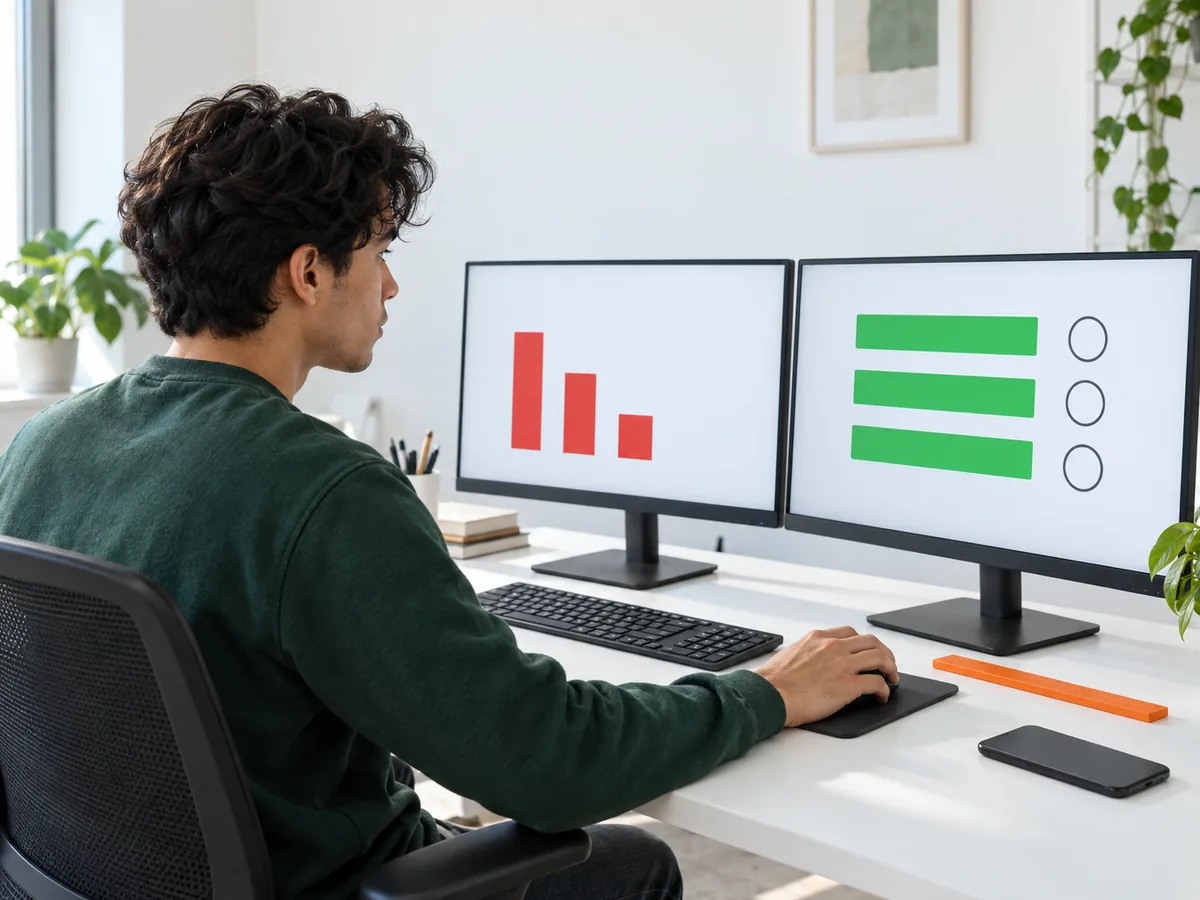
03 // CROSS-DEVICE CONSISTENCY
One Storefront, Tested on Every Screen
A fix that works on a 27-inch monitor can break on a phone. So every layout change gets checked on a laptop, a tablet, and a phone before it ships.
If your current theme cannot hold that consistency without a rebuild, that is a separate project from CRO testing. Our Shopify Plus agency team handles that piece.
Mobile carries most of the traffic. It should get the first look, not the last one.

Which Analytics, Testing, and Ecommerce Platforms We Connect To
CRO work only helps if it plugs into the systems you already run. Here is exactly what we connect to today.
Analytics & Behavioral Data
- GA4: funnel drop-off, revenue per session, and channel-level conversion tracking.
- Hotjar and Microsoft Clarity: heatmaps, scroll maps, and session replay.
- Native Shopify Analytics: order-level detail cross-checked against GA4.
Testing & Experimentation
- Optimizely and VWO: client-side and server-side A/B and multivariate tests.
- Custom Shopify Functions test harness: for checkout-level experiments the other tools cannot reach.
- PIE framework scoring (Potential, Importance, Ease): ranks every test idea before it enters a sprint.
Ecommerce & Payment Systems
- Shopify Plus, through Checkout Extensibility and Shopify Functions.
- BigCommerce and WooCommerce, for brands not on Shopify.
- Shop Pay, Klarna, Affirm, and Recharge: one-tap payment and subscription billing.
Still deciding between platforms? Our Shopify Plus vs BigCommerce comparison covers the checkout and app-ecosystem differences that affect CRO work directly.
Five Places We Look Before We Touch Your Theme
Every store loses revenue in a different spot. We find out which of these five areas is really costing you conversions, before writing a single line of code.
Shop Pay converts 50 percent higher than a standard guest checkout. Shopify's own checkout converts 15 percent higher than competing platforms on average, and up to 36 percent higher in some cases. Source: Shopify →
- 01 // MOBILE CHECKOUT FRICTION
Removing the Friction Mobile Shoppers Never Forgive
Most ecommerce traffic happens on mobile now, and so does most cart abandonment. A cramped address form sends shoppers away. So does a keyboard that does not match the input type. So does a shipping cost that appears at the worst possible moment.
We rebuild the mobile checkout flow using Shopify Plus Checkout Extensibility. That means numeric keypads for phone and card fields, plus address autocomplete. It also means an upfront shipping estimate before payment. Shop Pay or Apple Pay become the default one-tap option for returning devices.
- Checkout Extensibility UI
- Input-Type-Matched Keyboards
- Shop Pay/Apple Pay Default
- 02 // CART ABANDONMENT RECOVERY
Recovery Sequences Segmented by Drop-Off Point
A shopper who adds to cart and leaves is not necessarily gone for good. But a generic “you left something in your cart” email, sent 24 hours later with no context, converts only a small fraction of what a well-timed sequence can.
We build recovery sequences segmented by where the shopper actually dropped off: the cart page, the shipping step, or payment. Timing comes from real GA4 behavior data. The incentive escalates gradually too, starting with a free-shipping reminder before ever offering a discount code, so margin is not given away to shoppers who would have converted anyway.
- Drop-Off-Stage Segmentation
- GA4 Behavioral Timing
- Graduated Incentive Sequencing
- 03 // PRODUCT PAGE CONVERSION
Resolving What Stalls an Already-Interested Shopper
A shopper on a Product Detail Page has already shown intent. So a low add-to-cart rate usually means something specific is unresolved: unclear sizing, missing social proof, or a price that looks unjustified without enough context above the fold.
We run structured PDP tests on image order and zoom quality, review snippet placement, sizing and fit guidance, and clear pricing and shipping costs above the fold. We judge each change against add-to-cart rate and revenue per visitor, not surface-level opinion.
- Above-the-Fold Hierarchy Testing
- Sizing & Fit Guidance
- Add-to-Cart Rate Validation
- 04 // SUBSCRIPTION & UPSELL FLOWS
Upsells That Don't Undercut the Primary Sale
Subscribe-and-save and post-purchase upsell flows are easy to bolt on, and just as easy to get wrong. An upsell shown at the wrong moment reads as a hard sell, and it can suppress the very sale it is supposed to sit beside.
We test subscription frequency defaults and discount framing using Shopify subscription APIs. We also test upsell placement: the order confirmation page versus a follow-up flow, plus Klarna or Affirm installment options at checkout. We measure impact on both initial conversion and 90-day subscriber retention, not just upsell attach rate.
- Subscription Frequency Defaults
- Klarna/Affirm Installment Framing
- 90-Day Retention Measurement
- 05 // A/B TESTING INFRASTRUCTURE
Tests That Actually Reach a Trustworthy Answer
Many stores run “tests” that never reach real statistical significance. Some get called early because a stakeholder likes the early numbers. Others cannot tell which change actually drove the result, because three things changed at once.
We build and maintain the testing infrastructure itself. That means single-variable test design, plus GA4-integrated significance tracking against a set minimum sample size. Every result goes into a documented test log. A losing test still produces a usable finding instead of getting quietly forgotten.
- Single-Variable Test Design
- GA4 Significance Tracking
- Documented Test Log
Next step
Not sure where your store is actually leaking revenue?
Send us your GA4 funnel and mobile checkout data. We will show you which of these five areas is costing you the most conversions right now.
// SPRINT TIMELINE
How We Run a 30-Day Conversion Sprint
Every sprint follows the same four steps. Nothing ships to your live theme until it has been tested and verified. Already migrated to Shopify Plus? This is what comes next. Still on Wix or Squarespace? See our replatforming guides first.
- WEEK 1
Quantitative & Qualitative Funnel Audit
We pull GA4 checkout drop-off data, heatmap recordings, session replays, and a full Core Web Vitals audit. This shows us where shoppers actually get stuck, not where we assume they do.
- WEEK 1–2
Hypothesis Formulation & PIE Prioritization
Every fix becomes a written hypothesis, scored on Potential, Importance, and Ease using the PIE framework. The highest-scoring ideas go into the sprint first.
- WEEK 2–3
Bespoke UI/UX Design & Liquid/React Engineering
We design the mobile-first interface, then build it in clean Liquid or React code. Checkout extensions and cart drawer changes get built here too.
- WEEK 3–4
Statistical A/B Testing & Production Rollout
The test runs to 95 percent confidence over two full business cycles. A winning variant merges into your live theme. A losing one still gets logged, so nothing is wasted.
CRO Partner Approaches Compared
Why full-stack conversion engineering outperforms generic design agencies and automated widget apps.
| Evaluation Criteria | Technical CRO Agency (FactoryJet) | Generic Aesthetic Web Agencies | Automated CRO Widget Apps |
|---|---|---|---|
| Optimization Driver | Quantitative behavioral data & GA4 audits | Subjective visual opinions | Generic popups & countdown timers |
| Development Depth | Native Liquid, React & Checkout Extensibility | Standard template tweaks | Third-party script injection (Slows site) |
| Core Web Vitals Impact | Sub-1.5s LCP & code speed optimization | Often introduces heavy asset bloat | Degrades page speed & INP scores |
| Testing Rigor | 95% statistical confidence A/B tests | No formal A/B testing | Basic unsegmented analytics |
| Contract Flexibility | Focused 90-day sprints (Zero lock-in) | 12-month rigid agency retainers | Monthly recurring software subscriptions |
// DIRECT FOUNDER OVERSIGHT
Every Sprint Runs Under Direct Founder Oversight
CRO work fails quietly when nobody owns the result. At FactoryJet, founder Bhavesh Barot runs the discovery call for every sprint himself, and reviews every test before it ships.
You work directly with senior developers who have already built checkout extensions and PDP tests for other Shopify Plus brands. We do not hand your funnel to junior staff or outside contractors. If support tickets, not checkout conversion, are the real cost center, our AI customer support agents page covers that side instead.
Connect with Bhavesh on LinkedIn →
FREQUENTLY ASKED QUESTIONS
Questions ecommerce brands ask about conversion rate optimization
Everything ecommerce brand leaders need to know about CRO testing, speed optimization, and revenue results.
Topics
Can’t find your answer?
Talk to the founderAudit & Testing Methodology
What is an ecommerce CRO agency and how does conversion rate optimization drive revenue?
An ecommerce CRO agency studies how shoppers behave across your whole buying funnel. We find the friction points: on product pages, in the cart drawer, and at checkout. Then we design careful A/B tests to fix them. The goal is simple. More visitors complete a purchase, and revenue per session goes up, without spending more on ads.
How do you identify conversion bottlenecks on our online store?
We use five data sources together: GA4 funnel reports, heatmaps and click maps, session replays, customer surveys, and Core Web Vitals speed audits. Each one answers a different question. Analytics shows where shoppers drop off. Replays show why. Speed audits catch friction the other tools miss entirely.
What sample size and traffic volume are required to run statistically valid A/B tests?
Stores with 50,000 or more monthly visitors and 500 or more monthly orders can run fast, reliable A/B tests. Smaller stores do not have enough traffic for that. For those, we make high-conviction fixes instead, grounded in Baymard Institute research and real session-replay evidence rather than a guess. A low-traffic store would need months to reach a valid split-test result on just one change.
How do you ensure A/B test results are statistically significant?
Every test runs until it hits at least 95 percent statistical confidence. That takes a minimum of two full business cycles, or 14 to 28 days. This window accounts for weekend shopping patterns and day-of-week swings. We also check that traffic split evenly between the two versions. An uneven split is one of the most common causes of a false result.
Shopify Plus & Checkout Extensibility
How do you optimize the checkout experience on Shopify Plus?
We use Shopify Checkout Extensibility to add custom tools right inside checkout: address autocomplete, order notes, delivery date pickers, gift messages, upsell offers, and trust badges. These extensions run inside Shopify's own checkout. They do not redirect to a third-party page, so they automatically inherit Shop Pay's fast load speed and its PCI security compliance.
How does Shop Pay integration impact mobile conversion rates?
Shop Pay converts about 50 percent higher than a standard guest checkout. It lets more than 150 million registered US shoppers pay in one tap, using a saved biometric login, which skips manual address and card entry entirely. We set Shop Pay as the default option for returning devices on mobile. Typing a card number on a phone keyboard is one of the biggest causes of checkout abandonment.
How do you optimize Product Detail Pages (PDPs) for higher Add-to-Cart rates?
We rework the PDP layout so pricing, variant options, and the Add-to-Cart button sit above the mobile fold. We add a sticky buy bar that follows the scroll, real review snippets, and clear shipping estimates. Every layout change gets tested live first. We check its effect on add-to-cart rate and revenue per visitor. Nothing ships just because it looks better.
Can you implement custom in-cart upsells and tiered discount progress bars?
Yes. We build custom slide-out cart drawers with a free-shipping progress meter, one-click add-on products, and bundle builders. Together these lift Average Order Value by 12 to 25 percent. Our cross-sell picks come from real co-purchase data in your own order history, not a generic "customers also bought" widget bolted onto a theme.
Speed, CWV & Technical CRO
How does mobile page speed affect ecommerce conversion rates?
Google research found that every 0.1-second gain in mobile speed lifts retail conversion by 8.4 percent. A slow mobile load causes an immediate spike in bounce rate and cart abandonment. Mobile shoppers are also more likely to be on a weak cell signal. That makes the speed gap between a lean theme and a bloated one feel much bigger on mobile than on desktop.
How do you optimize Core Web Vitals (LCP, INP, CLS) on Shopify themes?
We remove dead app scripts, compress hero images as WebP, inline critical CSS, and defer JavaScript that is not needed right away. We also fix whatever is causing layout shift. Together, this gets Largest Contentful Paint under 1.5 seconds. We audit every installed app one at a time, since a single unused review widget or tracking pixel running in the background can add several hundred milliseconds to every page load.
Does technical CRO improve organic search rankings as well as conversion?
Yes. Better Core Web Vitals scores directly help Google's Page Experience ranking signal, and lower bounce rates tell Google your content is engaging. A faster PDP or collection page also gets crawled more efficiently. That matters for large catalogs, where crawl budget decides how fast new or updated products get indexed.
How do you audit and remove conversion-killing third-party app bloat?
We audit every installed Shopify app and tracking pixel, and measure the load delay each script tag adds. Then we merge redundant apps and build lightweight custom Liquid or React features straight into the theme. Many stores run three or four apps that all do roughly the same job. Replacing them with one custom feature removes all that extra script weight.
Engagement & Revenue Impact
What conversion rate improvements do clients typically experience?
Across a full 90-day CRO program, clients typically see conversion rate rise 15 to 35 percent. Average Order Value usually climbs 10 to 20 percent alongside it. The gains build as winning tests stack up: early wins tend to come from checkout and speed fixes, with PDP and merchandising tests adding more in later weeks.
How is FactoryJet's CRO process structured?
We work in 30-day sprints. Each one runs a full data audit, ranks the test roadmap using the PIE framework (Potential, Importance, Ease), then moves through UI/UX design, Liquid or React development, and statistical A/B analysis. A winning test merges into your live theme once verified. Every sprint ends with a written result, win or loss, and that result feeds straight into the next roadmap instead of starting the audit over.
Do you require long-term restrictive retainer contracts?
No. We run focused 90-day sprints with clear milestones and statistically validated results. After that, a monthly optimization retainer is optional, not required. If the 90-day sprint does not produce a measurable lift against your baseline, you owe us nothing further, and you keep every winning test we already shipped to your live theme.
How do we schedule an ecommerce CRO audit with FactoryJet?
You can book a 30-minute discovery call with founder Bhavesh Barot. We review your GA4 funnel data and your mobile PDP and cart experience together, then hand you a ranked conversion roadmap. You leave the call with specific test ideas tied to your own store's data, not a generic checklist copied from a template audit.
CRO Focus Areas & Playbooks
What specific mobile checkout changes reduce friction the most?
The biggest wins usually come from the smallest fixes. A numeric keypad on phone and card fields, instead of a full keyboard. Address autocomplete. A shipping estimate shown early, instead of sprung on the shopper at the final step. And Shop Pay or Apple Pay set as the default option for returning devices.
How do you segment cart abandonment recovery instead of sending one generic reminder?
We split recovery messages by the exact point where the shopper dropped off: the cart page, the shipping step, or payment. Each group gets different timing and wording, pulled from real GA4 behavior data. The incentive also escalates gradually. We lead with a free-shipping reminder, and only offer a discount code later if it is still needed.
What Product Detail Page elements do you test first?
We start with whatever is still unresolved above the mobile fold. That means image order and zoom quality, where the review snippet sits, sizing and fit guidance, and whether pricing and shipping costs are clear before the shopper has to scroll. We judge every change against add-to-cart rate and revenue per visitor, never against visual preference alone.
Does adding a post-purchase upsell hurt the primary checkout conversion?
It can, if the offer interrupts checkout itself. So we test upsell placement on the order confirmation page, and in a separate follow-up flow, never inside checkout. We also measure two things at once: initial conversion and 90-day subscriber retention. That way, an upsell that boosts short-term order value but hurts retention gets caught before it ships for good.
How do you make sure an A/B test result is trustworthy and not a false positive?
Every test changes exactly one variable at a time. It runs to a minimum sample size and a 95 percent confidence threshold, over at least two full business cycles. We log the result in a written test record either way, win or lose, so a losing test still produces a usable finding instead of getting quietly forgotten.
// READY TO LIFT REVENUE PER SESSION?
Schedule a 30-Minute Ecommerce CRO Audit
Speak directly with founder Bhavesh Barot. We will audit your mobile PDP, cart drawer, and checkout funnel together. You will leave with high-impact opportunities and a projected revenue gain.