Restaurant website design · United States
Restaurant website design that starts with the menu
Somebody is standing outside on a phone deciding between you and the place across the road. They want the menu, the hours and a way to order or book. If your menu is a PDF, they are pinching and zooming, and you are losing. We build the version that answers them in seconds.
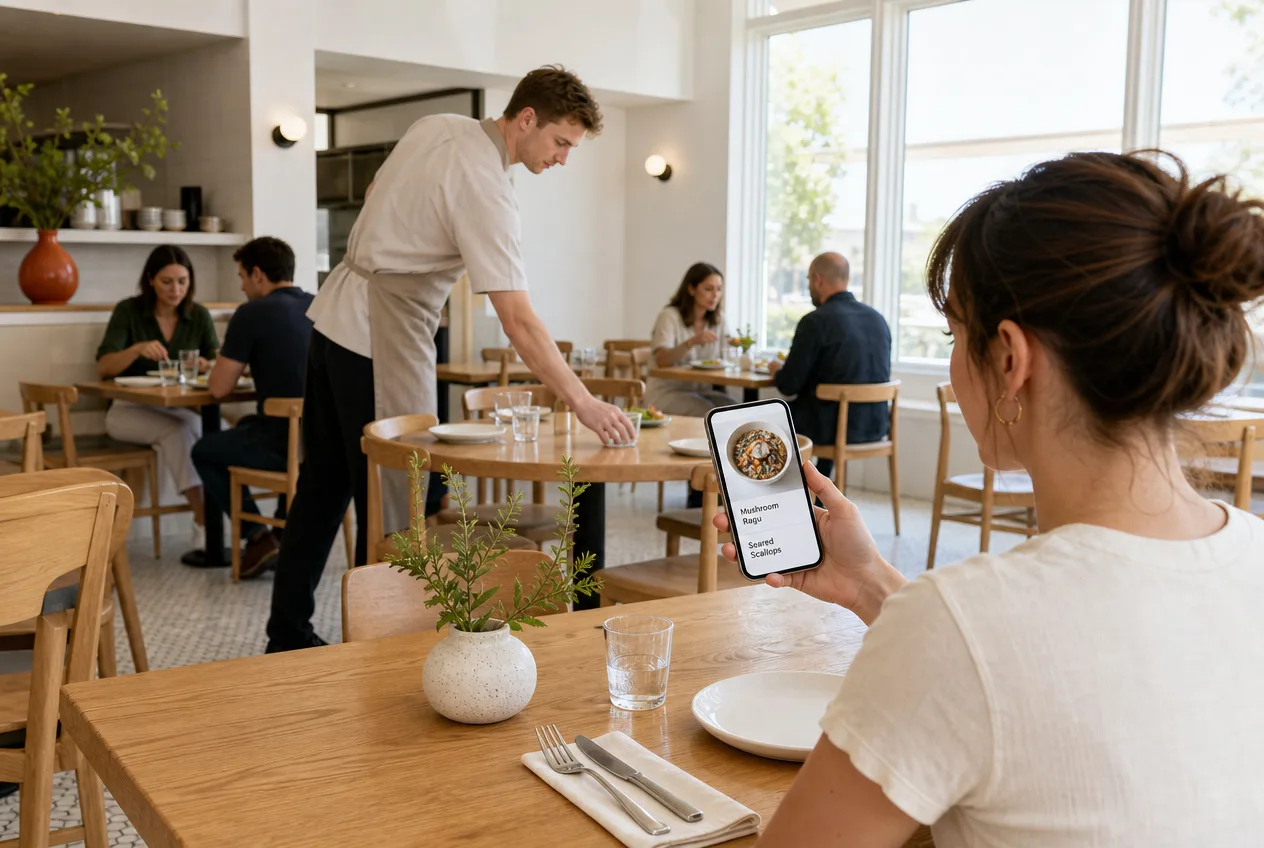
- What is on the menu?Text, not a PDF.
- Are you open right now?Holidays included.
- Where exactly are you?One tap to a map.
- How do I order or book?One obvious button.
Open your own site on a phone, on cellular data, and time it. Most fail at least one of these four.
Short answer
What is the best website design for a restaurant?
The best restaurant website answers four things on a phone in under ten seconds: what is on the menu, when you are open, where you are, and how to order or book. Best does not mean most beautiful. The costliest mistake is publishing the menu as a PDF, which strips out the structure people and search engines rely on.
Everything else follows. The menu is the product, so it is built as a real web page. Ordering and reservations are money, so the routes get chosen deliberately. Your Google Business Profile is the front door, so it is part of the build.
And one thing most agencies will not say on a sales page: for plenty of restaurants a template really is the right answer. We have written down exactly when that is, including the cases where you should not hire us.
Six failures we find on almost every restaurant site
Restaurant sites rarely fail on design. They fail on the boring parts
The sites that lose guests are almost never ugly. They are attractive sites where the menu cannot be read on a phone and the hours are from last winter.
The menu is a PDF.
A PDF forces pinch and zoom on mobile devices. Search crawlers cannot parse dishes cleanly. We implement HTML menus with schema markup and structured data. Kitchen staff update specials in seconds without editing PDFs.
Hours that are quietly wrong.
A guest arriving at a locked door leaves a bad review. Website hours must match Google Business Profile and holiday schedules. We synchronize local SEO citations and NAP consistency across directories.
Every order routed through a marketplace.
Marketplaces take heavy commissions and retain customer data. Direct online ordering via Toast POS, Square, Clover, or Stripe preserves your margins. First-party data lets you build reorder loyalty.
Photos that came with the template.
Stock food photos destroy diner trust immediately. Authentic kitchen, dining room, and dish photography creates appetite appeal. High-resolution WebP images feed Google Business Profile and local map pack rankings.
It is slow on cellular data.
Hungry guests search on mobile phones with weak signals. Bloated sliders and unoptimized video destroy Core Web Vitals. We optimize Largest Contentful Paint and Cumulative Layout Shift for sub-second speed.
Locations stacked on one page.
Jamming multiple branches onto one URL harms local search. Each branch needs its own location landing page with unique schema markup. Dedicated URLs capture nearby Google maps ranking positions.
The single most costly mistake
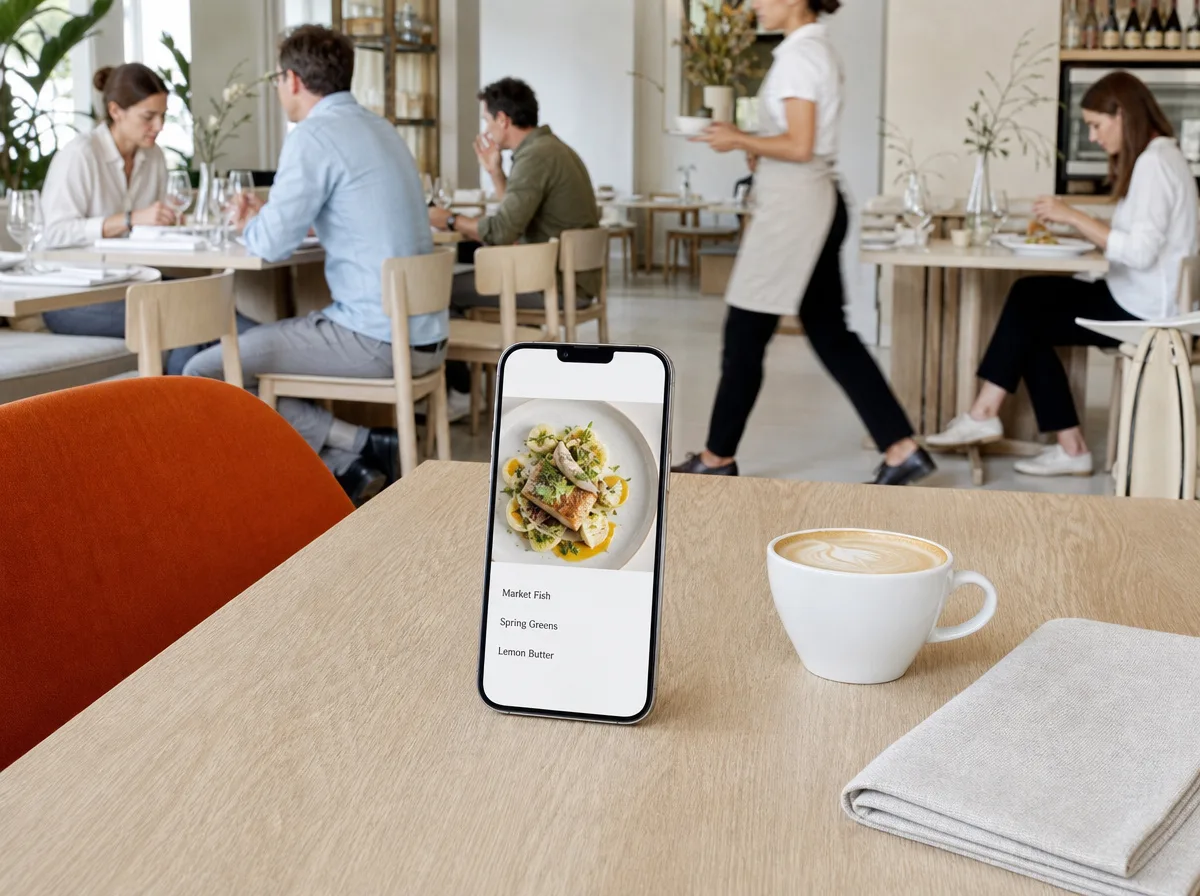
Your menu belongs on a page, not in a download
Be accurate first: the usual version of this argument is overstated. Google does list PDF among the file types it can index, so a PDF menu is not invisible. The real case is everything a PDF cannot do.
- Very often there is no text in it at all.A menu exported as flat artwork is pictures of words, so nothing can extract a dish name.
- No headings, so nothing is quotable.An assistant answering a question about your vegetarian options needs structured text.
- It breaks the path to the money.It opens in a viewer with no order button, no booking link and no way back.
- Staff cannot fix it during service.Marking the special sold out should take a phone and a minute, not an email to a designer.
The fix is the checklist below, starting with one page per menu. Keep a printable PDF if you want one. Just stop making it the only copy.
The build
Ten things a restaurant website has to get right
In roughly the order we do them. Run it against your current site, or anyone’s proposal including ours. If a quote is mostly items six and seven, the structure work has been skipped.
- 01
The menu as a real web page, one page per menu.
Brunch, dinner, bar cocktails, and catering each get dedicated URLs. Dishes use semantic HTML headings with allergen notes. Search engines and AI engines quote items accurately.
- 02
Menu structured data and JSON-LD schema.
Google supports explicit menu property schema markup on local business listings. We embed JSON-LD schema linking dishes, prices, and dietary tags directly to your domain.
- 03
Centralized hours synced with Google Business Profile.
Standard service hours, kitchen closing times, and holiday hours live in one place. We ensure NAP consistency across Google Search Console and local directory citations.
- 04
Direct ordering integration with Toast POS or Clover.
We integrate direct order workflows using Toast POS, Square, Clover, or Brink POS. Customers order without friction while you retain first-party data and full margins.
- 05
Single reservation system integration across web and maps.
We connect OpenTable, Resy, or SevenRooms directly to your booking buttons. Floor plans stay unified without risk of double-booking prime Saturday tables.
- 06
High-speed image optimization with explicit dimensions.
Food photography is compressed to modern WebP formats with explicit width and height. Fast edge caching and CDN delivery prevent layout shifts and pass Core Web Vitals.
- 07
Tap-to-call mobile header with call tracking.
We place tel links in the mobile header for immediate dialing. Optional call tracking and form tracking measure table inquiries from organic search.
- 08
Lightweight code tuned for mobile Core Web Vitals.
Zero bloated page builders. We build on Next.js and Tailwind CSS with fast server-side rendering. Every page passes Largest Contentful Paint and Interaction to Next Paint standards.
- 09
Dedicated branch landing pages for local map pack dominance.
Multi-unit concepts get unique service area pages with custom schema markup. Each branch links to its verified Google Business Profile to boost local pack rankings.
- 10
Accessibility audit and WCAG compliance.
High-contrast typography ensures readability on bright sidewalks. Clear focus states, ARIA labels, and an accessibility audit guarantee full WCAG compliance.
Items three, four and nine are as much local search work as web design, and item one is what decides whether AI answer engines can say anything useful about you. We do both, so the structure work ships.
Ordering, reservations and where the margin goes
Every order button on your site is a margin decision
Third-party marketplaces charge a commission on the order total, and the rate depends on your plan and on whether they handle delivery. We will not quote a number we cannot verify. Read your own agreement. The structural point stands whatever the rate is: the marketplace owns the customer, so the reorder happens in their app.
That does not make them bad. They bring discovery you would struggle to buy. The mistake is letting them become the only route, because then you pay a share of every regular customer forever.
- Check what is already on your Google profile.Third-party ordering links can appear automatically, so a marketplace may be taking orders you never routed to it.
- Set your preferred link.Google lets you mark one link as business preferred, so your own page sits on top.
- Removals are not instant, but they are enforced.Google states that providers need to process a removal request within five days.
- Run one reservation system, not two.Your profile carries a reservation link. Two systems is how a Saturday gets double-booked.
Want us to look at your current site first?
Send the link. We will open it on a phone and check whether the menu is readable text, whether the hours match your Google profile, what loads slowly, and which ordering links you did not put there.
Next step
Menu still living in a PDF?
Send us your site. We will tell you what search and AI answers cannot read today, and what it takes to fix.
Four ways to get a restaurant website
Builder vs restaurant platform vs template vs custom build
We sell the last column. We will still tell you to take the first one if you run a single cafe with a short menu.
| What you are comparing | Website builder | Restaurant platform | Template plus freelancer | Custom build |
|---|---|---|---|---|
| What you are really buying. | A drag and drop editor and generic templates. | A locked proprietary stack tied to hardware. | A layout theme requiring manual freelance setup. | A custom Next.js website with full code ownership. |
| Time to live. | One weekend for simple setups. | Several weeks waiting on vendor onboarding. | Two to three weeks with a designer. | Prompt 7 to 14 day delivery window. |
| Menu and POS sync. | Manual edits inside a slow page builder. | Automated sync from Toast POS or Clover. | Static text requiring developer code updates. | Direct POS integration or intuitive mobile CMS. |
| Online ordering & payments. | External marketplace links taking hefty fees. | Bundled ordering with recurring platform cuts. | Basic third-party widget embeds. | Direct Stripe, Apple Pay, and Google Pay checkout. |
| Speed on mobile phones. | Heavy scripts often failing Core Web Vitals. | Variable performance loaded with vendor trackers. | Bloated themes with sluggish load speeds. | Sub-second speeds passing Core Web Vitals checks. |
| Search and AI visibility. | Basic on-page tags. Menus saved as flat text. | Decent indexing locked into vendor subdomains. | Minimal schema markup and inconsistent meta. | Full JSON-LD structured data and local SEO schema. |
| Multiple location architecture. | Clumsy dropdowns confusing Google crawlers. | Standard branch lists with rigid templates. | Duplicate pages risking search penalties. | Dedicated location pages with local map pack SEO. |
| Asset and code ownership. | Site disappears if subscription is cancelled. | Complete vendor lock-in on menus and ordering. | You keep theme files but lack ongoing support. | 100% source code, domain, and data ownership. |
| Best fit for operators. | Single-unit cafes with short seasonal menus. | High-volume takeout spots relying on delivery. | Operators with ample time for self-setup. | Ambitious dining concepts maximizing direct revenue. |
Scroll the table sideways on smaller screens. A builder solves this weekend, a platform solves ordering, a template solves taste, and a custom build is worth it when the site carries revenue.
What is actually on this search result
Almost nobody searching this term is looking to hire an agency
We pulled the live United States results for restaurant website design in August 2026. Not one conventional agency in the top twelve: inspiration galleries, template libraries, builder products and two community threads. Here is the field, us included.
Position 3, and free to start.
A free drag-and-drop tool ranking well for casual searchers. Ideal for a single location or food truck with a small menu. You sacrifice custom schema markup, Core Web Vitals speed tuning, and multi-unit local SEO architecture.
Positions 5 and 7.
Framer provides sleek restaurant portfolio templates. Figma offers design files for developers. Both require substantial hands-on effort to implement live POS ordering, reservation widgets, and valid JSON-LD structured data.
Position 8, with ecosystem lock-in.
A popular hospitality web and ordering platform. BentoBox is now integrated into Clover point-of-sale systems. It provides convenient tools for Clover operators, but creates migration hurdles if you switch to Toast POS, Aloha, or Brink POS.
Positions 1, 2, 4, 10, and 11.
Inspiration galleries dominate search queries for restaurant web design. Operators browse these galleries for visual concepts. We translate high-end visual aesthetics into fast, accessible HTML websites that pass Core Web Vitals audits.
Positions 6 and 12.
Restaurant operators share unfiltered experiences regarding merchant processing fees and software lock-in. Threads frequently debate Toast POS vs. Square vs. Clover. Community consensus favors owning your digital assets and customer relationships.
Custom development with code ownership.
We engineer bespoke restaurant websites with live HTML menus, direct online ordering, and OpenTable or Resy integrations. We implement complete local SEO schema, Google Business Profile optimization, and sub-second mobile page speeds.
Worth hiring us for
- Several locations, currently jammed onto one page with a dropdown.
- A meaningful share of revenue arrives through ordering and you want it direct.
- Your menu is a PDF and nobody can update it during service.
- You have outgrown a platform and want out without losing visibility.
- Private hire, catering or events the current site does not sell.
- You want it fast on a phone and nobody has ever measured it.
Do not hire us if
- One location and a short menu. A builder does this well, live by Sunday.
- You need a site this week. We are slower than a template.
- You are opening a pop-up or a residency that ends this season.
- Ordering volume is the whole business, and a platform bundles that better.
- You want the site to fix footfall. The food, reviews and profile do that.
- Nobody on your side can supply final menu text or photographs.
If the honest answer is a template, take the template. For a second opinion on an existing site rather than a rebuild, our redesign service starts by working out whether a rebuild is warranted at all.
Check us against the source
Where the claims on this page come from
Do not take a web design company’s word for how Google treats restaurants. Three primary sources back the claims above.
The menu property wants a URL
Google’s local business structured data reference lists a menu property described as, for food establishments, the fully-qualified URL of the menu. The same reference covers opening hours and cuisine type.
Read the sourceMenu, ordering and reservation links
Google documents that a Business Profile can carry a menu link and up to ten links per category for actions such as making a reservation or placing a food order. It also states that third-party partner links can appear automatically, and that providers must process a removal request within five days.
Read the sourceSpecial and holiday hours
Google explains that special hours cover a temporary change or closure of up to six days in a row, and says it is a good idea to confirm your hours for official holidays even when they match your regular hours.
Read the sourceTwo more we checked. Google publishes a list of indexable file types that includes PDF, which is why we call the PDF menu a structure problem, not an invisibility one. And BentoBox’s own site states that it is now part of Clover and that its products are currently available only to Clover point-of-sale customers. Positions quoted here are from an August 2026 pull and move.
Who you actually work with
Founder-led, and blunt about what a site can do
FactoryJet is a small US-focused web and search team. Bhavesh Barot, our founder, scopes the work and shows up on the calls. There is no account layer between you and the person deciding your menu structure. We build sites and run search programmes, so the structure fixes actually ship.
We will not publish invented client numbers, borrowed testimonials or guaranteed results. If a restaurant marketing page shows a precise revenue lift with no named source, treat it like a supplier who cannot say where the fish came from.
Reviewed & updated August 12, 2026· Bhavesh Barot, Founder, FactoryJet
How we work
- Menu structure before styling.The menu architecture is written first, because everything hangs off it.
- Search and build in one team.Structured data, Business Profile and page speed are part of the build.
- You own everything.Domain, code and content stay yours, registered in your name from day one.
- Staff can update it.If your team cannot mark an item unavailable from a phone, we have not finished.
- We will talk you out of it.When a builder or a platform is the better buy, we say so on the first call.
Where to go next
Related services
Web design
The general build service. Same approach to speed and structure, any kind of business.
Explore →Website redesign
Find out whether your existing site needs replacing or just needs fixing properly.
Explore →Local SEO
Google Business Profile, map pack visibility and near-me search for local businesses.
Explore →AI SEO
Getting named and quoted inside ChatGPT, Perplexity and Google AI Overviews.
Explore →Small business websites
Scoped for owner-run businesses, including single-location restaurants.
Explore →Ecommerce development
For merchandise, gift cards, meal kits and anything you ship rather than plate.
Explore →Restaurant website FAQ
The questions restaurant owners actually search
What a restaurant site needs, why the menu should never be a PDF, how ordering affects your margin, what Google wants from your profile, and when a template beats hiring anyone.
Topics
Can’t find your answer?
Talk to the founderRestaurant site basics.
Do I need a website for my restaurant?
Yes. Your website is the only digital asset your business owns outright. Third-party platforms and social profiles can change algorithms or increase fees overnight. An owned website protects your menu and customer data. It provides the foundation for direct online ordering without commission fees.
What are the key elements of a good restaurant website?
Seven core elements determine website performance. First is an HTML menu with structured data. Second is verified hours synchronized with Google Business Profile. Third is an integrated reservation or ordering flow via Toast POS, Square, or OpenTable. Fourth is authentic food photography. Fifth is mobile speed passing Core Web Vitals. Sixth is tap-to-call dialing. Seventh is dedicated location pages with local SEO markup.
Why would a restaurant not have a website?
Many operators mistakenly rely on social media profiles or delivery apps. Social profiles cannot rank for local search queries or present structured dietary menus. Third-party delivery listings capture high commissions and keep diner emails. A dedicated website establishes authority and captures direct customer revenue.
Google, maps & AI answers.
How do I get my restaurant to show up on Google Maps?
Claim and verify your Google Business Profile. Select accurate primary categories and add complete operating hours. Upload authentic interior photos and link your live HTML menu page. Implement local SEO schema markup on your website. Consistent NAP data across local directories drives local map pack rankings.
Do I really need to update my hours for holidays?
Yes. Google allows businesses to set special hours for holidays and temporary closures. Failing to update holiday hours frustrates hungry customers and generates negative reviews. Confirming holiday hours in your Google Business Profile dashboard protects your local search reputation.
Why is a delivery app link showing on my Google profile that I never added?
Google partners with authorized delivery marketplaces to generate automatic order links. You can manage these links inside Google Business Profile settings. Designate your direct website ordering link as the preferred provider. You can also submit formal removal requests to third-party vendors.
How do I handle several restaurant locations on one website?
Build a dedicated landing page for every individual location. Each page needs unique addresses, local phone numbers, hours, menus, and embedded maps. Embed location-specific LocalBusiness schema markup on every page. Connect each page to its verified Google Business Profile to dominate the local pack.
Will ChatGPT or AI search recommend my restaurant?
AI search engines recommend restaurants with clear, crawlable information. AI models crawl web pages for structured text, menus, dietary options, and reviews. PDF menus and image-only sites leave AI crawlers blind. Structured HTML data and positive review management ensure inclusion in AI search answers.
Templates, builders & DIY.
Can I just use a website builder like Canva, Wix or Squarespace?
Basic builders work well for single-location cafes with simple menus. They provide affordable templates and quick setup. However, generic builders struggle with custom POS integrations, complex multi-location SEO, and strict Core Web Vitals optimization. Larger restaurants benefit from custom code architectures.
Should I use a restaurant website template?
Templates offer speed but introduce severe limitations. Many templates include bloated JavaScript libraries that hurt mobile performance. They often force menus into awkward accordion widgets. A custom build tailors typography, reservation workflows, and technical SEO specifically to your operational concept.
How do I create a website for my restaurant myself?
Start by registering your own domain name under your company account. Choose a reliable hosting provider with SSL security. Write your menu items, descriptions, and prices in plain text. Add your location, hours, and tap-to-call phone number. Finally, configure Google Business Profile and test mobile performance.
Scope, timing & budget.
How much does it cost to design a restaurant website?
No published survey prices restaurant sites on their own, but general small business websites cost $1,000 to $48,000 on average, and small agencies typically charge $6,000 to $12,000, according to WebFX. Cost drivers include location count, menu volume, direct POS ordering integrations, and custom reservation flows. We quote fixed-price milestones with agreed timelines. You own all source code and assets outright at completion.
Is there a monthly fee to have a website?
Mandatory ongoing expenses include domain registration and web hosting. Platform builders charge monthly software subscriptions. Custom websites built on modern frameworks avoid mandatory agency retainer fees. Third-party POS ordering systems like Toast POS or Clover charge payment processing fees separately.
Is a very low flat fee a good deal for a restaurant website?
Low flat fees usually mean recycled templates without technical optimization. Cheap builds often neglect Core Web Vitals, mobile responsiveness, and schema markup. They frequently lock you into proprietary hosting. Investing in proper site architecture delivers measurable return through direct orders and table reservations.
How long does a restaurant website take to build?
Basic template sites take one to two weeks. A custom restaurant website typically launches within four to six weeks. The primary timeline factor is content assembly. Providing finalized menu copy, high-resolution photography, and POS credentials upfront ensures fast, predictable project delivery.
Who should not hire us for this?
Single-unit coffee shops with chalkboard menus do not require custom engineering. Pop-up restaurants and seasonal food trucks are better served by simple builder templates. Operators unwilling to provide menu copy or authentic photos should also avoid custom builds. We focus on growing hospitality brands needing direct revenue.
START WITH THE MENU
Send us your site and we will tell you what is losing you tables
Book a call with the founder. We will open it on a phone, check the menu, the hours against your Google profile and the load time, then say plainly whether a build is worth it or whether a template would serve you better.
Founder-led. No invented case studies, no guaranteed results, and you own the domain, the code and the content.