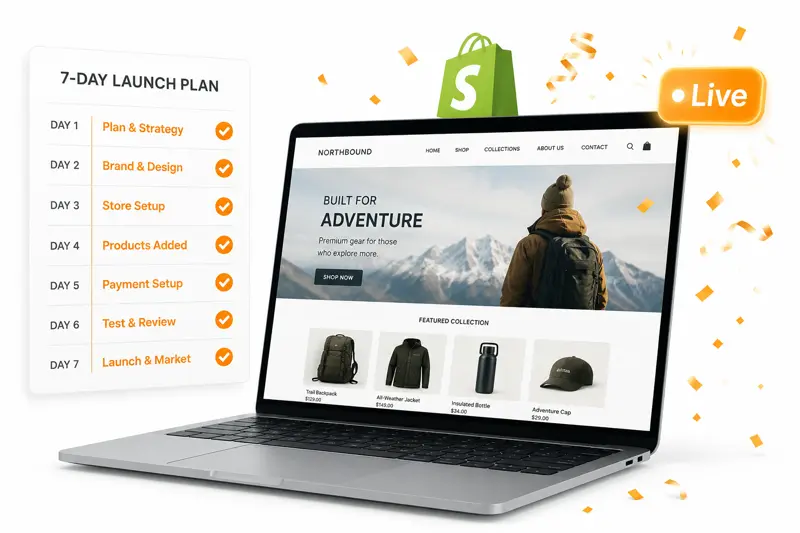
"Shopify gets a US small business selling in days with managed hosting, Stripe-powered checkout, and a deep app store. WooCommerce costs less long-term and gives you full ownership, but you'll own the hosting, plugins, and security too. Here's how to pick the right one for your store in 2026."
Key Takeaways
- 1Shopify is the right default for most US small businesses doing under $1M/year, fast to launch, managed hosting, Shopify Payments handles PCI compliance, and the app ecosystem covers nearly every use case.
- 2WooCommerce typically costs 30-50% less over three years for US stores doing $200K+ in annual revenue, because you avoid platform transaction fees and can use any payment processor at standard rates.
- 3Real US costs in 2026: Shopify runs $39-$399/month plus apps ($50-$300/month), versus WooCommerce at $25-$80/month for hosting plus a one-time $2,000-$5,000 build.
- 4Sales tax automation is built into Shopify (Shopify Tax) but is a paid plugin on WooCommerce (TaxJar or Avalara, $19-$50/month), factor this in if you have nexus in multiple states.
- 5For US payment stacks: both platforms support Stripe, PayPal, and Square. Shopify Payments waives the 0.5-2% platform fee; WooCommerce never charges a platform fee regardless of processor.
- 6Black Friday / Cyber Monday traffic handling favors Shopify out of the box, managed infrastructure scales automatically. WooCommerce needs a properly sized host (Cloudways, Kinsta, WP Engine) configured in advance.
- 7FactoryJet builds both platforms for US small businesses with 7-day delivery and Lighthouse 95+ performance, at a fixed price quoted in writing after a short scoping call.
Table of Contents
- The Short Answer for US Small Businesses
- Side-by-Side Comparison: Cost, Setup, Scalability, Flexibility
- When Shopify Wins for US SMBs
- When WooCommerce Wins for US SMBs
- The Hidden Costs Nobody Talks About
- US Sales Tax, Payments, and Shipping Realities
- Migration Path: Switching Between Platforms
- What FactoryJet Recommends
If you run a US small business and you're choosing between Shopify and WooCommerce in 2026, the honest answer is: most stores under $500,000 in annual revenue should use Shopify, and most stores above that should at least consider WooCommerce. The real decision is less about which platform is "better" and more about whether you want to rent a complete ecommerce system or own one. This guide walks through the real US costs, the US-specific tax and payments realities, and the trade-offs we see every week with US small business clients.
The Short Answer for US Small Businesses
Shopify is the safer default for most US small businesses doing under $1M in annual revenue. You launch in days, payments work out of the box through Shopify Payments (Stripe under the hood), sales tax across all 50 states is built in, and the app ecosystem solves nearly every problem you'll run into in your first three years. The trade-off is recurring cost: $39-$399/month plus apps, plus a transaction fee if you ever stray from Shopify Payments.
WooCommerce is the right choice when you've outgrown Shopify's pricing, want full ownership of your store, run content-heavy SEO, or need custom B2B features Shopify only unlocks on Shopify Plus ($2,300+/month). You'll pay $25-$80/month for hosting and a one-time $2,000-$5,000 to build it properly, then nothing extra on each sale. The trade-off is responsibility: you (or your agency) own updates, security, and performance.
Both platforms can ship a beautiful, fast, conversion-optimized store. The decision rarely comes down to design or features, it comes down to how much operational responsibility you want, and how much you're spending in platform fees right now.
Side-by-Side Comparison for US SMBs
| Factor | Shopify | WooCommerce |
|---|---|---|
| Monthly cost (platform) | $39 / $105 / $399 (Basic / Shopify / Advanced) | $0 platform fee, hosting $25-$80/month |
| Setup cost (professional) | $2,500-$8,000 | $3,000-$10,000 |
| Platform transaction fee | 0.5-2% (waived with Shopify Payments) | None, ever |
| Ease of use | Excellent, no-code dashboard | Good, WordPress learning curve |
| Time to launch | 1-7 days | 2-4 weeks |
| Scalability (BFCM-grade) | Automatic, fully managed | Manual, depends on hosting tier |
| Design flexibility | Theme + apps; checkout locked unless Plus | Unlimited, full code access |
| US sales tax handling | Built in (Shopify Tax) | Plugin required (TaxJar / Avalara) |
| SEO control | Good baseline; URL structure locked | Excellent, WordPress flexibility |
| Ownership | Rented, stop paying, store goes offline | Owned, code and data are yours forever |
➡ See pricing on both: Shopify development · WooCommerce development
When Shopify Wins for US Small Businesses
Shopify is the right call if any of the following describe your business. First, you need to launch fast: a US small business owner with product photos, copy, and a brand identity can have a working Shopify store live in 5-7 days. WooCommerce takes 2-4 weeks to build properly, because hosting setup, theme customization, payment gateway configuration, and plugin testing all happen in series rather than parallel.
Second, you have no in-house technical resource and don't want to think about hosting, security patches, or plugin conflicts. Shopify handles every piece of the infrastructure: PCI compliance, SSL, uptime, server scaling, automatic updates. You spend your time selling, not maintaining. A DTC brand owner running a 2-person team with no developer should almost always start on Shopify.
Third, you sell across multiple states and want sales tax handled automatically. Shopify Tax calculates the right rate for every US state, including economic nexus thresholds (the rule that requires you to collect tax in a state once you cross $100K in sales there, in most cases). On WooCommerce, you'd add TaxJar or Avalara as a $19-$50/month plugin to get equivalent coverage.
Fourth, your business gets a meaningful share of revenue from Black Friday / Cyber Monday or Memorial Day promotions. Shopify processed over $11 billion in BFCM 2024 sales without merchant-side outages because the infrastructure scales automatically. A WooCommerce store on a $30/month shared host will crash under a 10x traffic spike unless someone has pre-configured caching, CDN, and database tuning.
Fifth, you want to take advantage of Shopify-native tools like Shop Pay (the highest-converting one-click checkout in US ecommerce), Shopify Markets for cross-border selling, and the Shopify App Store's 8,000+ integrations. The app ecosystem is genuinely the deepest in the industry: Klaviyo for email, Judge.me for reviews, Gorgias for support, ReConvert for upsells, and most apps install in under five minutes.
For a concrete walkthrough of what this looks like in a smaller US market, see our real-world Shopify build example: Boise Idaho small business playbook.
When WooCommerce Wins for US Small Businesses
WooCommerce is the better call in five specific situations. First, you're already running WordPress for your content marketing, blog, or main site. Adding WooCommerce to an existing WordPress install takes a few hours, integrates with your existing Yoast SEO setup, and avoids the awkward "shop.yourdomain.com" subdomain that Shopify stores often end up with when bolted onto a WordPress site.
Second, you're processing more than $500,000 in annual revenue and the platform fees on Shopify start to feel like rent paid to a landlord you don't need. At $1M/year revenue, a US store on Shopify Advanced ($399/month) plus apps ($150/month) plus 0.5% transaction fees if you use a non-Shopify processor is spending $11,500+ per year in platform fees. The same store on WooCommerce with Kinsta hosting ($80/month) spends about $960/year and keeps the rest as margin.
Third, you need custom B2B functionality: wholesale pricing tiers, net-30 invoice terms, customer-specific catalogs, RFQ (request-for-quote) workflows, or minimum order quantities by customer group. Shopify gates most of this behind Shopify Plus ($2,300+/month). WooCommerce supports it natively or through low-cost plugins like Wholesale Suite ($148/year) or B2BKing ($149/year).
Fourth, your acquisition strategy depends on organic search and content marketing. WooCommerce runs on WordPress, which powers roughly 43% of the web and was built for content publishing. You get full URL structure control, unlimited blog flexibility, and seamless integration between product pages and educational content, important if you're targeting US informational search queries like "best [product category] for [use case]" alongside transactional ones.
Fifth, you want full code and data ownership. WooCommerce is open-source software running on your own hosting account. If your hosting provider raises prices, you move. If you want to migrate to a different theme, you do it without paying anyone. If you stop paying for any service, you still own every customer record, product image, and line of code. Shopify is a rental, convenient, but you don't own the storefront.
➡ Compare across all our ecommerce options: FactoryJet ecommerce development
➡ For total cost of ownership and architecture side by side, see our Shopify vs WooCommerce comparison
The Hidden Costs Nobody Talks About
Both platforms have costs that don't show up on the pricing page. Knowing them in advance saves a US small business 3-5x more than picking the "cheaper" platform on paper.
Shopify hidden costs. Apps are the big one. A typical US Shopify store ends up paying for: Klaviyo ($60-$200/month depending on contact count), a reviews app like Judge.me or Stamped ($15-$59/month), a post-purchase upsell app like ReConvert ($14.99-$74.99/month), a help desk like Gorgias ($10-$160/month), and a landing page builder like Shogun or PageFly ($39-$199/month). That's $150-$700/month in apps on top of your platform fee. The platform transaction fee bites if you use any payment processor other than Shopify Payments, 2% on Basic adds up to $2,000/year on $100K in revenue.
For a full breakdown of what you actually pay across every website option: DIY builders, freelancers, and agencies, see our US website cost guide.
WooCommerce hidden costs. Hosting is where surprises live. The $5/month shared hosts that work fine for a brochure WordPress site will not run a serious WooCommerce store. Plan for managed WordPress hosting: Cloudways ($14-$50/month), Kinsta ($35-$115/month), or WP Engine ($30-$120/month) at minimum. Premium plugins also add up: Yoast SEO Premium ($99/year), WPForms ($99/year), and a backup tool like UpdraftPlus Premium ($95/year). And you need a maintenance retainer or a developer on call for security updates and plugin conflicts, budget $99-$249/month or accept that something will eventually break at 2 AM.
US Sales Tax, Payments, and Shipping Realities
Sales tax. The 2018 Supreme Court Wayfair decision means a US small business has to collect sales tax in any state where it crosses economic nexus thresholds (typically $100K in sales or 200 transactions). Shopify Tax handles this automatically across all 50 states, including local district taxes. On WooCommerce, you'll add TaxJar ($19-$99/month) or Avalara AvaTax to get equivalent coverage. Neither platform files your tax returns for you, that's a separate service from TaxJar, Avalara, or your accountant.
Payments. Both platforms support every major US processor: Stripe, PayPal, Square, Authorize.net, Amazon Pay, and BNPL providers like Affirm, Klarna, and Afterpay. The cost structure is different. Shopify Payments (powered by Stripe under the hood) waives Shopify's 0.5-2% platform fee, you pay only the card processing rate (2.4-2.9% + $0.30 per transaction depending on plan). If you prefer Stripe direct, PayPal, or Square, for example, because you already have a Square POS in a physical retail location, Shopify adds its platform fee on top. WooCommerce never charges a platform fee on top of any processor.
Shipping. Both platforms integrate with USPS, UPS, and FedEx for live rate calculation. Shopify Shipping (US only) offers discounted USPS and UPS rates that often beat what a small business gets directly, savings of 10-30% on standard shipping. WooCommerce gets equivalent rate access through ShipStation ($9.99-$229.99/month), Easyship (free tier available), or direct carrier integrations. For most US small businesses doing fewer than 500 orders/month, Shopify Shipping is the simpler choice.
Migration Path: Switching Between Platforms
Migration is real work, but it's not the terrifying project some agencies make it sound. The standard flow: export products, customers, and orders from the source platform via CSV or API, then import into the destination using either built-in tools (Shopify has a "Store Importer" app that pulls from WooCommerce, BigCommerce, and Magento) or a third-party migration service like Cart2Cart or LitExtension ($59-$1,500+ depending on scope).
What does not transfer automatically: theme code, app integrations, custom checkout logic, and any data that lives in apps or plugins (loyalty programs, reviews from certain providers, subscription billing state). Those need a separate plan. A clean professional migration for a US small business with 100-500 products typically costs $2,000-$5,000 and takes 2-3 weeks of project time, including a parallel-run period where both stores stay live so you can verify checkout and order data.
A practical recommendation: don't migrate platforms because of FOMO. Migrate because the math changed (you've outgrown Shopify's pricing) or because the platform genuinely blocks something you need (custom B2B logic, code ownership, a specific SEO requirement). Most US small businesses we talk to who think they "need to switch" actually just need a better build on the platform they already use.
What FactoryJet Recommends
FactoryJet builds both platforms for US small businesses, and we genuinely don't have a horse in the race, we recommend the one that matches your numbers and your operational style. Here's the framework we use with US clients.
If you're doing under $500,000/year in revenue, have no in-house technical resource, and want to launch in under 2 weeks: Shopify. We build a Shopify store in 7 days, including custom theme configuration, up to 50 products loaded, Shopify Payments setup, US sales tax across all 50 states, Lighthouse 95+ performance, and 30 days of post-launch support. The vast majority of US DTC brands and retail businesses we work with fit this profile.
If you're doing over $500,000/year in revenue, already running WordPress for content, or you need B2B-specific features like wholesale tiers or net-30 terms: WooCommerce. We build WooCommerce stores in 10-14 days, with custom theme, payment gateway integration (Stripe, PayPal, or Square), managed hosting setup, TaxJar or Avalara configured for your nexus states, and Lighthouse 95+ across product and category pages.
For both platforms, every build ships with the same technical foundation: Lighthouse 95+, WCAG 2.2 Level AA accessibility, Product JSON-LD schema for Google Shopping rich results, Core Web Vitals optimization, GA4 and Search Console configured, and full code and data ownership transferred to you at final payment. No vendor lock-in on our side either, you can move to any agency or in-house team afterward.
➡ See pricing for both platforms: FactoryJet US pricing · All ecommerce options · Shopify vs custom website: which platform for your business
Not sure which platform fits your store?
Book a 30-minute conversation. Share your revenue, product count, and growth plans. We'll recommend the right platform and give you a fixed quote within 24 hours. No obligation.
Talk to the Founder →Fixed quote after scoping · 7-day delivery for sites of 5 pages or fewer · Lighthouse 95+
Quick Decision Cheat Sheet for US SMBs
Pick Shopify if any of these are true:
- You need to launch in under 2 weeks
- You have no in-house developer or technical resource
- You sell into 5+ US states and want sales tax automated
- You expect a meaningful BFCM or Memorial Day traffic spike
- Annual revenue is under $500K
Pick WooCommerce if any of these are true:
- You already run WordPress for content marketing
- Annual revenue is above $500K and platform fees are biting
- You need B2B features (wholesale pricing, net-30, RFQ)
- Organic search is your primary acquisition channel
- Full code and data ownership matters to you
Frequently Asked Questions
Which is cheaper for a US small business: Shopify or WooCommerce?
Does Shopify charge transaction fees in the US?
Which platform handles US sales tax better?
Can I switch from Shopify to WooCommerce (or vice versa) later?
Which platform is better for Black Friday and Cyber Monday traffic?
Do I need a developer to run WooCommerce on an ongoing basis?
Which platform is better for SEO and ranking on Google in the US?
What payment processors work with each platform in the US?
How do Shopify and WooCommerce compare specifically for US-based small businesses?
Are Shopify and WooCommerce both available and supported in the United States?
Which platform does FactoryJet recommend for US small businesses?

Bhavesh Barot
Founder & CEO
Founder & CEO of FactoryJet, which he started as a B2B ecommerce marketplace. FactoryJet has served 500+ businesses and builds online stores, B2B portals, AI agents and AI search.
Related reading
- Webflow vs WordPress for US Small Businesses: The Honest 2026 ComparisonWebflow gives a US small business a visually polished site with managed hosting and zero plugin chaos, but it caps out fast on content depth and integrations. WordPress costs less long-term, scales further, and runs on the world's largest plugin ecosystem, but you own the maintenance. This 2026 guide maps each platform to the team, budget, and content rhythm you actually have.
- Boise Shopify Development Guide: What Idaho Small Businesses Need to Know in 2026Boise has quietly become one of the most interesting Shopify markets in the Mountain West: an outdoor-recreation economy, a fast-growing downtown, a craft food and beverage scene, and a tech-fluent customer base that buys from local DTC brands on mobile. This guide breaks down what Idaho small businesses actually need from a Shopify build in 2026, from Treasure Valley pickup logistics to BSU football season traffic spikes to when custom Shopify development beats an off-the-shelf theme.
- How to Launch a Shopify Store in 7 Days for US Small BusinessesLaunching a Shopify store in 7 days is achievable for US small businesses with the right process. This guide breaks down the exact daily timeline, what's included in a professional 7-day Shopify setup, what kills timelines, and why a properly run build still ships with Lighthouse 100/100 and full product setup.