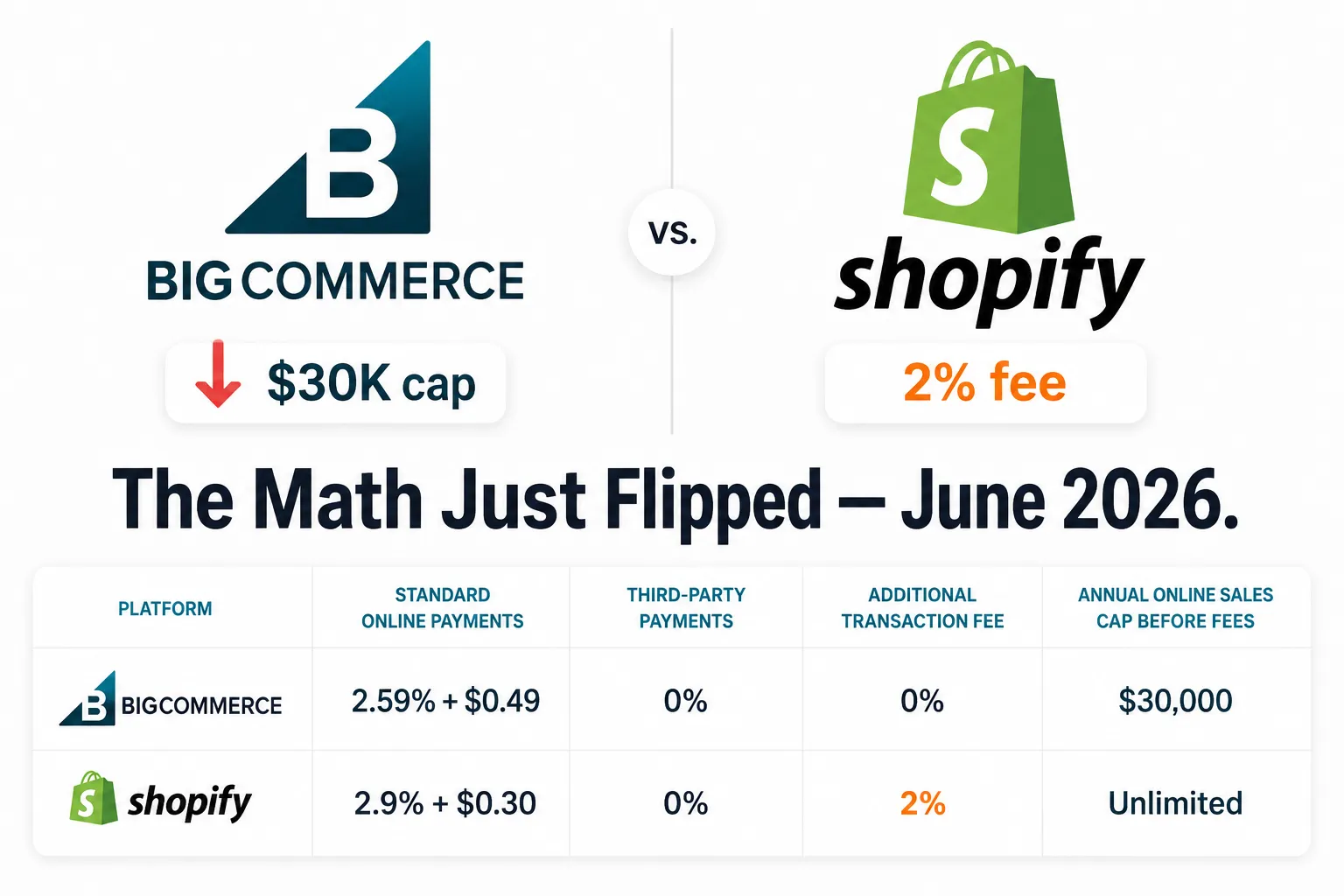
"BigCommerce updated its pricing on June 1, 2026: new Open Payment Provider fees and lower GMV caps. Here's what the math actually looks like for US small businesses comparing BigCommerce vs. Shopify right now."
Key Takeaways
- 1BigCommerce made three changes on June 1, 2026: plan renames, lower GMV caps (Core drops from $50K to $30K/year, Growth from $180K to $100K/year), and a new Open Payment Provider fee of 0.6–2.0% for non-Embedded processors.
- 2Stripe, PayPal, Adyen, Klarna, and 17 more providers are on BigCommerce's Embedded list: 0% fee on those. The Open Payment Provider fee only hits merchants using Square, Authorize.net, and other non-Embedded processors.
- 3Stores doing $31K–$50K/year that were on Standard ($39/mo) are likely auto-upgraded to Growth ($105/mo): a 169% price jump with no revenue change.
- 4Shopify charges 2%/1%/0.5% on Stripe, PayPal, and all third-party processors. BigCommerce still charges 0% on those same providers. For Embedded processor users, BigCommerce remains the better deal.
- 5Shopify has no GMV caps at any tier. A store growing past $100K/year on BigCommerce Growth gets auto-upgraded to Scale at $399/month.
- 6Before migrating platforms, factor in theme rebuild, URL redirect mapping, app re-integration, and payment re-setup, typically several weeks of developer time.
For years, one of the cleanest arguments for BigCommerce over Shopify was simple: BigCommerce charged no transaction fees on third-party payment providers. You could run your store on Stripe, PayPal, or Authorize.net and keep 100% of every sale. Shopify taxed you 0.5% to 2% for the same choice.
On June 1, 2026, that advantage got complicated.
BigCommerce announced three changes that took effect on that date: a plan rename, reduced GMV (gross merchandise value) caps, and a new “Open Payment Provider fee” for merchants using non-approved payment processors. Every comparison article written before June is now outdated.
This piece walks through what actually changed, who it affects, and what the real math looks like for US small businesses shopping between these two platforms right now.
Quick Answer
If you use Stripe, PayPal, or Adyen on BigCommerce and your annual GMV is inside the new caps ($30K on Core, $100K on Growth), staying put is the right call. BigCommerce still charges you 0% on those processors; Shopify charges 0.5%–2% for the same providers. If you are in the $31K–$50K GMV band, you may have already been auto-upgraded to Growth at $105/month. That is the group with the clearest reason to run the math on switching.
What BigCommerce Changed on June 1, 2026 (Official Announcement)
According to BigCommerce's own blog post published on May 11, 2026 and authored by Austin Comer, three things changed:
1. Plan renames.
Standard is now Core. Plus is now Growth. Pro is now Scale. Enterprise is now Performance. The monthly prices did not change.
2. Lower GMV caps.
The revenue thresholds that trigger automatic plan upgrades dropped significantly. The Core plan (formerly Standard) now caps at $30,000/year in GMV, down from $50,000 on Standard. Growth (formerly Plus) now caps at $100,000/year, down from $180,000 on Plus.
3. A new Open Payment Provider fee.
Self-serve plan merchants who process orders through payment providers not on BigCommerce's Embedded list now pay an additional fee:
- Core: 2.0% of GMV on those orders
- Growth: 1.0%
- Scale: 0.6%
- Performance (Enterprise): 0%
That third change sounds alarming. The second one is quietly the more painful one for a lot of stores.
The GMV Cap Reduction Is the Sneakier Hit
Here is what the GMV cap change means in practice. Say you run a small DTC brand doing $40,000 in annual sales. Before June 1, 2026, you were on the Standard plan at $39/month. Your GMV was under the $50,000 cap.
After June 1, your $40,000 in revenue exceeds Core's new $30,000 cap. You get auto-upgraded to Growth at $105/month.
Your revenue has not changed. Your product has not changed. Your plan costs just jumped from $39 to $105 per month, a 169% increase.
BigCommerce acknowledged this in their announcement, framing it as a move to align plan tiers with business scale and noting that merchants upgrading to Growth gain access to features like abandoned cart recovery and persistent cart. But the practical reality is that stores in the $30,000–$50,000 annual GMV band are now paying significantly more.
The Open Payment Provider Fee: Who Actually Gets Hit
This part requires careful reading because BigCommerce's marketing around it is targeted at Shopify.
BigCommerce published a list of 21 Embedded Payment Providers that carry no fee. That list includes: Stripe, PayPal Braintree, PayPal Complete Payments, PayPal Wallet, Adyen, Klarna, Afterpay, Amazon Pay, Checkout.com, Clearpay, Sezzle, Worldpay, Affirm, Global Payments, Fortis, Bluesnap (powered by Payroc), Bankful (Pinwheel), TD Online Mart, Zip Money, Bank of New Zealand, and BigCommerce Payments itself.
If you process through any provider on that list, the Open Payment Provider fee does not apply to those orders. Your fee is zero.
Most US small businesses using Stripe, PayPal, or Adyen are in the clear. The fee hits merchants using providers not on the Embedded list: Square, Authorize.net, WooPayments, and other processors not included in BigCommerce's curated set.
Side-by-Side Comparison: BigCommerce vs. Shopify in 2026
Here is how the platforms compare today, using verified pricing from BigCommerce's official pricing page and Shopify's pricing page:
| BigCommerce Core | BigCommerce Growth | BigCommerce Scale | Shopify Basic | Shopify (Grow) | Shopify Advanced | |
|---|---|---|---|---|---|---|
| Monthly price (billed annually) | $29/mo | $79/mo | $299/mo | $29/mo | $79/mo | $299/mo |
| Monthly price (billed monthly) | $39/mo | $105/mo | $399/mo | $39/mo | $105/mo | $399/mo |
| GMV cap (annual) | $30,000 | $100,000 | ~$400,000 | None | None | None |
| Fee-free payment option | 20+ Embedded providers | 20+ Embedded providers | 20+ Embedded providers | Shopify Payments only | Shopify Payments only | Shopify Payments only |
| Third-party processor fee | 2.0% (non-Embedded) | 1.0% (non-Embedded) | 0.6% (non-Embedded) | 2.0% | 1.0% | 0.5% |
| Stripe fee | 0% (Embedded) | 0% (Embedded) | 0% (Embedded) | 2.0% | 1.0% | 0.5% |
| PayPal fee | 0% (Embedded) | 0% (Embedded) | 0% (Embedded) | 2.0% | 1.0% | 0.5% |
Shopify has no GMV caps. You can sell $500,000 on Basic without being auto-upgraded. BigCommerce caps Core at $30,000 and Growth at $100,000.
Shopify charges 2%, 1%, or 0.5% on any payment processor other than Shopify Payments, including Stripe and PayPal. BigCommerce charges nothing on 20+ Embedded providers.
Where the Math Flipped and Where It Did Not
The BigCommerce PR angle (“Shopify has one fee-free provider, we have 20+”) is technically accurate. But “the math just flipped” only describes part of the picture.
Where the math did flip: For merchants using non-Embedded providers (Square, Authorize.net, etc.) on BigCommerce Core, there is now a 2% fee where before there was 0%. That is a real change. And for stores in the $30K–$50K GMV range, the forced upgrade to Growth is a meaningful cost jump.
Where the math did not flip: If you are using Stripe or PayPal on BigCommerce, your fee is still 0%. On Shopify, those same providers cost you 0.5% to 2% depending on your plan. BigCommerce remains the better deal for merchants on Embedded providers.
Where Shopify wins now: Shopify has no GMV caps. A store growing from $80,000 to $110,000 in sales stays on the same Shopify plan. On BigCommerce, hitting $101,000 on Growth triggers an upgrade to Scale at $399/month.
What to Factor In Before Switching
Migrating from BigCommerce to Shopify (or the reverse) is not a weekend project. Consider:
Theme rebuild. Shopify and BigCommerce use different templating systems. A custom BigCommerce Stencil theme does not port over. You are looking at a fresh build on Liquid.
URL structure and redirects. Product and collection URLs differ between platforms. Without proper 301 redirects and a Google Search Console re-indexing request, you will lose organic rankings built over years.
App ecosystem differences.Many apps exist on both platforms, but not all. Audit your current app stack against Shopify's App Store before assuming a clean lift-and-shift.
Payment re-setup. Switching platforms means re-connecting payment processors, verifying accounts, and potentially renegotiating rates.
If you are already using Stripe or PayPal on BigCommerce and your GMV is comfortably inside the new caps, a migration is hard to justify financially.
The Stores That Should Look at Their Numbers Right Now
Three situations where doing the math is worth 30 minutes of your time:
You're selling $31,000–$50,000/year on BigCommerce Standard (now Core). Your plan probably auto-upgraded to Growth. You are now paying $105/month instead of $39. Over a year, that is $792 more. Whether Shopify (which has no cap at that GMV) makes sense depends on your payment processor and growth trajectory.
You use Square or another non-Embedded processor on BigCommerce Core.You now pay 2% on every order through that provider. On $30,000 in GMV, that is $600/year in new fees. Switching to one of BigCommerce's Embedded providers (or comparing against Shopify Basic, which charges the same 2% for third-party processors) is worth the time.
You are evaluating platforms fresh and doing under $100,000/year. Shopify's lack of GMV caps is a genuine structural advantage at this scale. Both platforms charge the same base prices. The fee-free payment provider list still favors BigCommerce if you plan to use Stripe or PayPal. FactoryJet has built stores for small businesses across the US, including markets like Nashville, and can help you run the real cost comparison for your specific setup.
What This Means for Platform Selection Going Forward
Neither platform won this round cleanly.
BigCommerce's 20+ Embedded providers remain a genuine differentiator for merchants who already use Stripe, PayPal, or Adyen. For those merchants, the Open Payment Provider fee is irrelevant. But the GMV cap reduction is a harder sell, as it forces growing stores into higher-tier plans earlier than before, and Shopify has no equivalent limit.
Shopify's transaction fee structure is unchanged and applies to a wide range of third-party processors. For merchants using Shopify Payments, the platform remains competitive. For everyone else, BigCommerce still tends to cost less in payment fees.
The most important thing for any US small business: your store's performance, checkout speed, and conversion rate will have far more impact on your bottom line than the difference between 0.5% and 1% in platform fees. We've seen stores on both platforms lose far more to slow page loads and a clunky checkout than they ever paid in transaction fees. If you want a broader comparison before deciding, the Shopify vs WooCommerce breakdown covers how those two compare on total cost of ownership. If you pick BigCommerce, see which BigCommerce agency fits your store.
If you are choosing between platforms, or thinking about migrating, FactoryJet handles Shopify and custom ecommerce builds for US businesses with a fixed-price quote within 24 hours. We are happy to do a free platform audit and lay out the math for your store. Book a 30-minute call with our team and we will walk through the numbers together.
Sources: BigCommerce official pricing announcement, May 2026 | BigCommerce pricing page | Shopify pricing page
Bhavesh Barot is the founder of FactoryJet. He has spent 12+ years building ecommerce stores for hundreds of US businesses. FactoryJet delivers in 7 days, not 7 weeks. Talk to Bhavesh directly.
Planning a store
Tell Us What You Sell, and Where
We reply with what we would build and how long it takes. You see a working draft of your store before you sign.
Frequently Asked Questions
What did BigCommerce change on June 1, 2026?
Does the new BigCommerce fee apply to Stripe?
How does BigCommerce's new fee compare to Shopify's transaction fees?
Who is hurt most by BigCommerce's pricing changes?
Who is not affected by BigCommerce's fee change?
Is BigCommerce still better than Shopify on payment fees?
Does Shopify have GMV caps like BigCommerce?
What are BigCommerce's new plan names after June 2026?
What is BigCommerce's Embedded Payment Provider list?
Should I switch from BigCommerce to Shopify after this change?
What does migrating from BigCommerce to Shopify actually cost?
What is Shopify's transaction fee if I use Stripe or another third-party processor?
Can BigCommerce merchants avoid the new fee entirely?
What happens if my GMV exceeds my BigCommerce plan cap?
Does the fee change affect BigCommerce enterprise (Performance) merchants?
Are Shopify and BigCommerce priced the same in 2026?
What is the BigCommerce GMV cap on the Core plan?
What ecommerce platform does FactoryJet build on?
Is BigCommerce losing market share to Shopify because of this change?
How do I know which payment providers are Embedded on BigCommerce?
Who should I talk to about choosing between BigCommerce and Shopify?

Bhavesh Barot
Founder & CEO
Founder & CEO of FactoryJet, an ecommerce and AI services company that has served 500+ businesses across the US, UK, UAE, and India. Writes about ecommerce builds, AI agents, and AI search.
Related reading
- How Much Does an Ecommerce Website Cost in 2026? Shopify, WooCommerce, BigCommerce and Custom ComparedWhat a US online store really costs in 2026, priced three ways: a hosted plan you set up yourself, an agency build on Shopify, WooCommerce or BigCommerce, and a custom or headless build. Every number links to its source.
- Best Ecommerce Platform in Australia 2026: Shopify, WooCommerce, BigCommerce and More ComparedThe best ecommerce platform in Australia for 2026, compared on real AUD list prices, payment fees on a $100 sale, GST, Afterpay and Zip, Australia Post and Xero or MYOB. Shopify, Shopify Plus, WooCommerce, BigCommerce, Maropost (Neto), Adobe Commerce, Wix and Squarespace, with a plain answer for each type of business.
- Ecommerce Website Cost in the UK (2026): Build Prices in Pounds for Shopify, Shopify Plus, WooCommerce, Magento and BigCommerceWhat an ecommerce website costs to have built in the UK in 2026, in pounds: Shopify, Shopify Plus, WooCommerce, Magento, Adobe Commerce and BigCommerce, by platform and by size of project. Every figure is a published UK market range or a platform list price, with its source, date and VAT basis.