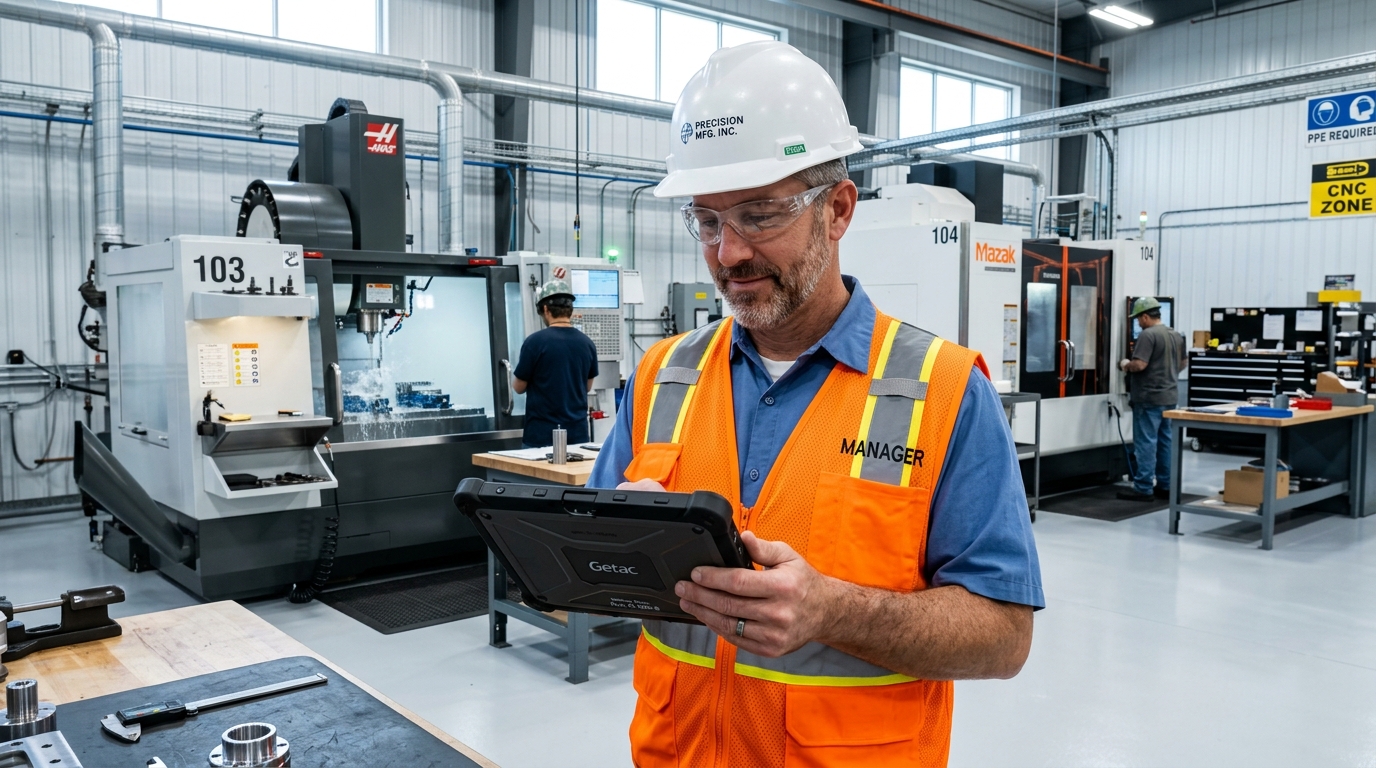
"Technical blueprint for manufacturing AI agents: PDF CAD drawing parsing, multi-tier BOM costing, and bi-directional NetSuite and SAP ERP synchronization."
Key Takeaways
- 1RFQ quoting is the highest-value manufacturing workflow to automate first, because it is high frequency, highly repetitive and directly gates revenue, and because slow quotes lose orders to whoever answers faster.
- 2The hard part is not reading the RFQ, it is pricing it. An agent has to reach live cost data, material pricing and capacity in your ERP, which is an integration problem rather than a language problem.
- 3Keep a human approval step on any quote that leaves the building. The agent should assemble and price the quote and hand it to an estimator, not send it, until the error rate is proven over real volume.
- 4Structured extraction beats free-form parsing for RFQ documents. Define the fields you need, validate them against your part master, and flag anything that does not resolve rather than guessing.
- 5Measure it on quotes turned around per day and win rate on quoted work, not on time saved. Time saved is easy to claim and impossible to bank.
- 6Start with one product family and one customer type. Manufacturing RFQs vary enormously across lines, and an agent tuned for one is rarely correct for another without rework.
- •RFQ Turnaround Reduction: Custom manufacturing AI agents shorten quotation cycles by automating multi-page PDF engineering print ingestion, title block extraction, and geometric feature decomposition, with an estimator approving every quote.
- •Multi-Modal Vision Pipelines: High-resolution neural vision models extract part numbers, revision letters, material callouts (e.g. 6061-T6 Aluminum, 4140 Alloy Steel), GD&T tolerances (+/- 0.0005 in), and surface finishing specifications directly from rasterized and vector CAD prints.
- •Bi-Directional ERP Synchronization: Deterministic connectors query live inventory stock, machine center hourly rates (Haas, Mazak, Makino), and customer-specific contract pricing tables inside NetSuite, SAP S/4HANA, Epicor Prophet 21, and Infor CloudSuite without manual data entry.
- •Supply Chain PO Reconciliation: Purchasing AI agents parse incoming vendor order acknowledgements and PDF confirmations, reconciling promised delivery dates against open purchase orders to reduce unexpected assembly line downtime.
- •Human-in-the-Loop Approval Console: Senior estimating engineers review draft quotes in a side-by-side verification interface with visual bounding box highlights and confidence scoring before publishing final proposals into the ERP.
- •100% Code & IP Ownership: Manufacturing enterprises retain complete ownership of Git repositories, Python connectors, and prompt state machines with zero recurring per-seat software licensing fees.
The Quoting Bottleneck in Mid-Market American Manufacturing
For American precision CNC machine shops, custom fabricators, and contract manufacturers ($5M to $50M annual revenue), the estimating department is often the single greatest operational bottleneck. Estimating teams receive a steady flow of inbound RFQs across customer email inboxes, supplier bidding portals, and EDI feeds.
Each RFQ package typically includes multi-page PDF engineering prints, 3D CAD STEP files, complex geometric dimensioning and tolerancing (GD&T) specifications, surface treatment requirements (such as anodizing, passivating, or heat-treating), and custom packaging standards.
Senior estimating engineers spend much of their working time manually transcribing part dimensions into Excel spreadsheets, looking up standard raw stock material costs, calculating machine cycle times, and manually re-keying line items into ERP sales order screens. When a detailed quote takes days to go back to the customer, faster competitors can win the business first.
The 5-Stage Multi-Modal Industrial AI Architecture
Modern industrial AI agents do not rely on generic chat interfaces. They are engineered as deterministic, multi-stage state machines with strict error bounds, structured JSON outputs, and bi-directional ERP integration:
Stage 1: Document & CAD Ingestion Pipeline
When an RFQ email arrives in shared sales inboxes (e.g. rfq@company.com), the ingestion worker extracts all attached documents, including rasterized PDF prints, vector DWG drawings, STEP geometry, and Excel specification sheets. The pipeline runs high-resolution OCR combined with multi-modal vision models to isolate title blocks, customer revision letters, part numbers, material callouts, and general tolerance blocks.
Stage 2: Feature & GD&T Extraction
The agent extracts critical manufacturing parameters into a validated JSON schema:
- Raw Material Master: Material grade (e.g. 6061-T6 Aluminum, 304 Stainless Steel, Acetal), bounding box stock dimensions, and cut allowances.
- Machining Operations: 3-axis milling, 5-axis simultaneous contouring, turning, wire EDM, and secondary deburring.
- Tolerances & Critical Features: Tight-tolerance bore diameters (+/- 0.0005 in), tapped hole threads, surface roughness callouts (e.g. 32 Ra micro-inch), and plating requirements.
- Batch Quantities & Break Points: Quantity tiers (e.g. 25, 50, 100, 500, 2500 pieces) for setup amortization.
Stage 3: ERP Master Data & Commodity Index Lookup
The agent executes secure, least-privilege tool calls into your internal databases:
- ERP Machine Rate Tables: Hourly run rates for Haas VF-4, Mazak Integrex, and Makino machining centers.
- Raw Stock Inventory: Real-time on-hand bar stock, plate inventory, and standard vendor lead times.
- Live Scrap & Metal Spot Feeds: Real-time commodity indexing to ensure material markup buffers remain protected.
- Approved Vendor List (AVL): Secondary process pricing from local certified plating, painting, and heat-treat vendors.
Stage 4: Cost Modeling & Cycle Time Computation
Referencing your internal feeds-and-speeds algorithms, the agent calculates setup hours, machining cycle times per part, tool wear depreciation, and scrap factor allowances. It computes total manufacturing cost and applies customer-specific contract margin rules retrieved from your CRM or ERP customer master record.
Stage 5: Staging & Human Approval Console
The agent generates a draft quote inside your ERP (NetSuite, SAP S/4HANA, Epicor Prophet 21, or JobBOSS) and presents the package to the lead estimator in a side-by-side web dashboard. The estimator reviews highlighted drawing callouts, verifies machine time estimates, makes any necessary adjustments, and clicks approve to issue the formal customer proposal.
If your quotes live in NetSuite, Odoo or SAP Business One, our guide to AI agents inside NetSuite, Odoo and SAP Business One explains how each of those ERPs handles draft records, API limits and approvals.
How Estimating Work Changes: Manual Estimating vs. Custom AI Agent
| What Changes | Custom AI Agent (Estimator Approves) | Manual Estimating |
|---|---|---|
| Assembling the quote package | The agent extracts drawing data, looks up costs and drafts the quote; the estimator reviews it | The estimator transcribes prints and looks up every cost by hand |
| What limits capacity | Review time, since typing and lookups are automated | How many packages an estimator can key in each week |
| Data entry into the ERP | Fields are checked against a schema and your part master before anything is written; mismatches go to a person | Line items are retyped, so typos can reach the ERP |
| Ongoing cost | Model usage, hosting and upkeep; no per-seat license on code you own | Estimator salaries* |
*Per the U.S. Bureau of Labor Statistics (May 2025), the median annual wage for cost estimators in manufacturing was $75,940, and the highest-paid 10% of cost estimators nationally earned more than $130,820, before payroll taxes and benefits.
Data Security, ITAR, and CMMC Compliance
Manufacturing enterprises handle sensitive defense, aerospace, and commercial intellectual property. Consumer AI chatbots that store conversations or train on them are the wrong place for drawings covered by ITAR (International Traffic in Arms Regulations) or CMMC (Cybersecurity Maturity Model Certification) requirements, and your export compliance lead should approve any AI design that touches that data.
FactoryJet designs private AI deployments for this work:
- Zero Data Retention (ZDR): OpenAI and Anthropic offer zero data retention arrangements to approved API customers, which limit how long prompts containing CAD prints and pricing are stored. Check each provider's terms for exceptions.
- Government Cloud Regions: Defense suppliers can run workloads in a government cloud such as AWS GovCloud (US), which AWS describes as isolated U.S. regions operated by U.S. citizens, with access limited to U.S. persons.
- On-Premise Execution: When data cannot leave your network, open-weight models can run on your own GPU servers behind your firewall.
Technical Schema Architecture & ERP Payload Structure
To ensure deterministic quote generation without hallucination, our Python backend pipeline parses drawings into strongly typed Pydantic models before interacting with your ERP APIs. Below is a representative extraction schema for precision machining RFQs:
{
  "rfq_id": "RFQ-2026-08942",
  "customer_code": "AERO-CORP-US",
  "part_number": "AC-7704-REV-D",
  "material": {
    "grade": "6061-T6 Aluminum Bar",
    "bounding_box_inches": { "length": 8.50, "width": 4.25, "height": 2.75 },
    "stock_unit_cost_usd": 42.15
  },
  "machining_operations": [
    { "step": 1, "machine": "Haas VF-4", "setup_hours": 1.25, "cycle_min": 18.4 },
    { "step": 2, "machine": "Wire EDM AgieCharmilles", "setup_hours": 0.50, "cycle_min": 8.2 }
  ],
  "critical_tolerances": [
    { "feature": "Bearing Bore ID", "dimension_in": 1.5000, "tolerance": "+/-0.0003", "surface_ra": 16 }
  ],
  "outside_processing": [
    { "process": "Type II Clear Anodize (MIL-A-8625)", "lead_days": 4, "lot_charge_usd": 125.00 }
  ],
  "quantity_break_pricing": [
    { "qty": 25, "unit_cost": 184.20, "margin_pct": 38.0, "quoted_price": 297.10 },
    { "qty": 100, "unit_cost": 112.50, "margin_pct": 35.0, "quoted_price": 173.08 },
    { "qty": 500, "unit_cost": 76.40, "margin_pct": 32.0, "quoted_price": 112.35 }
  ]
}
Token Compute Economics & Infrastructure Costs
A frequent concern for Chief Information Officers is ongoing token compute expenses. As an illustration, suppose parsing a 10-page drawing package with a multi-modal vision model uses 22,000 input tokens and 1,800 output tokens. Image-heavy packages can use more.
At Anthropic's published API prices for Claude Sonnet 5 ($2 per million input tokens and $10 per million output tokens, checked September 17, 2026), that package costs about 6 cents in model usage: $0.044 for input and $0.018 for output. Even at 1,000 packages a month, model usage comes to about $62, which is small next to the fully-loaded cost of hiring another full-time estimator. Hosting, monitoring and upkeep come on top of model usage.
Automate Your Manufacturing Quoting Pipeline
Speak directly with founder Bhavesh Barot. We will audit your current drawing formats, review your ERP schema, and deliver a fixed-scope AI implementation proposal.
Book 30-Min Architecture Discovery Call →Free assessment
Find Out if an AI Agent Can Take the Task
Name one task your team repeats every day. We tell you whether an agent can do it or whether a tool you can buy already does, and we build a demo on your own sample files before you sign.
Frequently Asked Questions
How does the AI agent parse scanned PDF engineering drawings with poor contrast?
Can the agent calculate multi-operation setup times for CNC milling and turning?
Which ERP systems support automated draft quote injection?
How does the agent handle outside processing like heat treatment or anodizing?
Does the AI agent replace our existing human estimating engineers?
How does the agent reconcile supplier PO confirmations in purchasing?
What happens when drawing dimensions or tolerances are unreadable?
Can the AI agent estimate assembly weldments and sheet metal fabrication?
How are volatile raw metal prices factored into quote margins?
Is the AI deployment compliant with ITAR and defense data regulations?
What is the implementation timeline for a custom manufacturing AI agent?
Do we own the full source code and connectors after launch?

Bhavesh Barot
Founder & CEO
Founder & CEO of FactoryJet, an ecommerce and AI services company that has served 500+ businesses across the US, UK, UAE, and India. Writes about ecommerce builds, AI agents, and AI search.
Related reading
- AI Customer Support Agent Architecture: Zendesk, Intercom & Gorgias Integration Guide (2026)A technical guide to building custom AI customer support agents: webhook event architecture, tool calling into Shopify and NetSuite, live carrier tracking, guardrail engineering, and helpdesk integration.
- Best AI Agent Development Companies for Manufacturers (2026): 14 AI Manufacturing Companies ComparedA fact-checked guide to the companies that build AI for manufacturers and distributors in 2026, grouped by what you are buying: plant-floor and industrial-data AI, ready-made quote and order software, or a custom agent on your ERP. What each sells, which systems it names, who it suits and one question to ask it. FactoryJet is on the list and says so.
- Multi-Agent Workflows in Production: How to Orchestrate LangGraph and n8n with Enterprise ERPs (2026)A comprehensive 3,400-word engineering guide on orchestrating multi-agent systems in production: combining n8n deterministic webhook pipelines with LangGraph cyclical state machines, Model Context Protocol (MCP) tool calling, and NetSuite/SAP ERP integrations.