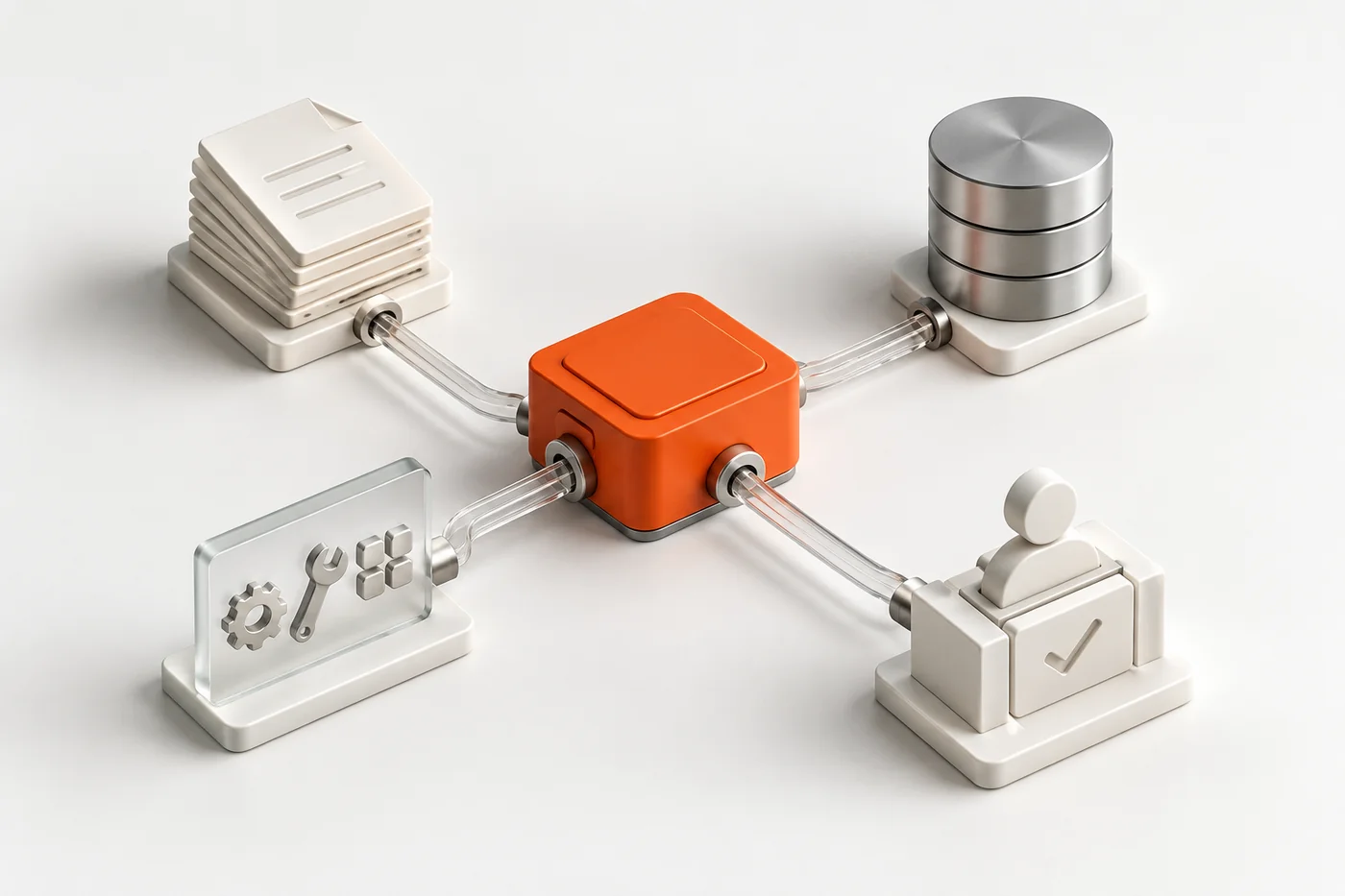
"A fact-checked guide to the companies that build AI for manufacturers and distributors in 2026, grouped by what you are buying: plant-floor and industrial-data AI, ready-made quote and order software, or a custom agent on your ERP. What each sells, which systems it names, who it suits and one question to ask it. FactoryJet is on the list and says so."
Key Takeaways
- 1Manufacturers buy two different things under the name AI agent: AI for machines and production data, and agents for office work such as RFQs, quotes and orders. Decide which one you need before you compare companies.
- 2We read 14 companies on their own websites on 11 October 2026 and grouped them by the kind of purchase. Nobody paid to be listed, and the order is not a ranking.
- 3Four sell plant-floor and industrial-data AI: Siemens, Rockwell Automation, Cognite and MachineMetrics. Three sell ready-made quote and order software: Paperless Parts, Conexiom and Proton.ai.
- 4Seven build custom agents and name manufacturing: Intellectyx, USM Business Systems, Xcelacore, Phos AI Labs, Markovate, LeewayHertz and FactoryJet.
- 5All seven of the manufacturing lists we read that AI assistants cite rank their own publisher first, and none mentions EDI, punchout or order entry. Treat every list, including this one, as a starting point.
The short answer
The best AI agent development company for a manufacturer depends on where the work sits. For machines and production data: Siemens, Rockwell Automation, Cognite or MachineMetrics. For ready-made quote and order software: Paperless Parts, Conexiom or Proton.ai. For a custom agent on your ERP: Intellectyx, USM Business Systems, Xcelacore, Phos AI Labs, Markovate, LeewayHertz or FactoryJet.
We read all 14 companies on their own websites on 11 October 2026: what each sells, which systems it names and who it says it serves. Nobody paid to be listed. The order is not a ranking. FactoryJet wrote this list and is on it.
If you are short on time, tell us the one quoting or order task your team repeats most and we will tell you which kind of company fits.
On 9 October 2026 we put three buyer questions about manufacturing to ChatGPT, Claude, Gemini, Perplexity and Google’s AI answers, and collected 42 answers. Those answers cited 132 different pages on 108 websites. Lists of companies were the largest group at 46 pages, one ahead of service pages at 45.
On 11 October we read seven of the manufacturing lists those answers cited, from five publishers. All seven rank the publisher first. The phrase “predictive maintenance” appears 59 times across the seven pages. EDI, punchout, order entry and sales orders appear in none of them.
That matters because manufacturers buy two different things under the name “AI agent”. One works on the plant floor, with machines, sensors and production data. The other works in the office, on RFQs, quotes, purchase orders and the ERP. Five of the seven lists we read put the publisher in one ranking with global consultancies or automation suppliers such as Accenture, IBM and Siemens. A plant manager and a sales operations manager would each have to read past most of the page to find a name that fits.
So we sorted them. We opened each company’s own website, wrote down only what the company says about itself, and grouped the 14 by the kind of purchase. Every profile links to its source.
A note on who wrote this. FactoryJet designs, builds and supports AI agents for the quoting and order side of manufacturing and distribution, so we are on this list, in the last group. Our entry follows the same format as every other. Read every list with that in mind, including this one.
A few terms first, in plain English. An AI agent is software that takes actions in your systems, such as drafting a quote in the ERP, instead of only answering questions. An ERP is the system that holds orders, stock, purchasing and accounts. An MES (manufacturing execution system) tracks production on the shop floor. An RFQ is a customer’s request for a quote. EDI (electronic data interchange) is the structured way large customers send orders computer to computer. A punchout catalog lets a buyer shop your catalog from inside their own purchasing system.
The shortlist at a glance
Scan this first. Find the rows that match what you are buying and the systems you run, then read those profiles in full.
| Company | Kind | What you buy | Systems it names |
|---|---|---|---|
| Siemens | Plant floor and industrial data | Industrial Copilots and AI agents inside Siemens automation, engineering and design software | TIA Portal, NX CAD, Insights Hub, Teamcenter, Siemens Xcelerator |
| Rockwell Automation (Plex) | Plant floor and industrial data | Cloud MES (the system that tracks production on the shop floor) with AI built in | Plex MES; its page names ERP, PLM and supply chain systems as data sources |
| Cognite | Plant floor and industrial data | Industrial data platform plus a low-code workbench for building AI agents | Cognite Data Fusion and Cognite Atlas AI; time-series data, events, documents and engineering models |
| MachineMetrics | Plant floor and industrial data | Machine-data platform and MES for discrete manufacturing, with a built-in AI assistant | Machine controls old and new, your ERP (a case study names Epicor) and your CMMS |
| Paperless Parts | Ready-made software | Quoting and estimating software for job shops | ERP integrations including JobBOSS, E2 Shop, Epicor, Fulcrum, Genius ERP, Global Shop Solutions and Infor SyteLine |
| Conexiom | Ready-made software | Order automation software for purchase orders, RFQs and invoices | Pre-built integrations with more than 40 ERPs |
| Proton.ai | Ready-made software | AI sales platform for distributors: CRM, product data, ecommerce AI, and order and quote entry | Its own CRM and product information manager, plus your catalog and ERP |
| Intellectyx | Custom agent builder | Custom agents configured from pre-built manufacturing blueprints | ERP, CPQ, dealer management, PLM and MES |
| USM Business Systems | Custom agent builder | Custom AI agent development and IT services | Pre-built adapters for MES, ERP and supply chain systems, by its own account, naming SAP, Oracle, Rockwell and Siemens |
| Xcelacore | Custom agent builder | Technology consulting: AI, custom software, robotic process automation and system integrations | Salesforce, Microsoft Dynamics 365 and NetSuite; Microsoft Azure and AWS |
| Phos AI Labs | Custom agent builder | AI consulting and implementation for the office work around production | Your ERP; it offers Claude and OpenAI consulting |
| Markovate | Custom agent builder | Drawing-reading agents as a product, plus custom agent development | DWG, DXF, STEP and PDF drawings; ERP, PLM and CRM |
| LeewayHertz | Custom agent builder | AI consulting and custom development, plus its ZBrain agent platform | AutoGen Studio, Copilot Studio, Vertex AI and crewAI as agent-building tools |
| FactoryJet (that is us) | Custom agent builder | Custom AI agents and integrations built on the ERP you already run | Odoo, NetSuite, SAP Business One, ERPNext and custom ERPs; EDI, punchout catalogs and Shopify |
Plant-floor AI or office-side agents: two different purchases
Before you compare names, decide which of these three purchases you are making. They need different data, different people on your side and a different first conversation.
| Plant-floor and industrial-data vendor | Ready-made quote and order software | Custom AI agent builder | |
|---|---|---|---|
| What it works on | Machines, sensors, schedules, quality and maintenance data | Quotes from part files, emailed purchase orders, distributor quotes | The office workflow you choose: RFQs, quotes, orders, supplier paperwork |
| What you buy | A platform, or a module inside automation software you already run | A subscription you configure | A build made for your process, on your ERP, that you own |
| Who it suits | Plants with connected machines and an engineering or digital team | Shops and distributors whose process matches the product | Companies with their own pricing rules, exceptions, or an ERP the products do not cover |
| What must be ready | Machine connectivity and usable production data | Part files or a catalog, and an ERP the product integrates with | ERP access, sample documents and a person who knows the rules |
| Ask first | Which features are shipping today for the software versions you run | Which ERPs it writes into, and how your pricing rules get in | Who owns the code, and who approves what the agent drafts |
A plant can need more than one. A machine shop might run MachineMetrics on the floor, Paperless Parts for quoting, and a custom agent for the purchase orders that arrive by email. The three do not compete. Buying one when you needed another is the expensive mistake.
How we built this list
- Start with what buyers ask. The three questions came from our own buyer-question research. “AI manufacturing companies” and six close phrasings get about 440 US Google searches a month between them (DataForSEO, October 2026). Google showed an AI Overview on all seven when we checked on 11 October.
- Read the lists assistants cite. We read seven, from five publishers, to see who gets named and what is missing. We did not copy them.
- Sort by the purchase. A company went into a group only when its own site describes that kind of product or service for manufacturers or distributors.
- Read the source, not the summary. Every description comes from the company’s own pages, opened on 11 October 2026. Numbers such as customer counts are the company’s own claims, and we say so.
- No scores we cannot prove. A star rating would need a work history with every company, so this list carries none. We say who each one suits and one question worth asking it.
- Leave the global consultancies to their own list. Accenture and IBM each appear on three of the seven lists we read. They run company-wide programs, which is a different purchase. See our list of AI consulting firms in the USA.
The best AI agent development companies for manufacturers, profiled
The order is not a ranking. Companies are grouped by what you are buying: plant-floor and industrial-data AI, ready-made quote and order software, custom agent builders, then us.
AI manufacturing companies for the plant floor and industrial data
Companies whose AI works on machines, sensors and production data. Two are automation suppliers, one is an industrial data platform and one connects machine tools. You buy a platform or a module, and it needs connected machines to be useful.
1. Siemens
Company: Siemens AG. Its about page says it works in over 200 countries. What you buy: Industrial Copilots and AI agents inside Siemens automation, engineering and design software.
Siemens announced AI agents for industrial automation at Automate 2025 in Detroit, in a press release dated 12 May 2025. It separates Industrial Copilots, the assistants people talk to, from the AI agents that do the work behind them, with an orchestrator that hands tasks to specialized agents. Its copilots cover design, planning, engineering, operations and services. The engineering copilot writes automation code for TIA Portal from plain-language requests. Siemens also said it plans a marketplace for its own and third-party agents on Siemens Xcelerator, and says its Industrial Copilot was developed in partnership with Microsoft.
- Best for: Plants and machine builders already standardized on Siemens controls and engineering software.
- Typical client: Industrial companies in process and discrete industries.
- Systems it names: TIA Portal, NX CAD, Insights Hub, Teamcenter, Siemens Xcelerator.
- Worth asking them: Which copilots and agents are generally available for the software versions you run today, and which are still in pre-release.
Sources: press.siemens.com/global/en/pressrelease/siemens-introduces-ai-agents-industrial-automation | www.siemens.com/en-us/company/insights/generative-ai-industrial-copilot/ | www.siemens.com/en-us/company/about/
2. Rockwell Automation (Plex)
Company: Rockwell Automation, which describes itself as dedicated to industrial automation and information. Plex is its cloud MES brand. What you buy: Cloud MES (the system that tracks production on the shop floor) with AI built in.
Rockwell Automation sells the Plex Smart Manufacturing Platform, which it describes as a multi-tenant SaaS MES with embedded AI. Its agentic AI page describes agents for production orders, resource management, material handling, quality control and maintenance that share information across the plant. Rockwell says agentic AI is only as effective as the data it receives, so connected equipment and an MES come first. Its roadmap starts with connecting production equipment and ends with wider autonomous decisions as confidence grows.
- Best for: Manufacturers that want AI inside the system that already runs production, quality and maintenance.
- Typical client: Discrete, hybrid and regulated manufacturers.
- Systems it names: Plex MES; its page names ERP, PLM and supply chain systems as data sources.
- Worth asking them: Which of the agents on that page are shipping features of Plex today, and which describe where the product is heading.
Sources: plex.rockwellautomation.com/en-us/platform/agentic-ai-in-manufacturing.html | plex.rockwellautomation.com/en-us.html | www.rockwellautomation.com/en-us/company/about-us.html
3. Cognite
Company: Lists a Phoenix headquarters in Tempe, Arizona, offices in Austin and Houston, and an Oslo office. Working on its platform since 2016. What you buy: Industrial data platform plus a low-code workbench for building AI agents.
Cognite calls itself an AI company that delivers industrial software. Cognite Data Fusion pulls plant data into what it calls an Industrial Knowledge Graph: time-series readings, events, documents, visual data and engineering models. Cognite Atlas AI is a low-code workbench where a digital team builds agents on that data from preconfigured templates. Its page shows a root cause analysis agent and a troubleshooting agent for rotating equipment, and says agents can run on any cloud with any language model.
- Best for: Asset-heavy and process plants with an in-house digital team and data spread across many systems.
- Typical client: Energy, process manufacturing and other industrial companies.
- Systems it names: Cognite Data Fusion and Cognite Atlas AI; time-series data, events, documents and engineering models.
- Worth asking them: How much of your plant data has to be modelled in Cognite Data Fusion before the first agent is useful.
Sources: www.cognite.com/en/product/atlas | www.cognite.com/en/company/about-us-cognite
4. MachineMetrics
Company: Headquarters in Northampton, Massachusetts. What you buy: Machine-data platform and MES for discrete manufacturing, with a built-in AI assistant.
MachineMetrics connects machines, operators and the ERP, and calls the result a next-generation MES built for discrete manufacturing. It says more than 10,000 machines are connected to it. Its platform, MaximaOS, covers scheduling, work orders, downtime and OEE, a measure of how much planned machine time ends up making good parts. Its assistant, Max AI, answers plain-language questions from live machine data, writes shift summaries and flags anomalies before they become scrap. Maintenance work orders can open in your CMMS, the system that tracks maintenance jobs.
- Best for: Machine shops and discrete manufacturers that want machine data and AI answers without building a data platform first.
- Typical client: Discrete manufacturers; it names aerospace and defense, contract manufacturing, automotive, medical device and heavy equipment.
- Systems it names: Machine controls old and new, your ERP (a case study names Epicor) and your CMMS.
- Worth asking them: Which of your machine controls connect out of the box, and what the ERP connection needs from your side.
Sources: www.machinemetrics.com/
Ready-made AI software for quotes and orders
Products you subscribe to and configure. All three work on the office side: quotes from part files, emailed purchase orders, and quotes and orders for distributors. Each connects to an ERP and publishes no price on the pages we read.
5. Paperless Parts
Company: Corporate headquarters in Boston, Massachusetts, with a West Coast office in Encinitas, California. What you buy: Quoting and estimating software for job shops.
Paperless Parts is quoting software built for job shops and contract manufacturers. It analyzes a part file, finds the features that drive cost, such as bends, holes and setup count, and applies costing and pricing logic set up for your shop. It says its customers send 45,000 quotes a week. It says it is ITAR registered and hosted on AWS US GovCloud, which matters for defense work. Pricing is in tiers and given on request. You subscribe to it and configure it for your shop.
- Best for: Job shops whose bottleneck is the time an estimator spends on each quote from a part file.
- Typical client: Job shops and contract manufacturers: CNC machining, sheet metal, Swiss screw machining and additive. It says 800+ manufacturers use it.
- Systems it names: ERP integrations including JobBOSS, E2 Shop, Epicor, Fulcrum, Genius ERP, Global Shop Solutions and Infor SyteLine.
- Worth asking them: How the integration with your ERP works in practice: which records move, in which direction, and how often.
Sources: www.paperlessparts.com/ | www.paperlessparts.com/company/ | www.paperlessparts.com/integrations/ | www.paperlessparts.com/pricing/
6. Conexiom
Company: Corporate headquarters in Vancouver, Canada, with offices in Chicago, Kitchener, London and Munich. What you buy: Order automation software for purchase orders, RFQs and invoices.
Conexiom turns orders, RFQs, acknowledgements and invoices that arrive as PDFs, spreadsheets or emails into data your ERP can accept. It captures the document, validates it against your ERP, corrects errors and passes it on. It says it processes more than 1.5 billion line items a year, that implementation averages 30 days and that your ERP needs no changes. Its site says it is SOC 2 Type II certified.
- Best for: Manufacturers and distributors with a high volume of emailed purchase orders that staff key into an ERP.
- Typical client: Manufacturers and distributors; it says more than 600 brands use it.
- Systems it names: Pre-built integrations with more than 40 ERPs.
- Worth asking them: How it handles your messiest customer order formats, and what happens to a line it cannot match.
Sources: conexiom.com/ | conexiom.com/about | conexiom.com/contact/
7. Proton.ai
Company: Cambridge, Massachusetts. What you buy: AI sales platform for distributors: CRM, product data, ecommerce AI, and order and quote entry.
Proton builds software only for distributors. Its order and quote entry tool reads an inbound request, matches the products to your catalog, applies your contract pricing and sourcing rules, and drafts the quote or order. A rep reviews and approves it, and then it goes into the ERP. The same platform has a CRM, a product information manager and ecommerce AI. Its site lists pricing AI and inventory AI as coming soon.
- Best for: Distributors whose inside sales team spends its day typing quotes and orders from emails.
- Typical client: Distributors, from family-owned to publicly traded.
- Systems it names: Its own CRM and product information manager, plus your catalog and ERP.
- Worth asking them: Which ERPs it writes orders into today, and how it learns your contract pricing.
Sources: www.proton.ai/order-and-quote-entry | www.proton.ai/ | www.proton.ai/contact

AI agent development companies that build for manufacturers
Firms that build an agent around your own process and systems. Each one names manufacturing on its own site. They differ in size and in where they start: enterprise blueprints, drawings, procurement, or the office paperwork around production.
8. Intellectyx
Company: Los Angeles headquarters in Pasadena, California, and a Denver office. It says it has operated for 16+ years. What you buy: Custom agents configured from pre-built manufacturing blueprints.
Intellectyx offers nine families of pre-built agent blueprints for manufacturing, which it configures around your ERP, CPQ (the tool that prices configured products), dealer and PLM systems. The families include sales operations and order management, dealer and distribution networks, aftermarket parts and service, sourcing, pricing and plant operations. It says a first solution can reach production in as little as 90 days and publishes an indicative 90-day plan. After launch it runs the agents under a managed service it calls AgentOps.
- Best for: Larger manufacturers with dealer networks, aftermarket parts and several enterprise systems to connect.
- Typical client: Enterprise manufacturers; its site cites a global construction equipment maker and an automotive components manufacturer.
- Systems it names: ERP, CPQ, dealer management, PLM and MES.
- Worth asking them: How much of the blueprint fits your process as it stands, and what the 90 days assume about your data.
Sources: www.intellectyx.com/industries/agentic-ai-for-manufacturing/ | www.intellectyx.com/
9. USM Business Systems
Company: Headquarters in Ashburn, Virginia, and an office in Frisco, Texas. Founded in 1999 as a staffing provider. What you buy: Custom AI agent development and IT services.
USM began in 1999 as a staffing provider and later added artificial intelligence, machine learning and automation services. On its own list of manufacturing agent developers it describes pre-built adapters for MES, ERP and supply chain systems, a co-delivery model that places its people with your team, and audit trails, approval gates and rollback built into each agent. It quotes four to six months for implementation and says pricing is custom after discovery.
- Best for: Mid-size and large manufacturers that want extra engineers working alongside an in-house IT team.
- Typical client: Mid-size to large manufacturing and supply chain enterprises, by its own description.
- Systems it names: Pre-built adapters for MES, ERP and supply chain systems, by its own account, naming SAP, Oracle, Rockwell and Siemens.
- Worth asking them: Which manufacturing agents it has running in production, and whether you can speak to that client.
Sources: usmsystems.com/top-ai-agent-development-companies-for-manufacturing/ | usmsystems.com/about-us/ | usmsystems.com/contact-us/
10. Xcelacore
Company: Calls itself a Chicago-based technology consulting firm; its office is in Oak Brook, Illinois. Founded in 2014. What you buy: Technology consulting: AI, custom software, robotic process automation and system integrations.
Xcelacore is a technology consulting firm that lists manufacturing and distribution as an industry it serves. It names manufacturers, industrial distributors and wholesalers as the businesses it works with, and offers AI, custom software, robotic process automation (software that repeats the manual steps of office work), testing, and ERP or CRM implementation. Its co-founders came from Accenture, and it says it brings management consulting experience to mid-size companies.
- Best for: Mid-size manufacturers and distributors that want one firm for AI, integrations and custom software.
- Typical client: Manufacturers, industrial distributors and wholesalers.
- Systems it names: Salesforce, Microsoft Dynamics 365 and NetSuite; Microsoft Azure and AWS.
- Worth asking them: Which manufacturing or distribution AI projects it can walk you through, step by step.
Sources: xcelacore.com/industries/manufacturing-distribution/ | xcelacore.com/ | xcelacore.com/about-us/
11. Phos AI Labs
Company: Says it has built AI products since 2022 and is trusted across 450+ builds by the LowCode Agency team. Founder and CEO: Jesus Vargas. What you buy: AI consulting and implementation for the office work around production.
Phos AI Labs says it builds and governs AI systems that run RFQ triage, purchase order processing, quality and corrective-action paperwork, shift reports and knowledge capture inside your existing operation. It draws a firm line: every physical action, spec sign-off and safety decision stays with a qualified person. Its page argues that the fastest and safest wins sit upstream in the office, in RFQ triage and purchase order entry, while predictive maintenance takes the headlines. It says it identifies the right starting point in two weeks.
- Best for: Mid-market manufacturers that want a consultant to pick the first office workflow and then build it.
- Typical client: Mid-market manufacturers; its site frames the full engagement for companies of $5 million and up.
- Systems it names: Your ERP; it offers Claude and OpenAI consulting.
- Worth asking them: Which ERPs it has written quotes or orders into, and who looks after the system after the first build.
Sources: phosailabs.com/ai-consulting/manufacturing | phosailabs.com/about
12. Markovate
Company: Lists offices in Toronto, San Francisco and Gurugram. What you buy: Drawing-reading agents as a product, plus custom agent development.
Markovate builds manufacturing agents that read drawings, validate bills of materials and automate production, inventory and maintenance workflows. Its product, AI Blueprint Classifier, runs on a catalog of agents it calls CADIAM. One turns a drawing into a costed quote ready for the ERP. Another reads tolerances and surface finish off a part drawing. A third compares two drawing revisions and flags what changed. It also runs a scoped pilot on your own data, usually within a few weeks, and says it holds ISO 9001:2015 and ISO/IEC 27001:2022 certification.
- Best for: Manufacturers whose quotes start from an engineering drawing and who want a ready-made starting point.
- Typical client: Manufacturing teams that estimate parts or projects from engineering drawings.
- Systems it names: DWG, DXF, STEP and PDF drawings; ERP, PLM and CRM.
- Worth asking them: How the quote agent gets your rates and margins, and what a person checks before a quote goes out.
Sources: markovate.com/manufacturing-ai-agents/ | markovate.com/contact-us/
13. LeewayHertz
Company: Part of The Hackett Group, a NASDAQ-listed consultancy that announced its acquisition of LeewayHertz. What you buy: AI consulting and custom development, plus its ZBrain agent platform.
LeewayHertz offers manufacturing AI consulting and development: strategy, proofs of concept, custom solutions, model fine-tuning, integration, and agent or copilot development. Its page also shows ready-made ZBrain agents for manufacturers, most of them on the purchasing side: supplier performance monitoring, supplier risk assessment, contract compliance review and penalty clause identification. Its contact page carries the news that The Hackett Group acquired it.
- Best for: Larger manufacturers that want a broad AI engineering team, especially for procurement and supplier work.
- Typical client: Startups, scale-ups and enterprises.
- Systems it names: AutoGen Studio, Copilot Studio, Vertex AI and crewAI as agent-building tools.
- Worth asking them: Which parts of your project would be custom code and which would run on its ZBrain platform.
Sources: www.leewayhertz.com/manufacturing-ai-consulting-and-development-company/ | www.leewayhertz.com/about-us/ | www.leewayhertz.com/contact-us/

RFQ, order and EDI agents on your ERP: FactoryJet
FactoryJet wrote this list and builds this kind of agent, so it is on the list. The entry follows the same format as every other.
14. FactoryJet (that is us)
Company: Has served 500+ businesses since 2014. Works remotely with US clients and schedules calls in US business hours. What you buy: Custom AI agents and integrations built on the ERP you already run.
FactoryJet builds agents for the quoting and order work around production. An RFQ agent reads the incoming request, pulls prices and stock from your ERP and drafts the quote for your estimator to approve. Order agents prepare purchase orders and sales orders in the ERP for a person to check. We also build EDI and punchout catalog integrations and B2B ordering portals. We have worked on Odoo, NetSuite, SAP Business One, ERPNext and custom ERPs. We design, build, implement and support, and you own what we build.
- Best for: Manufacturers and distributors that want quoting and order entry sped up inside the ERP they already own.
- Typical client: Small and mid-size manufacturers and distributors.
- Systems it names: Odoo, NetSuite, SAP Business One, ERPNext and custom ERPs; EDI, punchout catalogs and Shopify.
- Worth asking them: To see working software run on your own RFQs or orders before you sign a contract.
If the work is quotes, orders or ERP entry
Our manufacturing AI agents service starts with one workflow and a fixed price in writing. We show working software on your own RFQs or orders before a contract.
Talk to the FounderWhich kind of company fits your problem
Find the line that sounds most like your plant or your order desk. It points to a kind of company and a name or two to start with.
“A machine goes down and we find out an hour later.”
A plant-floor vendor. MachineMetrics for machine shops and discrete plants. Siemens or Rockwell Automation if you already run their automation.
“Our plant data sits in a dozen systems and engineers cannot find it.”
An industrial data platform with agents on top, such as Cognite.
“We are a job shop and quotes take too long.”
Look at Paperless Parts first. If your quotes start from drawings and your rules are unusual, Markovate has a drawing-to-quote agent, and a custom builder can work from your ERP.
“Customers email purchase orders and we type them in.”
Order automation software: Conexiom, or Proton.ai if you are a distributor. If your ERP or your order rules fall outside what those cover, a custom order agent.
“Our quoting rules are our own and no product fits.”
A custom builder that works on your ERP: FactoryJet or Phos AI Labs for mid-size companies, Intellectyx for larger groups. See our RFQ and bidding agent page.
“We want agents across sales, dealers, parts and the plant.”
A larger builder with enterprise blueprints or a broad bench: Intellectyx, USM Business Systems or LeewayHertz.
“A big customer wants EDI or punchout and we do not have it.”
That is integration work on your ERP and catalog. FactoryJet builds both, along with B2B ordering portals.
What AI agents do for manufacturers and distributors: eight jobs
Buyers search for “AI agents for manufacturing” and get use-case lists with no names attached. This table ties each job to the systems it touches and to the companies on this page that sell it, going only by what each one says on its own site.
| Job | Systems it touches | What the agent does | Who on this list sells it |
|---|---|---|---|
| RFQ to quote | Email, drawings or part files, price lists, ERP | Reads the request, finds the parts and prices, and drafts the quote for an estimator to approve | Paperless Parts, Markovate, Phos AI Labs, Proton.ai for distributors, FactoryJet |
| Order entry | Email, PDF and spreadsheet purchase orders, ERP | Turns a customer purchase order into a sales order and flags the lines that do not match | Conexiom, Proton.ai, FactoryJet |
| Purchasing and supplier paperwork | ERP, supplier emails, contracts | Prepares purchase orders, tracks supplier performance and reviews supplier documents | Phos AI Labs, LeewayHertz, FactoryJet |
| EDI and punchout | Customer purchasing systems, your catalog, ERP | Moves structured orders and catalogs between your ERP and a large customer system without email | FactoryJet builds these integrations |
| Machine monitoring and maintenance | Machine controls, sensors, MES, CMMS | Watches machine data, flags anomalies and opens maintenance work | MachineMetrics, Siemens, Rockwell Automation |
| Root cause and troubleshooting | Plant data platform, documents, engineering models | Gathers the data and documents for a fault and suggests likely causes | Cognite, Siemens |
| Production scheduling | MES, ERP | Re-plans work orders when a machine, a material or a customer priority changes | Rockwell Automation, MachineMetrics |
| Dealer, parts and service | ERP, CPQ, dealer management systems | Handles dealer, aftermarket parts and service workflows across enterprise systems | Intellectyx |
The first four jobs are office work around the ERP. The next three need data from the machines. The last one sits in between and suits larger manufacturers with dealer networks. For how an RFQ agent is put together, read our guide to RFQ quoting and ERP sync.
Hire AI agent developers for factory automation: check which kind first
One buyer typed exactly that: “Hire AI agent developers for factory automation”. The phrase covers two trades, and hiring the wrong one wastes a month.
Factory automation in the strict sense means PLCs (the controllers that run machines), robots and SCADA screens. The people who program those are control system integrators. The Control System Integrators Association runs a directory it calls the Industrial Automation Exchange, and says it holds thousands of integrators and suppliers.
AI agent developers work one layer up, on the data and documents around the machines. The four vendors in the first group sell agents that sit close to production. The builders in the third group, and FactoryJet, write agents for quoting, orders and ERP work. Four questions sort a developer into the right trade:
- Which system will the agent read from, and which will it write to?
- Can anything it does stop a line or change a machine setting?
- Who approves its output before it reaches a customer, a supplier or the ERP?
- Which of your own documents or data will it be tested on before go-live?
AI consulting for workflow automation in manufacturing companies
Another buyer searched for “AI consulting for workflow automation manufacturing companies”. Consulting comes before a build when you do not yet know which workflow to start with. There are three routes.
A public program. NIST runs the Manufacturing Extension Partnership through state-designated centers. It says the program has nearly 1,400 manufacturing advisors and experts at more than 450 service locations, and that its mission is small and medium-sized US manufacturers.
A specialist that advises and then builds. Phos AI Labs says it finds the right starting point in two weeks. Xcelacore offers consulting alongside development. FactoryJet’s AI consulting starts with one workflow, such as RFQ to quote: we record how many you handle and how long each takes, then check your ERP edition, API access and permissions in a sandbox.
A large consultancy. For a program across several plants with formal governance, see our list of AI consulting firms in the USA.
Whichever route you take, a consultant should leave you with four things:
- A map of one workflow, step by step, with every exception written down.
- Baseline numbers: how many a week, how long each takes, how often one is wrong.
- A list of the systems involved and the access each one allows.
- A written scope that says which steps the agent does and which stay with a person.

What a custom agent build costs
Build prices vary with the number of systems the agent reads and writes, the document formats it must handle and how many exceptions your rules have. As a market reference, development firm ProductCraftersputs 2026 custom AI agent builds at about $5,000 to more than $180,000. That is one firm’s market range for a build.
The ready-made products on this list quote on request. Paperless Parts, for example, says its pricing is in tiers and asks you to request it. FactoryJet quotes the build and the ongoing support as fixed prices in writing after a short scoping call.
How to choose an AI agent development company: 6 steps
Open each step for the detail.
1. Decide which side of the plant the problem is on
Machines, schedules and quality data point to the first group. Quotes, orders and supplier paperwork point to the second and third. Use the comparison table above. This one decision removes most names from any list.
2. Write down one workflow with real numbers
Pick the task your team repeats most. Note what starts it, which systems it touches, how many arrive a week and how long each takes. One page is enough. Companies give far better answers to “we get 60 RFQs a week and each takes 40 minutes” than to “we want to use AI”.
3. Check whether a product already does it
If you are a job shop quoting from part files, or a distributor keying emailed orders, a product in the second group may cover most of the work. Ask for a trial on your own files. Go custom for the parts a product cannot reach. Our build versus buy guide goes through the trade-offs.
4. Send the same five documents to three companies
Five real RFQs or purchase orders, including the messiest one you have. Good companies ask about exceptions (“what happens when the drawing revision does not match the PO?”), ERP access and who approves the output. Compare the questions they ask as closely as the answers they give.
5. Ask who approves what the agent drafts
Anything that commits money, promises a date or goes to a customer should pass a named person. Phos AI Labs and Proton.ai both state this on their sites. Ask where the approval step sits and whether the software enforces it.
6. Ask who owns the build and who looks after it
With a product, you rent it. With a custom build, the code, connectors and test cases should be yours. Then ask who watches the agent when your ERP is upgraded or a customer changes its order format. Our page on AI agent monitoring and support shows what good looks like.
Five warning signs when you talk to an AI vendor
- A demo on someone else’s data. A polished demo proves the demo. Ask to see your own RFQs, orders or machine data go through.
- Nobody asks about exceptions. Quoting and order entry are mostly exceptions. A company that does not ask about yours has not done this work.
- The agent sends or posts without approval. A quote or an order that reaches a customer or the ERP unchecked is a risk you carry.
- Vague answers about your ERP. “We integrate with everything” tells you nothing. Ask which version of your ERP they have connected before, and how.
- Big savings claims with no baseline. A headline number means little unless the task was measured before the build. Ask how many RFQs or orders they counted, and over how many weeks.
Where FactoryJet fits
We are FactoryJet. We have served 500+ businesses since 2014, most of that time in commerce: online stores, B2B ordering and the operations behind them. Our founder, Bhavesh Barot, is involved in every project. We design, build, implement and support, and you own everything we build.
For manufacturers and distributors we build four things: RFQ and quoting agents that work from your ERP, purchase and sales order agents, EDI and punchout catalog integrations, and B2B ordering portals. We have worked on Odoo, NetSuite, SAP Business One, ERPNext and custom ERPs.
Who it suits: manufacturers and distributors whose quoting and order entry run on rules of their own, on an ERP they intend to keep, and who want one team for the agent, the integrations and the customer-facing portal. For AI on machines and sensors, start with the companies in the first group.
We show working software on your own data before a contract. We quote the build and the ongoing support as fixed prices in writing after a short scoping call, and we keep managing the servers, AI, APIs and maintenance so your team does not have to.
More detail sits on these pages: manufacturing AI agents, ERP AI agents for Odoo, NetSuite, SAP Business One and ERPNext, ecommerce for manufacturers, and our wider list of AI agent development companies across all industries.
If you are still deciding what to buy
Send us one RFQ or purchase order your team handled this week. On a short call we will tell you whether it needs a product, a custom agent or a plant-floor vendor, and what the first step would be.
See manufacturing AI agentsFree assessment
Find Out if an AI Agent Can Take the Task
Name one task your team repeats every day. We tell you whether an agent can do it or whether a tool you can buy already does, and we build a demo on your own sample files before you sign.
Frequently Asked Questions
Who are the best AI agent development companies for manufacturers?
I want to hire AI agent developers for factory automation. Who should I call?
Who offers AI consulting for workflow automation in manufacturing companies?
What are the top AI manufacturing companies in the USA?
What companies use AI for manufacturing?
Which AI is best for the manufacturing industry?
What are some examples of how artificial intelligence is used in manufacturing?
What are AI agents in manufacturing?
Is ChatGPT an AI agent?
What are the top companies in AI automation?
What is the difference between a plant-floor AI vendor and an AI agent development company?
Should a manufacturer buy AI software or have an agent built?
How much does it cost to build an AI agent for a manufacturer?
Who looks after a manufacturing AI agent after it goes live?
How long does it take to build an AI agent for a manufacturer?
Which ERP systems can AI agents work with?
Which companies build RFQ and quoting agents for manufacturers?
Which companies build AI agents for distributors?
What is EDI, and does an AI agent replace it?
What is a punchout catalog?
Do AI agents replace estimators or customer service staff?
Is our drawing and pricing data safe with an AI vendor?
Can a small manufacturer or job shop use AI agents?
Where can a small manufacturer get independent advice on AI and automation?
Is it safe to pick a company that an AI assistant recommended?
Does FactoryJet build AI agents for manufacturers?

Bhavesh Barot
Founder & CEO
Founder & CEO of FactoryJet, an ecommerce and AI services company that has served 500+ businesses across the US, UK, UAE, and India. Writes about ecommerce builds, AI agents, and AI search.
Related reading
- 10 AI Agent Development Companies Compared (2026)Ten AI agent development companies compared by what each one publishes, with a link to every offer, 2026 market cost ranges from named sources and one question to ask each firm.
- Best AI Agent Development Companies and AI Automation Agencies in the UK (2026): 15 ComparedA fact-checked guide to UK firms that build AI agents and AI automation for small and mid-size businesses, in London and the regions. Where each one is based, who it suits, which systems it works with, what it publishes about price, and how to choose. FactoryJet is on the list and says so.
- The 6 Best AI Agent Development Companies for Small Business (2026)6 AI agent development companies and platforms for small business, compared. Sourced 2026 cost ranges, build timelines and what to ask before you hire.