AI Medical Scribe Agents That Draft the Note and the Referral Letter
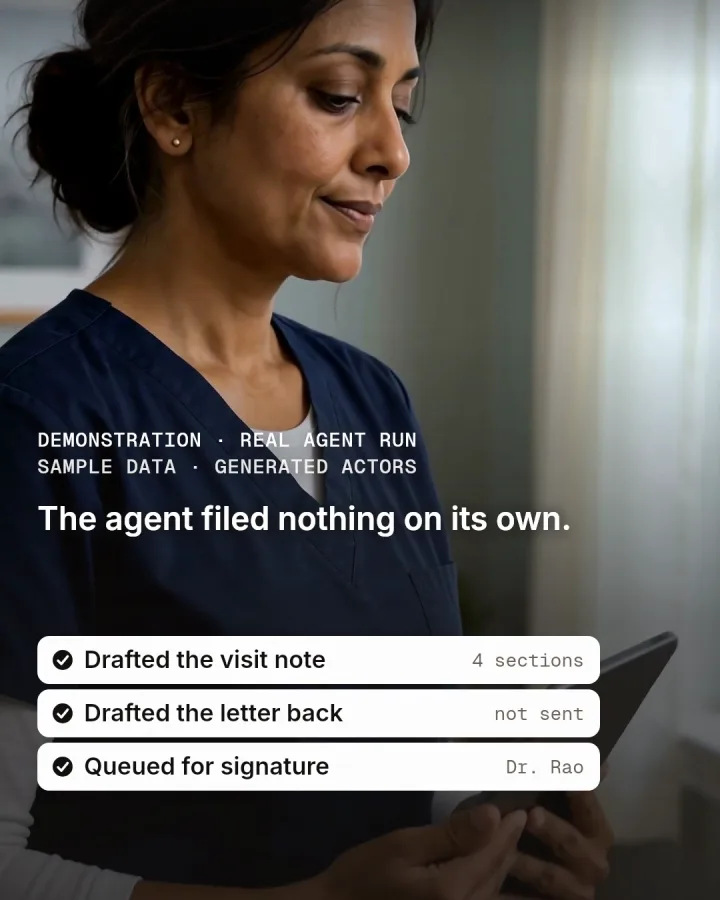
FactoryJet builds AI agents that draft clinical notes and referral letters for specialist clinics. The agent reads the referral, the last visit and the medication list, drafts the note under your headings, flags where the referral and the patient disagree, and queues every draft for the doctor's signature. It files nothing on its own.
Need an AI that answers the phone and books visits? See healthcare AI agents.
What an AI Medical Scribe Agent Is, and Why Specialists Need the Letter Too
An AI medical scribe agent listens to a consented visit, reads the patient's records, and drafts the clinical note and the referral letter for the doctor to review and sign. An ordinary AI scribe writes the note from the conversation. Also called an ambient AI medical scribe or an AI-powered medical scribe, it works in the background of the visit. The agent version adds three jobs:
- Reads the records before it writes: referral, last visit, medication list
- Checks the referral against what the patient said, and flags any mismatch
- Drafts the letter back to the referring doctor, next to the AI clinical note
Ambient AI scribes are already in daily use at scale. The AMA reported that 7,260 Permanente Medical Group physicians used them across 2,576,627 patient encounters in 63 weeks, with cuts in note time and in "pajama time", the charting doctors do after hours. AMA, 12 June 2025 ↗
AI scribes still miss things, so the doctor has to stay the last check. A 2025 review of 18 studies reported frequent omissions and occasional clinically significant hallucinations. Our agent quotes its sources when it flags a conflict, and it cannot file a note or send a letter. Narrative review on PMC ↗
US searches for "ai medical scribe" run at about 5,400 a month, with clicks bid at about $40. That is our own DataForSEO measurement for the US on 18 October 2026. Searches naming orthopedics were too few to measure, which is one reason this page shows a full orthopedic run instead of a feature list.
Pajama Time
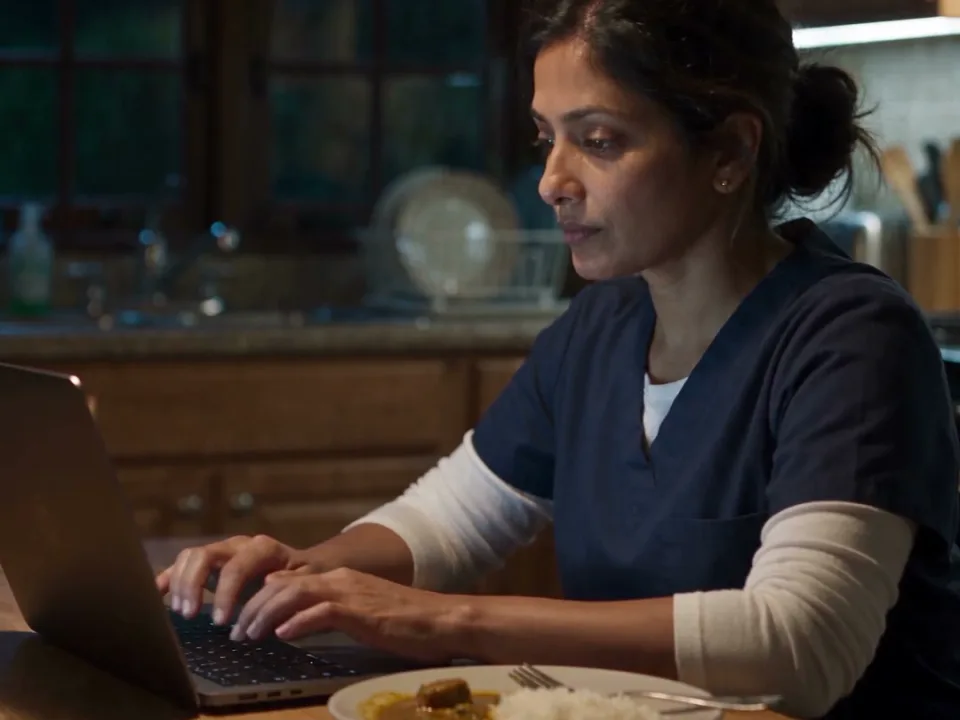
Pajama time is the charting doctors do outside clinic hours: notes, orders and letters finished at home after the last patient. The AMA calls clinical documentation a leading contributor to physician burnout, and pajama time is where that work lands.
Our film opens on it: 9:40 pm, eighteen notes still to write. That scene is a dramatisation; the agent run below is real, on a sample visit.
Three Things the Referral Got Different, Flagged and Left for the Doctor
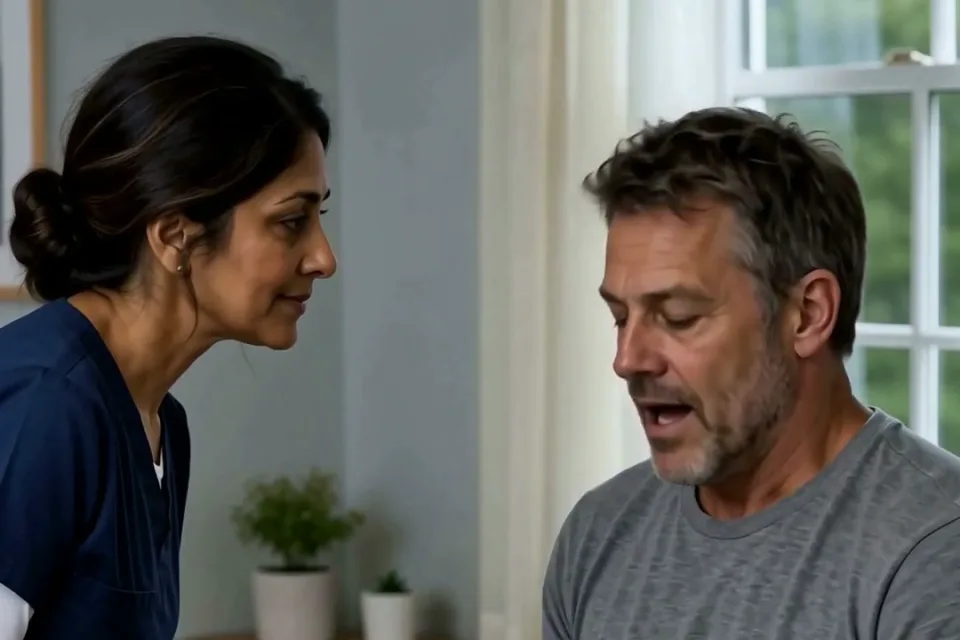
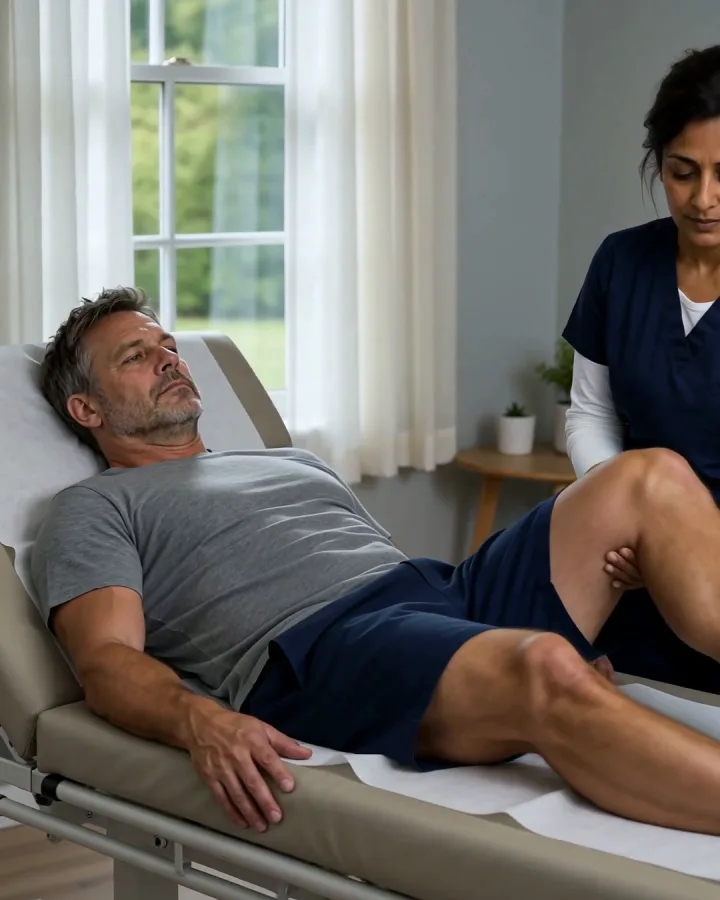
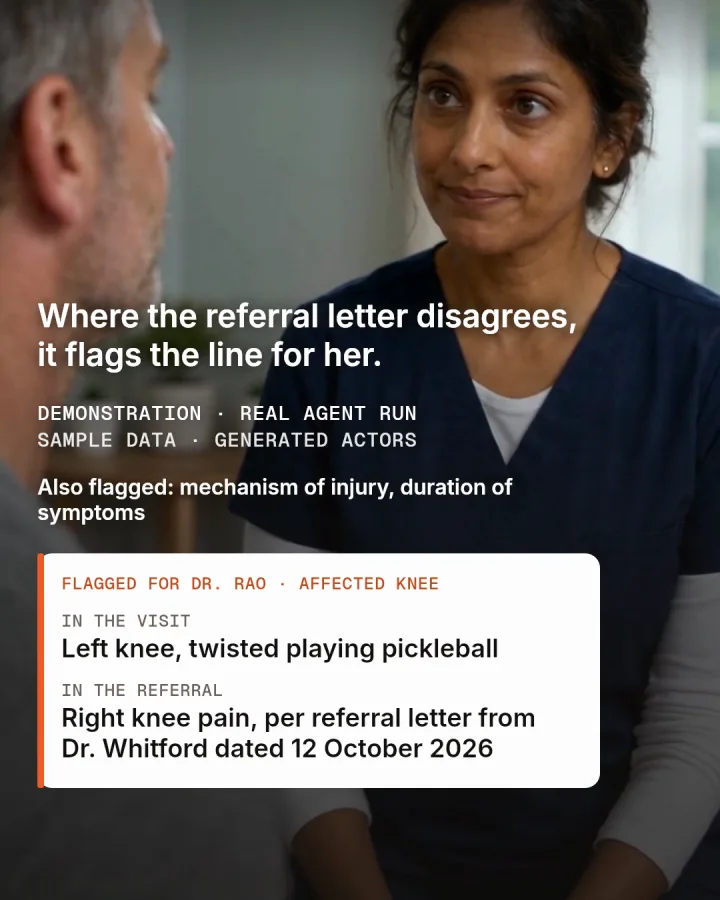
A sample orthopedic visit: a 52-year-old man referred by his family doctor for knee pain. The agent compared the referral, last visit and medication list with what he said in the room. Its three flags, word for word:
| Field | Said in the visit | Says in the record | Agent's decision |
|---|---|---|---|
| Affected knee | Left knee, twisted playing pickleball | Right knee pain, per referral letter from Dr. Whitford dated 12 October 2026 | None. Flagged for the doctor |
| Mechanism of injury | Twisted playing pickleball | Fall at home, per referral letter from Dr. Whitford dated 12 October 2026 | None. Flagged for the doctor |
| Duration of symptoms | About ten days ago | Six week history, per referral letter from Dr. Whitford dated 12 October 2026 | None. Flagged for the doctor |
From one recorded run of the agent on 18 October 2026. The clinic, doctor, patient and referral are sample data, and one run on one visit does not measure accuracy. That comes from testing on your own past visits.
The AI Clinical Note It Drafted, Under the Clinic's Four Headings
The sample clinic's headings were Reason for visit, History, Examination and Plan. The agent read them from the clinic's settings, wrote the note in that order, and saved it with the status "draft saved, not filed".
| Heading | Draft text, as written by the agent |
|---|---|
| Reason for visit | Mr Daniel Price, born 3 March 1974, presents with left knee pain following a twisting injury while playing pickleball approximately ten days ago. He reports swelling, catching on stairs, and two episodes of locking requiring manipulation to straighten. |
| History | Swelling developed by the evening of the injury and has partially resolved. The patient is taking ibuprofen most days and Lisinopril 10 mg once daily for blood pressure. |
| Examination | Swelling noted on the medial aspect of the left knee with tenderness along the medial joint line. Range of motion is full extension to approximately 110 degrees of flexion, McMurray's test is painful medially, and ligaments are stable. |
| Plan | Dr Rao suspects a medial meniscus tear and has requested an MRI of the left knee. The patient is to commence physiotherapy, continue ibuprofen with food, avoid pickleball, and return in two weeks with the scan result. |
It also drafted a letter to the referring doctor at the sample family practice, with the findings, the suspected medial meniscus tear, the MRI requested and the plan, saved as "draft saved, not sent". Both drafts were then queued with the status "waiting for Dr. Rao to review and sign".

Virtual Medical Scribe vs AI Scribe App vs a Note-Drafting Agent
| Option | Who writes the draft | Reads the referral and records | Best for |
|---|---|---|---|
| Human or virtual medical scribe a person | A trained scribe, in the room or remote | If you give them chart access and time | Practices that want a person who can ask the doctor questions |
| AI medical scribe software subscription app | The app, from the visit conversation | Varies by product; ask for a demo on a referred patient | Clinicians whose main paperwork is the visit note |
| EHR built-in ambient notes already in your EHR | Your EHR vendor's AI feature | Inside that EHR's own records | Practices whose EHR offers it and whose notes fit its templates |
| Custom note-drafting agent This page | An agent built around your clinic's workflow | Yes: referral, last visit and medication list in our sample run, with mismatches flagged | Referral-based specialist clinics with their own headings and letters |
If a subscription app or your EHR's own feature covers your notes, buy that first. We build when the job crosses documents: referral in, note, letter out.
The AI Scribe Apps US Doctors Search For by Name
If you are comparing the best AI medical scribe options, these are the products people look up most. Monthly US searches are our DataForSEO measurement from 18 October 2026. We have not tested these products; ask each one the seven questions below.
| Product | What people type | US searches a month |
|---|---|---|
| Freed | freed ai | 110,000 |
| Abridge | abridge | 33,100 |
| Nabla | nabla | 9,900 |
| Heidi Health | heidi health | 6,600 |
| Microsoft DAX Copilot | dax copilot | 2,900 |
| Suki | suki ai | 2,900 |
| DeepScribe | deepscribe | 2,400 |
"Abridge" and "nabla" are also ordinary words, so part of their volume is not about the products. For scale, "ai medical scribe" gets about 5,400 a month.
What the Note-Drafting Agent Does, Step by Step
Reads the Chart Before It Writes
Before drafting, the agent pulls the referral letter, the patient's last visit and the medication list. In the sample run that meant a family doctor's referral, a 2024 shoulder visit and two medications.
Drafts Under Your Headings
The note follows the clinic's own headings, read from the clinic's settings. The sample clinic used Reason for visit, History, Examination and Plan; a SOAP practice gets Subjective, Objective, Assessment and Plan.
Drafts the Letter Back
From the same visit it drafts the reply to the referring doctor: findings, suspected diagnosis, tests ordered and plan, addressed to the referrer named in the incoming letter.
Flags Mismatches, Decides None
When the visit and the record disagree, the agent records both versions with the source and date, and leaves the call to the doctor. In the sample run it flagged three: the knee, the cause and the duration.
Files Nothing on Its Own
The note is saved as a draft and not filed. The letter is saved as a draft and not sent. Both go to the doctor's signature queue, and the signature is the only way out.
Tested on Your Past Visits
Before any doctor relies on it, the agent drafts notes for a set of your past visits and your clinicians score them against what they actually signed. It is re-scored after every model or template change.
Open the page ↗What a Note-Drafting Agent Build Includes, Item by Item
Four groups, 24 items. Ask any AI medical documentation vendor for a list this specific, us included.
Your clinic, written down
The agent can only follow rules someone has written down.
6 items- Note headings in your order, from your own templates
- Letter templates for the referral reply and any other letter you send often
- Specialty terms and exam findings your doctors expect to see written out
- Records to read: referral, last visit, medication list, and anything else you name
- Fields to cross-check between the referral and the visit, such as side, cause and duration
- Consent wording set by your counsel, recorded with each visit
The agent itself
Its tools decide what it can and cannot do.
6 items- Read-only record tools for the referral, last visit and medication list
- A draft tool that saves the note and the letter as drafts
- A flag tool that records the field, what was said and what the record says, with its source
- A signature-queue tool as the last step of every run
- No filing or sending tool, so a draft cannot leave without the doctor
- A run log of every tool the agent called and what came back
Testing before go-live
One demo is not evidence. Your own visits are.
6 items- A test set of past visits of the types you see most
- Clinician scoring of each draft against the note that was actually signed
- A pass mark agreed with you before the build is called finished
- Missed-detail checks, since AI scribes are known to omit things
- Mismatch cases planted in test referrals to prove the flags fire
- Re-scoring after every model, template or heading change
Handover and ownership
The agent should outlive any one vendor.
6 items- Code in your repository and running in accounts you control
- Prompts, templates and test visits handed over with the code
- Plain-English docs for the next developer
- Defect cover for a stated period inside the build price
- Changes approved per request, with no monthly minimum
- Model layer kept swappable, so a better model is a configuration change
Next step
See it draft one of your notes
Tell us your specialty and the note you write most. We set the agent up on a sample visit of that type, with your headings, and you watch it draft, flag and queue for signature before you sign anything.
7 Questions to Ask Before Any AI Scribe Writes in Your Charts
Ask them of every vendor, us included.
- 01
Does anything reach the chart without a signature?
Ask the vendor to show the exact state of a draft before and after the doctor signs. "Saved, not filed" should be visible on screen.
- 02
Does it read the referral, or only the room?
A specialist note that ignores the referral letter will miss the left-knee, right-knee kind of conflict our sample run caught.
- 03
What does it do when the patient and the record disagree?
The right answer is a flag that quotes both sides with a source. A wrong answer is the tool quietly picking one.
- 04
Can it use our headings and our letter style?
If the note comes out in someone else's template, the doctor rewrites it, and the time saved goes back into editing.
- 05
How was it tested on visits like ours?
Ask for results on your specialty, scored by clinicians. A review of 18 studies found omissions were frequent in ambient AI scribes.
- 06
Who touches the patient data, and is each one under a BAA?
HHS treats a vendor handling protected health information for a practice as a business associate. Subcontractors count too.
- 07
Can we see it draft one of our notes before we sign?
A demo on your own note type, with sample or de-identified data, tells you more than any feature list.
From First Call to the Agent Drafting Your Real Notes
- 01
Scope
Your specialty, the note and letter types you write most, your headings and your EHR. We say plainly if a ready-made AI scribe would do.
- 02
Demo
The agent drafts one of your note types on a sample or de-identified visit, flags mismatches and queues for signature. You see it before you sign.
- 03
Test visits
Your clinicians score drafts for a set of past visits against what they signed. We agree the pass mark with you first.
- 04
Connect & pilot
Once your compliance lead approves, the agent's tools are connected to your EHR and one doctor pilots it with the signature step in place.
- 05
Roll out & re-test
More doctors and letter types, with the same test visits re-scored after every model or template change.

How the Agent Stays Inside the Doctor's Control
Drafts only, signed by the doctor
The agent has no tool that files a note or sends a letter. It can save a draft and add it to the doctor's signature queue, and that is where its job ends.
Conflicts are shown, never settled
When the record and the visit disagree, the flag quotes both and names the source and date. AI scribes are known to omit details, so the doctor sees the conflict before signing. Review ↗
Business associate terms before real data
HHS treats a vendor handling protected health information for a practice as a business associate. Demos use sample or de-identified data; real patient data waits for the agreements your compliance lead requires. HHS ↗
The patient agrees to the recording
Recording rules differ by state. The demo visit opens with the patient agreeing to the recording for the note, and your counsel sets the consent wording for your clinic.
When You Do Not Need a Custom AI Scribe Agent
A built agent is the right answer for some clinics and the wrong one for many.
- 01
Your paperwork is the visit note
Do this insteadTrial two or three AI scribe appsIf you write standard notes and few letters, a subscription AI medical scribe is quicker to start. Test each on your own visits.
- 02
Your EHR already has ambient notes
Do this insteadTurn on the built-in feature firstSome EHR vendors now include an ambient AI note feature. If it fits your templates, set it up well and build only for the gap, such as referral letters.
- 03
You have no consent process yet
Do this insteadSet the consent wording firstNo AI scribe of any kind should listen to a visit until your counsel has set how and when patients are asked.
- 04
The bottleneck is the phone
Do this insteadLook at a phone and scheduling agentIf missed calls and booking hurt more than charting, a different agent answers, books and logs calls. That one stays out of clinical notes.
What Else Ranks for "AI Medical Scribe", and How This Page Differs
Business sites on Google's US first page for "ai medical scribe", "ai scribe for orthopedics" and "ai medical scribe for specialists" on 18 October 2026 (DataForSEO), with each site's referring domains. We have not tested their products.
| Site | Page title shown in Google | Referring domains |
|---|---|---|
| athelas.com | AI Medical Scribe: What Is It and Why Is It a Necessity? | 2,709 |
| medwriter.ai | Medwriter: The Best AI Medical Scribe | 160 |
| athenahealth.com | Ambient Notes AI Medical Scribe | 15,678 |
| sully.ai | AI Medical Scribe | AI Scribe - Sully | 889 |
| deepscribe.ai | DeepScribe AI Medical Scribe | Built for Specialty Care | 1,471 |
| skriber.com | AI medical scribe for Orthopedic surgeons | 1,779 |
| modmed.com | Reimagining Orthopedic & Pain Documentation With AI | 4,408 |
| heidihealth.com | Best AI Medical Scribes 2026 [Updated] | 4,932 |
Most of these pages sell a scribe app. This one shows a full agent run, word for word, and says when an app is the better buy.
AI Medical Scribe Questions, Answered Directly
24 questions doctors and practice managers ask about AI scribes and note-drafting agents, many taken from Google's People Also Ask boxes on 18 October 2026.
Q01What is an AI scribe?
An AI scribe is software that listens to a patient visit, with the patient's consent, and writes a draft of the clinical note for the doctor to check and sign. An AI medical scribe agent goes a step further: it also reads the patient's records, such as the referral letter and medication list, and can draft other documents, like the letter back to the referring doctor.
Q02What does ambient mean in medical terms?
Ambient means the software works in the background of a normal visit. The doctor talks to the patient as usual and the tool listens, instead of the doctor typing or dictating. Ambient clinical documentation is the name for notes produced this way, and the tool is often called an ambient scribe. The doctor still reviews and signs every note before it enters the chart.
Q03What is AI clinical documentation?
AI clinical documentation is any use of AI to write or prepare clinical paperwork: visit notes, SOAP notes, referral letters, discharge summaries and follow-up letters. Most products focus on the visit note, whether they sell themselves as an AI note taker for doctors or as AI medical note taking. The useful test for any of them is simple: does the doctor end up with an accurate draft faster than typing it, and does anything get filed without the doctor seeing it?
Q04Is AI replacing medical scribes?
In many practices it is taking over the typing part of the job. A human or virtual medical scribe still brings judgment an app does not, such as asking the doctor about something unclear. The Permanente Medical Group reported 7,260 physicians using ambient AI scribes across 2,576,627 patient encounters in 63 weeks, which shows how fast the shift is moving in large groups. AMA, 12 June 2025 ↗
Q05How is AI being used for clinical notes today?
The most common use is ambient AI scribes that draft the visit note from the conversation. In the Permanente Medical Group rollout the AMA reported, 84% of physicians said it helped their communication with patients and 82% said their work satisfaction improved. AI charting of notes, letters and chart summaries comes first because that work eats the hours after clinic that doctors call pajama time. AMA report ↗
Q06What did the note-drafting agent do in your demo?
On one recorded sample visit it read the referral letter, the patient's last visit and the medication list. It drafted the visit note under the sample clinic's four headings: Reason for visit, History, Examination and Plan. It drafted a letter back to the referring doctor. It flagged three places where the referral disagreed with the visit, filed nothing, and queued both drafts for the doctor's signature.
Q07What were the three referral mismatches it flagged?
The referral letter said right knee; the patient said left knee. The referral said a fall at home; the patient said he twisted it playing pickleball. The referral said a six week history; the patient said about ten days. The agent recorded both versions of each line for the doctor and decided none of them. Choosing which is right is a clinical call.
Q08Does the AI file notes or send letters on its own?
No. In the recorded run the note was saved as a draft and not filed, the letter was saved as a draft and not sent, and both were queued for the doctor to review and sign. We build every note-drafting agent this way: the doctor's signature is the only route from a draft into the chart or out to another practice.
Q09Can an AI scribe write a referral letter?
Yes. In our sample run the agent drafted the reply to the referring family doctor from the same visit: findings, the suspected diagnosis, the scan requested and the plan. It used the referrer's name and practice from the medical referral letter it had read. The letter stayed a draft until the doctor signed it, the same as the note.
Q10Can it write SOAP notes instead of our own headings?
It writes under whatever headings the clinic uses. In the demo the sample clinic's headings were Reason for visit, History, Examination and Plan, and the agent read them from the clinic's settings before drafting. A practice that uses Subjective, Objective, Assessment and Plan would get AI SOAP notes in that order instead. Headings are clinic data, not code.
Q11What happens when the patient and the record disagree?
The agent flags the line and leaves it for the doctor. Each flag names the field, quotes what was said in the visit, and quotes what the record says with its source and date. In the demo that meant the referral from the family practice dated 12 October 2026. The draft note follows what was said in the room; the flag makes sure the doctor sees the conflict before signing.
Q12Is there an AI scribe for orthopedics?
Several AI scribe products sell an orthopedic scribe template, and some EHRs built for orthopedics ship their own AI note features. What orthopedic clinics often need on top is the referral side: checking the incoming letter against the visit, and drafting the reply. That is the job our demo agent was built for, on a sample knee visit, with the orthopedic exam findings written into the Examination heading.
Q13Why do specialist clinics need more than a generic AI scribe?
Specialists work from referrals. Every new patient arrives with a letter from another doctor, and every visit ends with a letter back. A generic scribe listens to the room. A specialist clinic also needs the referral read, the mismatches caught, and the reply drafted in the clinic's own style. The note is half the paperwork; the letters are the other half.
Q14Which specialties can a note-drafting agent work for?
Orthopedics is where we started because the demo visit was a knee. The same pattern fits any referral-based specialty with set exam findings and set letters: sports medicine, pain clinics, cardiology, dermatology, ENT and neurology among them. Each specialty gets its own headings, its own letter template and its own test visits before any doctor relies on it.
Q15Will it understand orthopedic exam terms?
In the sample run it turned the spoken exam into chart language: tenderness along the inner joint line became medial joint line tenderness, and the doctor's words on bending became full extension to about 110 degrees of flexion, with McMurray's test painful medially. For your clinic we test this on your own past visits and specialty terms before go-live.
Q16Do I need patient consent for an AI scribe?
Plan on asking every time. Recording laws differ by state, and some states require every person in a conversation to agree to a recording. Many practices ask at check-in and again at the start of the visit. In our demo the visit opens with the patient agreeing to the recording for the note. Your counsel should set the wording for your state.
Q17Is an AI scribe HIPAA compliant?
No software is HIPAA compliant on its own label. Under HIPAA, a vendor that creates, receives, keeps or sends protected health information for a practice is a business associate, and the practice needs a business associate agreement (BAA) with it. Ask any AI scribe vendor, us included, which of their subcontractors touch patient data and whether each one is covered. HHS: business associates ↗
Q18Can AI scribes get things wrong?
Yes. A 2025 narrative review of 18 studies found ambient AI scribes cut documentation burden, but also reported frequent omissions and occasional clinically significant hallucinations, meaning content that was never said. That is why our agent quotes its sources on every flag and why nothing reaches the chart without the doctor's signature. Narrative review on PMC ↗
Q19Where does the patient data go during a demo?
The demo runs on sample or de-identified material: a made-up clinic, patient and referral, like the one in our film. Real patient data does not reach the agent until your compliance lead has approved where it is processed and stored, and the agreements they require, including a BAA, are signed.
Q20Which AI medical scribe is the best?
It depends on the paperwork you need. For a single clinician writing standard visit notes, a ready-made AI scribe for doctors, sold as a subscription, is usually the quickest fit. Clinics that live on referrals, with their own headings, letter style and records to check, often need an agent built around that workflow. Test any option on ten of your own past visits before you choose.
Q21How much does an AI scribe cost?
Ready-made AI medical scribe software is usually sold as a monthly subscription per clinician; check each vendor's current price page. A custom note-drafting agent is a build project with a fixed price per phase, quoted after a short scoping call, and you see it draft one of your notes before you sign anything.
Q22Should we buy an AI scribe app or have an agent built?
Buy if the app covers your notes and your EHR already connects to it; that is the simplest way to start using AI for clinical notes. Build when the job crosses documents: reading the referral, checking it against the visit, drafting the letter back, and following the clinic's own headings. A built agent is code you own and can extend to the next letter type without waiting for a vendor roadmap.
Q23Does it work with our EHR?
In the demo the agent's tools read from a sample clinic record. For a real clinic those same tools are connected to your EHR or document system, through its official API where one exists, and the connection is scoped and tested per clinic. Tell us your EHR on the first call and we will say plainly what it allows.
Q24How do we see it draft one of our notes?
Send the form on this page with your specialty and the note or letter type you write most. We set up a demo on a sample or de-identified visit of that type, using your headings and letter style, and you see the agent draft it, flag any mismatches and queue it for signature. That happens before any contract.
Tell Us the Note You Write Most
Send your specialty, your note headings and the letter you send after a referral. We will show the agent drafting one on a sample visit before you sign, then put a fixed price per phase in writing.