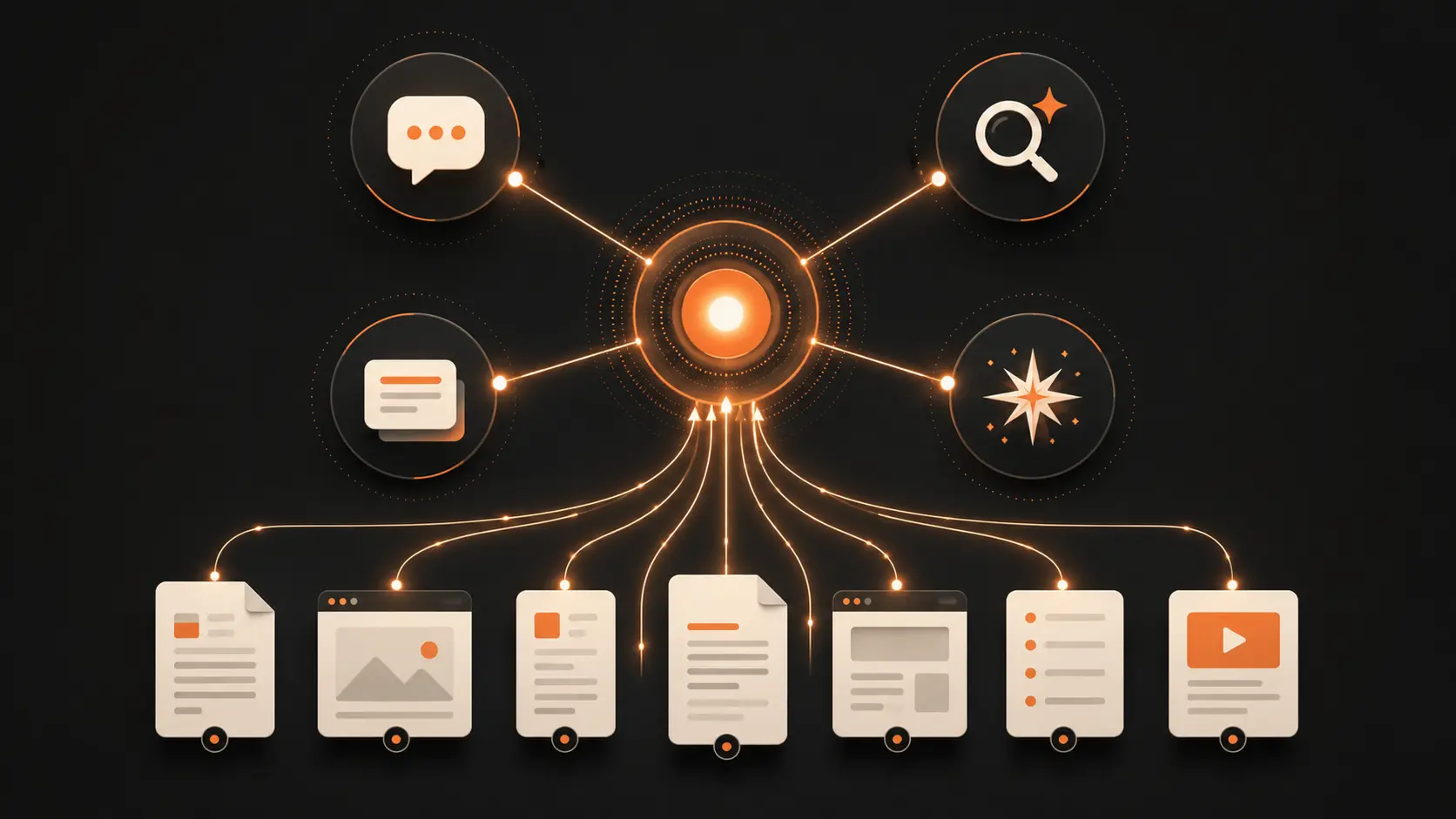
"Generative AI creates content. Agentic AI takes action. Here is the plain-English difference, with real examples, a side-by-side comparison, and what it actually means for your business in 2026."
Key Takeaways
- 1Generative AI creates content: text, images, code, or answers. Agentic AI takes action to complete a goal. In one line: generative AI writes the answer, agentic AI goes and does the thing.
- 2They are not rivals. Most agentic systems use a generative model as their brain, wrapped in tools, memory, and a plan-act-check loop. Generative AI supplies the intelligence; agentic AI supplies the hands.
- 3An AI agent is a single system that acts toward a goal. Agentic AI is the broader approach, often several agents and tools working together, so an agent is one worker and agentic AI is the way of working.
- 4Generative examples: drafting an email, making an image, suggesting code. Agentic examples: booking the trip end to end, resolving a support ticket, or buying a product for you.
- 5The business shift is from AI that suggests to AI that does, which is where the real time savings and ROI are moving in 2026.
- 6You do not pick one. You use generative AI to create and agentic AI to execute. In ecommerce, that execution layer is what people call agentic commerce.
What this guide covers
- What generative AI is, in plain English
- What agentic AI is, and how it differs
- Agentic AI vs generative AI: a side-by-side comparison
- Is agentic AI the same as an AI agent?
- Real examples of agentic AI
- How the two work together
- What it means for your business
The short version: generative AI creates content, and agentic AI takes action. Generative AI writes you an email, drafts an image, or suggests code when you ask. Agentic AI sets a goal, makes a plan, uses tools, and completes a multi-step task with little supervision, like actually booking the trip or placing the order. Most agentic systems use a generative model inside them, so they are not rivals. They are layers, and 2026 is the year the action layer went mainstream. Here is the difference in plain English, with examples you can point to.
What is generative AI?
Generative AI is software that creates new content from a prompt. You describe what you want, and it produces text, an image, audio, or code. Under the hood, it works by predicting what should come next, the next word, the next pixel, based on patterns it learned from enormous amounts of data. That is why a chatbot can write a coherent paragraph and an image model can render a photo that never existed.
You already use it. ChatGPT drafting a reply, Midjourney or an image tool making a picture, GitHub Copilot suggesting the next few lines of code, these are all generative AI. It is genuinely useful, and it changed how fast we can produce a first draft of almost anything.
But notice the ceiling: generative AI suggests, and then you act. It writes the email, and you send it. It drafts the code, and you test and ship it. It hands you an output and waits. That gap between a good draft and a finished job is exactly where agentic AI comes in.
What is agentic AI?
Agentic AI is software that takes action to complete a goal, not just generates content. Give it an outcome, and it plans the steps, uses tools and APIs, checks its own work, and carries the task through with limited supervision. Instead of handing you a draft, it does the job.
The way it works is a loop rather than a single reply: understand the goal, make a plan, take a step, look at the result, adjust, and repeat until the task is done. Along the way it can call a calendar, search the web, run code, query a database, or complete a checkout. The generative model is the brain that reasons about what to do next, and the agentic scaffolding, memory, tools, and that plan-act-check loop, is what gives the brain hands.
So where generative AI drafts the email, agentic AI reads the thread, decides who to reply to, writes the response, books the meeting it mentions, and adds it to your calendar. It is the difference between an assistant that suggests and a worker that does. For a fuller definition with examples, see what is agentic AI.
Agentic AI vs generative AI: the key differences
| Dimension | Generative AI | Agentic AI |
|---|---|---|
| What it does | Creates content | Completes tasks |
| What you get | A draft, answer, or image | An action taken, a result |
| Autonomy | Waits for your next prompt | Pursues a goal across steps |
| Uses tools and APIs | Rarely, on its own | Yes, that is the point |
| Your role | You act on its output | You set the goal and approve key steps |
| Example | Write an email | Send the email and book the meeting |
One line to remember it by: generative AI writes the answer, agentic AI goes and does the thing.
Wondering what agentic AI means for your store?
The action layer is already reshaping how people buy. See how agentic AI is turning into agentic commerce, and whether your brand is ready for AI agents that discover and check out on their own.
Read the agentic commerce guide →Is agentic AI the same as an AI agent?
Close, but not the same, and the two terms get mixed up constantly. An AI agent is a single system that perceives its situation, decides what to do, and acts toward a goal. Agentic AI is the broader capability, the whole approach of getting real work done autonomously, often with several agents and tools working together.
The clean way to hold it: an AI agent is one worker, and agentic AI is the way of working, a distinction we break down in agentic AI vs AI agents. A customer-support agent that resolves a ticket is an AI agent. A system where a planner agent coordinates a research agent and a checkout agent to complete a purchase is agentic AI at work. If you want the deeper dive on where all of this is heading in commerce, we cover it in our agentic commerce guide, and we build these systems as part of our AI agent development work.
Real examples of agentic AI
The fastest way to feel the difference is to look at what agentic AI actually does. A few examples that are real in 2026, not science fiction:
- Coding agents that read a bug report, edit several files, run the tests, and open a pull request, instead of just suggesting a snippet.
- Customer-support agents that read a ticket, check the order in your system, issue the refund, and reply to the customer end to end.
- Shopping and travel agents that take a request like find me a flight under three hundred dollars, compare options, and complete the booking or purchase.
- Operations agents that reconcile data between systems, chase the exceptions, and flag only what a human needs to see.
- Commerce agents that list products, adjust pricing, and keep inventory in sync across your store and marketplaces without someone doing it by hand.
Notice the pattern: each one finishes a multi-step job. That is the tell. If the AI hands you something to act on, it is generative. If it acts, it is agentic.
How generative and agentic AI work together
Here is the part most head-to-head articles miss: this is not a fight. Agentic AI is built on top of generative AI. The generative model is the reasoning engine, the part that reads a goal, thinks through the steps, and writes the plan. The agentic layer gives that engine memory, tools, and permission to act, then runs it in a loop until the work is done.
In practice you use both, often in the same task. You lean on generative AI to draft the product description, the ad, or the code. You lean on agentic AI to publish it, launch it, or ship it across every channel. The smart question in 2026 is not which one to use. It is where you still want a human to create and decide, and where you are ready to let an agent execute.
What agentic AI means for your business
The reason this distinction matters is money and time. For two years, most AI value came from generating things faster: quicker copy, quicker images, quicker code. That is real, but it caps out, because a human still has to act on everything the model produces. Agentic AI moves the value from suggesting to doing, and completed tasks are worth far more than faster drafts.
In ecommerce, that execution layer has a name: agentic commerce, where AI agents discover products, compare options, and check out on a shopper behalf, and where your own agents keep your catalog, pricing, and inventory accurate across channels. It is the same shift, applied to buying and selling. If that is where your business lives, it is worth understanding early, which is exactly why we wrote the agentic commerce field guide and built Commerceflo by FactoryJet, our AI commerce operator, to put agentic AI to work across a store.
The takeaway is simple. Generative AI made everyone faster at creating. Agentic AI is about to make software actually do the work. Understand the difference now, decide where you want agents acting for you, and you will be ready for the part of AI that changes how business gets done, not just how fast content gets made.
Free assessment
Find Out if an AI Agent Can Take the Task
Name one task your team repeats every day. We tell you whether an agent can do it or whether a tool you can buy already does, and we build a demo on your own sample files before you sign.
Frequently Asked Questions
What is the difference between agentic AI and generative AI?
Is agentic AI better than generative AI?
What is an example of agentic AI?
Is agentic AI the same as an AI agent?
What is generative AI in simple terms?
Does agentic AI use generative AI?
Is ChatGPT agentic AI or generative AI?
What are the risks of agentic AI?
How do businesses use agentic AI?

Bhavesh Barot
Founder & CEO
Founder & CEO of FactoryJet, an ecommerce and AI services company that has served 500+ businesses across the US, UK, UAE, and India. Writes about ecommerce builds, AI agents, and AI search.
Related reading
- Agentic AI vs AI Agents: What Is the Difference?An AI agent is one worker. Agentic AI is the whole way of getting autonomous work done. Here is the difference in plain English, with examples and why it matters once you are building or buying.
- The 10 Best GEO (Generative Engine Optimization) Agencies for Ecommerce & SMBs (2026)ChatGPT, Perplexity, and Claude now answer buying questions directly, without sending users to Google. GEO is the discipline of getting your brand cited in those answers. Most GEO agencies on the market serve enterprise SaaS. Here is who actually works with ecommerce stores and small businesses.
- Generative Engine Optimization (GEO): The 2026 GuideGenerative engine optimization is how you get cited by ChatGPT, Google AI Overviews, Perplexity, and Gemini. A plain-English guide to what GEO is, how it differs from SEO, how AI engines choose sources, and a 7-step playbook to start.