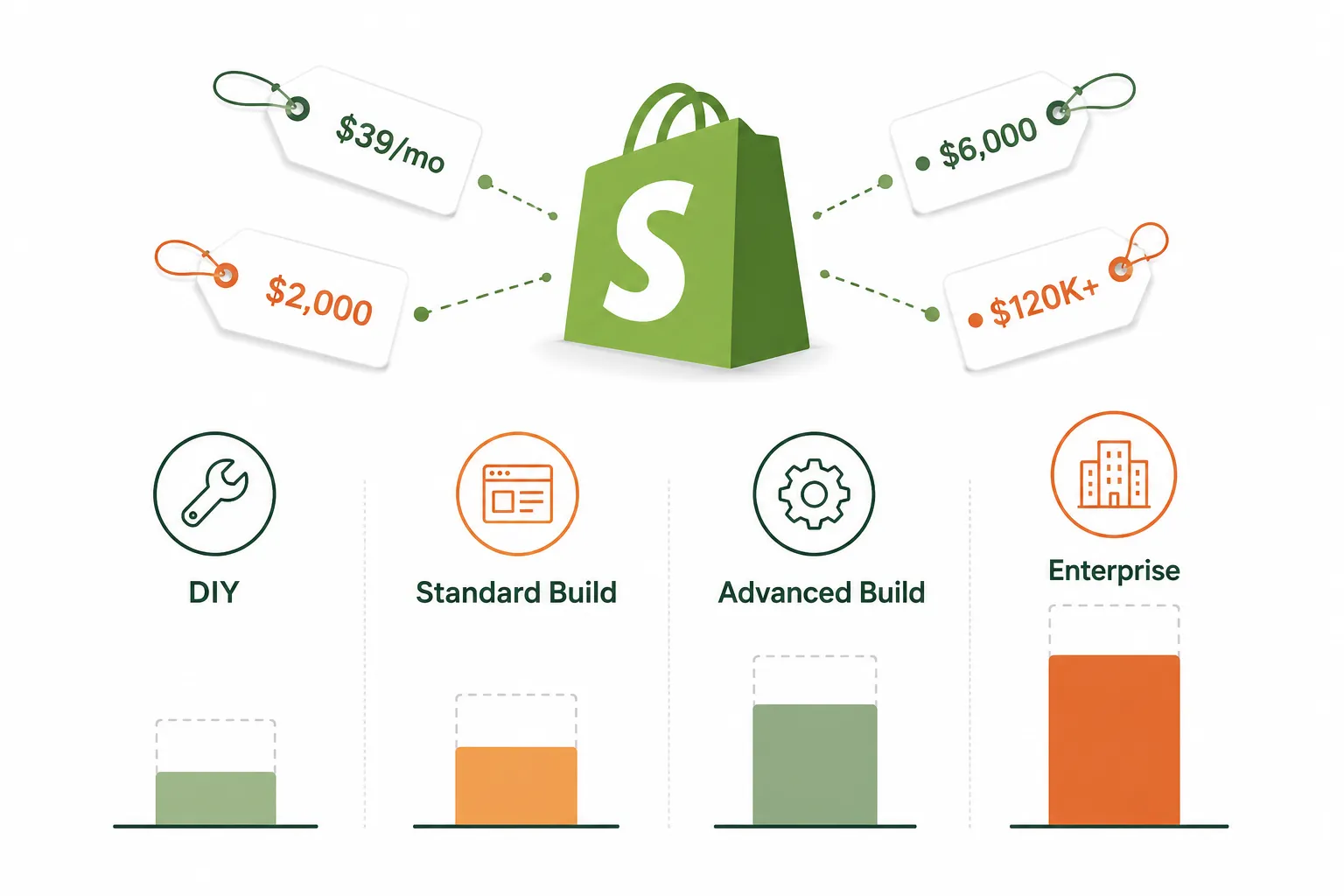
"UK SMBs can launch a professional Shopify store in 2-4 weeks for £2,000-£8,000, with ongoing costs of £100-£300/month. This guide covers setup, payment integration, UK compliance, and scaling strategies that work for businesses from Manchester to Brighton."
Key Takeaways
- 1Professional Shopify stores for UK SMBs cost £2,000-£8,000 to build and £100-£300/month to maintain, with 2-4 week delivery timelines when working with experienced agencies.
- 2UK-specific requirements include GDPR compliance, ICO registration, Royal Mail and DPD integration, Stripe/PayPal setup with UK merchant accounts, and VAT handling for domestic and EU sales.
- 3Shopify's 2026 platform includes native AI product recommendations, enhanced mobile checkout (converting 15-20% higher than desktop), and built-in multi-currency support for international expansion.
- 4Post-launch scaling requires conversion rate optimisation (targeting 2-4% for new stores), email marketing automation (recovering 8-12% of abandoned carts), and strategic SEO for product and collection pages.
- 5Working with FactoryJet delivers 50-60% cost savings versus typical UK agency pricing while maintaining Lighthouse performance scores of 92+ and 98% client satisfaction across 500+ projects.
- 6The first 90 days determine long-term success: focus on mobile experience (70% of UK e-commerce traffic), fast checkout (under 3 clicks), and trust signals like reviews, secure payment badges, and clear return policies.
Table of Content: In This Article
- Why UK SMBs Choose Shopify in 2026
- Shopify Store Development Costs and Timeline for UK Businesses
- UK-Specific Setup Requirements: Compliance, Payments, and Shipping
- Shopify vs WooCommerce vs Custom: Which Platform Fits Your UK Business?
- Post-Launch Scaling: From First Sale to £100K/Month
- How FactoryJet Delivers Shopify Stores on a Fixed, Up-Front Price
- Common Shopify Mistakes UK SMBs Make (and How to Avoid Them)
UK SMBs can launch a professional Shopify store in 2–4 weeks for £2,000–£8,000, with ongoing costs of £100–£300 monthly for maintenance plus £25–£384 for Shopify's subscription. The platform handles hosting, security, and payment processing automatically, making it ideal for businesses without technical teams. Essential features include GDPR compliance, UK payment integration through Stripe or PayPal, and shipping setup for Royal Mail or DPD.
Why UK SMBs Choose Shopify in 2026
Shopify has become the platform of choice for UK SMBs in 2026 because it removes technical barriers while delivering enterprise-grade e-commerce capabilities at SMB-friendly pricing. The managed hosting infrastructure handles security patches, SSL certificates, and server maintenance automatically, freeing business owners to focus on product development and customer acquisition rather than wrestling with WordPress plugins or server configurations. Payment processing through Shopify Payments accepts all major UK methods: Visa, Mastercard, Apple Pay, Google Pay, and Shop Pay, with transaction fees between 1.5% and 2% depending on plan tier. This built-in solution eliminates the complexity of integrating third-party payment gateways while keeping processing costs competitive with standalone providers like Stripe or PayPal. Mobile optimisation delivers measurable business impact. Shopify's native responsive themes produce conversion rates 15-20% higher on mobile devices compared to desktop-first platforms retrofitted for mobile. With mobile traffic accounting for 70% of UK e-commerce sessions in 2026, this performance advantage translates directly to revenue. The Shopify App Store provides over 8,000 pre-built integrations for email marketing (Klaviyo, Omnisend), customer reviews (Judge.me, Yotpo), loyalty programs (Smile.io, LoyaltyLion), and shipping automation (ShipStation, Shippo). SMBs can add sophisticated functionality without custom development budgets or lengthy implementation timelines. Scalability matters for growing businesses. Shopify's architecture supports companies from first sale through £1 million+ annual revenue without requiring platform migration. Upgrading from Basic to Shopify or Advanced plans takes minutes, not months, and preserves all existing data, customer accounts, and SEO equity. This continuity eliminates the re-platforming costs and revenue disruption that plague businesses outgrowing WooCommerce or Magento installations.
Shopify Store Development Costs and Timeline for UK Businesses
A basic Shopify store for a UK SMB typically costs £2,000 to £3,500 to build, while complex multi-product catalogues with custom features, advanced integrations, or bespoke design elements run £5,000 to £8,000. These figures cover initial development only: your total cost of ownership includes monthly recurring expenses that many businesses underestimate during budgeting. Shopify's subscription fees start at £25 per month for the Basic plan and scale to £384 monthly for Advanced, depending on your transaction volume and feature requirements. Beyond the platform fee, budget £100 to £300 monthly for maintenance and updates, £50 to £200 for essential apps like email marketing or inventory management, and payment processing fees of 1.5% to 2% of gross sales. A £50,000 annual revenue store should expect roughly £3,000 to £4,500 in annual recurring costs before marketing spend. Timeline expectations matter as much as budget. Standard Shopify builds deliver in 2 to 4 weeks from project kickoff to public launch, assuming you provide product data, imagery, and content on schedule. Complex projects requiring custom Liquid templates, third-party API integrations with existing ERP systems, or multi-currency configurations for international sales extend timelines to 6 to 8 weeks. Delays typically stem from client-side content preparation rather than technical development. Working with remote development partners delivers substantial cost advantages without sacrificing quality or UK compliance standards. The good ones maintain the same Lighthouse performance benchmarks, 92+ scores across performance, accessibility, and SEO, while charging a fraction of what UK studios charge for the same scope. The key is verifying their portfolio includes UK clients operating under GDPR, verifying their understanding of UK payment processing requirements through Stripe or PayPal, and confirming they build with mobile-first responsive design that meets UK consumer expectations. Geography matters less than demonstrated capability and communication standards in 2026's remote-first development landscape.
➡ Learn more: Ecommerce Development
| Cost Component | UK Agency Range | FactoryJet | What's Included |
|---|---|---|---|
| Initial Development | £5,000-£15,000 | Fixed quote after scoping | Design, setup, product upload, payment integration, UK compliance |
| Monthly Maintenance | £300-£800 | Fixed quote after scoping | Security monitoring, updates, backups, performance optimisation, support |
| Shopify Subscription | £25-£384 | £25-£384 | Hosting, SSL, checkout, abandoned cart recovery (plan-dependent) |
| Apps & Extensions | £50-£300 | £50-£200 | Reviews, email marketing, SEO, shipping integration, analytics |
| Delivery Timeline | 6-12 weeks | 2-4 weeks | Design approval to launch, including testing and training |
UK-Specific Setup Requirements: Compliance, Payments, and Shipping
A Shopify store serving UK customers must satisfy legal compliance requirements, payment processing standards, and shipping integrations that differ significantly from US or EU configurations. Getting these fundamentals right from day one prevents costly retrofits and protects your business from regulatory penalties. GDPR compliance sits at the foundation of any UK e-commerce operation. Your Shopify store needs a cookie consent banner that allows customers to accept or reject non-essential cookies, a comprehensive privacy policy detailing how you collect and process personal data, and data processing agreements with any third-party apps you install. If you store customer information beyond basic order fulfillment, such as marketing lists or browsing behaviour analytics, you must register with the Information Commissioner's Office and maintain documented consent records. The Consumer Rights Act 2015 establishes mandatory protections that override any terms you might prefer. UK customers have an automatic 14-day cooling-off period for online purchases, meaning your returns policy must accommodate this window without question. All pricing must display VAT-inclusive amounts prominently, with the 20% tax component either shown separately or stated clearly in product descriptions. Refund terms cannot impose unreasonable conditions, and delivery timeframes must be stated before purchase. Payment processing requires UK-specific business verification. Stripe demands UK company registration documents and a UK bank account for payouts, while PayPal merchant accounts need similar verification to avoid transaction holds. Many UK customers expect Klarna or Clearpay as payment options, which require separate merchant applications and compliance checks. Shipping integration with Royal Mail, DPD, or Evri involves API connections that calculate real-time rates based on package weight, dimensions, and destination postcode. Shopify's native shipping calculator works, but most UK merchants achieve better rates through direct carrier integrations that pull negotiated pricing and provide tracking numbers automatically. VAT handling becomes complex when selling beyond UK borders. Your store must display VAT-inclusive prices to UK customers, calculate and collect VAT on EU orders under the £135 threshold, and exclude VAT entirely for international shipments while documenting customs declarations. Shopify's tax settings handle most scenarios, but cross-border sales often need apps like Avalara or manual configuration. Accessibility compliance under WCAG 2.1 AA standards protects you from discrimination claims while expanding your addressable market to the 14 million UK residents with disabilities.
E-Commerce Development: Practical Guidance for Your Business
We'll review your specific situation and recommend the right approach. No obligation.
Shopify vs WooCommerce vs Custom: Which Platform Fits Your UK Business?
UK SMBs should choose their e-commerce platform based on internal technical capacity, budget predictability, and growth timeline, not just initial setup cost. Shopify delivers managed hosting, automatic security patches, and PCI compliance out of the box, making it ideal for businesses without dedicated IT staff. The platform starts at £25/month with predictable scaling costs, and updates deploy automatically without breaking custom code or requiring developer intervention. WooCommerce appears cheaper initially because the plugin itself is free, but the true cost emerges when you factor in WordPress hosting (£15-£80/month for quality providers), SSL certificates, security monitoring, and developer time for plugin conflicts and updates. A Sheffield retailer we consulted had spent £2,400 annually on WooCommerce maintenance alone, more than Shopify's total platform cost, before migrating to managed infrastructure. Custom platforms make sense for businesses with complex B2B workflows or unique inventory requirements that standard platforms can't accommodate. Building bespoke e-commerce typically costs £15,000-£50,000 upfront, then requires ongoing developer retainers for security patches, feature additions, and payment gateway updates. GPSUK in Staines needed custom B2B functionality, request-for-quote workflows, trade account management, and artwork visualisation, which we delivered on custom B2B platforms, an AI-native unified commerce platform that bridges the gap between off-the-shelf limitations and full custom builds. For most UK SMBs, Shopify's total cost of ownership beats WooCommerce when you calculate three-year expenses including hosting, security, developer time, and downtime risk. Businesses with technical teams or very specific customisation needs may justify WooCommerce or custom builds, but companies prioritising speed to market and predictable costs typically see faster ROI with Shopify's managed infrastructure. The platform handles 98% of technical maintenance automatically, letting you focus on products and customers rather than server configurations and plugin compatibility.
| Factor | Shopify | WooCommerce | Custom Platform |
|---|---|---|---|
| Initial Cost | £2,000-£8,000 | £1,500-£6,000 | £15,000-£50,000+ |
| Monthly Cost | £124-£684 all-in | £65-£400 (hosting + dev) | £500-£2,000+ (hosting + dev) |
| Technical Skills Required | None | Basic WordPress | Developer team |
| Time to Launch | 2-4 weeks | 3-6 weeks | 3-6 months |
| Maintenance Burden | Automatic | Manual updates | Full developer support |
| Best For | Most UK SMBs | Content-heavy sites | Unique requirements |
Post-Launch Scaling: From First Sale to £100K/Month
UK SMBs should focus on six measurable growth levers after launch: conversion optimisation, email automation, organic SEO, paid acquisition, and retention programs that compound over 12-18 months. New Shopify stores typically convert at 2-4%, but systematic A/B testing of checkout flow, product page layouts, and trust signals pushes that to 4-6% by month twelve. Every percentage point gained multiplies revenue without increasing traffic costs. Email marketing automation recovers 8-12% of abandoned carts through timed sequences and drives 20-30% of repeat purchases when segmented by customer behaviour. Post-purchase flows that trigger based on order value or product category outperform generic newsletters by three-to-one margins. Most UK merchants underutilise this channel despite its zero marginal cost per send. SEO for product and collection pages builds compounding organic traffic when structured with proper schema markup and UK-specific search terms. A lighting retailer ranking for "industrial pendant lights UK" generates qualified traffic indefinitely, unlike paid ads that stop the moment budgets pause. Google's algorithm rewards fast-loading Shopify themes and mobile-optimised product imagery, both technical requirements FactoryJet builds into every store from day one. Paid advertising through Google Shopping and Meta scales predictably once organic conversion rates exceed 2%. Target return on ad spend of 3:1 or higher becomes achievable with refined audience segments and dynamic product feeds. Start small, measure cost per acquisition against customer lifetime value, then increase budgets on proven winners. Customer retention programs including loyalty points, subscription options for consumables, and VIP tiers increase lifetime value 40-60% versus one-time buyers. Shopify's native tools and apps like Smile.io or Recharge make implementation straightforward. Retention costs one-fifth of new acquisition, making it the highest-use growth strategy past the first hundred customers.
How FactoryJet Delivers Shopify Stores on a Fixed, Up-Front Price
FactoryJet delivers professional Shopify development with a team holding 12+ years combined expertise, without the overhead costs that inflate London and Manchester agency pricing. That saving doesn't compromise quality: every build meets the same Lighthouse performance threshold of 92+ that UK clients expect, with full GDPR compliance and UK payment gateway integration. The cost difference starts with project timelines. Where a typical UK agency quotes 6-12 weeks for a Shopify store, FactoryJet's streamlined process delivers in 2-4 weeks. Shorter timelines mean lower project overhead, fewer billable hours, and faster revenue generation for the client. Belle Maison in Mumbai needed both B2B and B2C e-commerce functionality with integrated payment and delivery solutions: the team delivered a conversion-optimised store without the extended discovery phases that UK agencies often bill separately. Direct communication eliminates another markup layer. Technical leads handle requirements gathering, design approval, and launch coordination without account managers adding 20-30% to the invoice. GPSUK's Gareth Sampson worked directly with developers to build a WordPress site that now ranks first page for competitive Sheffield search terms: the same hands-on approach applies to every Shopify project. Transparent pricing reflects actual development costs rather than London office rent. UK agencies typically quote £5,000-£15,000 for a full Shopify store with custom theme, product catalogue, checkout optimisation, and mobile responsiveness, plus £300-£800 a month for maintenance. FactoryJet quotes a fixed price in writing after a short scoping call, based on workflows refined across 500+ projects. The model works because quality stays consistent. Every store launches with Core Web Vitals passing, mobile-first design, and SEO-ready structure, no post-launch remediation bills.
➡ Learn more: Ecommerce Development
Common Shopify Mistakes UK SMBs Make (and How to Avoid Them)
UK businesses launching Shopify stores consistently make six preventable mistakes that cost them revenue, compliance headaches, and customer trust before they've processed their first hundred orders. The most expensive error is choosing the wrong plan at launch. Most UK SMBs should start on Shopify Basic at £25 monthly and upgrade to the £65 Shopify plan only after crossing £10,000 in monthly revenue. Jumping to higher tiers prematurely burns cash on features you won't use for months, while staying on Basic too long means paying higher transaction fees that eat into margins once volume picks up. Mobile optimisation failures kill conversions silently. Seventy percent of UK e-commerce traffic now comes from mobile devices, yet countless stores still design desktop-first and treat mobile as an afterthought. This approach produces mobile conversion rates 40-50% lower than desktop, meaning you're losing nearly half your potential revenue from the majority of your traffic. Test every product page, checkout flow, and navigation element on an actual iPhone and Android device before launch. App bloat destroys performance and profitability. Each Shopify app adds load time and monthly subscription costs that compound quickly. Stores routinely carry eight to twelve apps when three would suffice. Audit your app library quarterly, remove anything you haven't actively used in thirty days, and prioritise Shopify's native features before installing third-party solutions. UK compliance gaps expose you to serious legal risk. Missing GDPR consent mechanisms, displaying VAT incorrectly, or publishing vague return policies can trigger Information Commissioner's Office fines up to £17.5 million or four percent of annual turnover. Install a compliant cookie consent banner, show VAT-inclusive pricing clearly, and publish a UK-specific returns policy that meets Consumer Rights Act 2015 requirements. Email capture neglect wastes your most valuable asset. Sixty to seventy percent of first-time visitors never return to your store, yet most launches skip popup email capture entirely. Implement a simple popup offering ten percent off in exchange for an email address from day one, building a marketing list you own independently of Instagram algorithms or Google ad costs.
➡ Looking to launch your Shopify store? FactoryJet Shopify development for US businesses, custom theme, full product setup, with a fixed price quoted in writing after a short scoping call. Also explore our e-commerce development services.
Ready to transform your business?
We'll review your specific situation and recommend the right approach. No obligation.
Book a Free 30-Min Consultation →500+ businesses · 98% satisfaction · 12+ years combined experience
Planning a store
Tell Us What You Sell, and Where
We reply with what we would build and how long it takes. You see a working draft of your store before you sign.
Frequently Asked Questions
How much does it cost to build a Shopify store for a UK small business in 2026?
What UK-specific compliance requirements must my Shopify store meet?
How long does it take to launch a Shopify store from scratch?
Should I use Shopify or WooCommerce for my UK business?
What payment methods should a UK Shopify store accept in 2026?
How do I handle VAT on my Shopify store for UK and EU sales?
What ongoing maintenance does a Shopify store need?
How can I scale my Shopify store after launch?
What Shopify apps do UK stores need in 2026?
Can FactoryJet migrate my existing store to Shopify?
What makes FactoryJet different from other Shopify agencies?
How do I optimise my Shopify store for mobile shoppers in the UK?

Bhavesh Barot
Founder & CEO
Founder & CEO of FactoryJet, an ecommerce and AI services company that has served 500+ businesses across the US, UK, UAE, and India. Writes about ecommerce builds, AI agents, and AI search.
Related reading
- Custom Online Store Development for UK SMBs: Enterprise Features Without Enterprise Costs (2026 Guide)UK SMBs can now access enterprise-grade e-commerce features (multi-currency, B2B workflows, AI personalisation) at prices that used to be out of reach, through AI-native development platforms. This guide shows how custom online stores deliver advanced capabilities without the £50k+ price tags.
- E-Commerce Development in the UK: Shopify & WooCommerce Solutions for Growing SMBs (2026)UK SMBs choosing between Shopify and WooCommerce in 2026 face a clear trade-off: Shopify offers faster setup and managed hosting, while WooCommerce provides deeper customisation and lower long-term costs. This guide compares both platforms across pricing, features, scalability, and real-world performance for UK businesses.
- Shopify Development Cost in 2026: What a Store Really CostsShort answer: a DIY Shopify store costs $468 to $1,068 in year one. A professionally built store for a small US business typically costs $2,000 to $6,000 one time plus $39 to $105 a month. Advanced builds run $6,000 to $20,000, and Shopify Plus or headless builds start around $40,000. Ranges come from Shopify's own pricing and published 2026 agency data.