B2B Ecommerce Agency UK: Trade Portals Built Around Your Prices, Credit Terms and ERP
FactoryJet is a B2B ecommerce agency for UK manufacturers, wholesalers and distributors. We design, build, integrate and support trade portals where approved customers log in, see their own prices, reorder in seconds, request quotes and pay on account, with every order flowing straight into your ERP. Then we stay on after launch.

A B2B ecommerce agency builds the website your trade customers order from. It sets up logins for approved accounts, shows each one its own prices and terms, adds quick order, reorder and quotes, and connects everything to your ERP and stock. A good agency also moves your customers off phone and email ordering and supports the system after launch.
A trade portal (or B2B portal) is the logged-in part of your website that only approved business customers can use. An ERP, or enterprise resource planning system, is the software that runs your stock, prices, customers and invoices, such as Sage, Microsoft Dynamics, NetSuite or SAP Business One.
Here is why this matters. The Office for National Statistics found that website sales by UK businesses grew 28.8% between 2019 and 2021, and that figure leaves out EDI orders, the direct computer-to-computer links many large trade accounts use. Your buyers already order online from someone. The question is whether it is you.
- 28.8%
growth in UK business website sales between 2019 and 2021
ONS, Digital Economy Survey - 59.4%
of UK website sales made by businesses with 1,000 or more staff
ONS, Digital Economy Survey - 30 days
the normal time limit to issue a VAT invoice to a VAT-registered customer
HMRC, VAT Notice 700 - MTD
VAT records kept digitally in compatible software, with digital links
HMRC, VAT Notice 700/22
What B2B ecommerce is, and why it is not just a shop with a login
B2B ecommerce, or ecommerce for B2B, is selling to other businesses online. Your customers are builders’ merchants, shops, cafés, installers, hospitals, schools or other manufacturers. They buy often, in bulk, on agreed prices, and usually on credit.
A DTC (direct to consumer) shop is simpler: one price for everyone, pay by card, one person buying for themselves. A B2B ecommerce website has to carry the rules your sales office keeps in its head today. This customer gets band C pricing. That one has a contract price on six lines. This branch can order but needs head office approval over a set amount. That account is on hold.
That is why off-the-shelf B2C themes with a wholesale plugin bolted on often fail. The hard part of B2B ecommerce is not the storefront. It is getting prices, stock, credit and invoices right, every time, from your ERP.
12 features UK trade buyers expect from a B2B ecommerce website
Trade buyers are busy people ordering between jobs, often on a phone in a van or a stockroom. These are the features that decide whether they use your B2B portal or pick up the phone again.
- 01
A trade login with account approval
New trade customers apply online. Your team approves them, sets their price list and terms, and only then can they see trade prices. The public never sees your trade pricing.
- 02
Their own prices, every time
Each account sees its agreed prices, whether that is a price band, a contract price on certain lines, or volume breaks. The price comes from your ERP, so the website and the invoice always match.
- 03
Quick order by SKU or part number
Regular buyers know your codes. A quick order pad lets them type or paste product codes and quantities and add twenty lines to the basket in seconds, without browsing.
- 04
Bulk order upload
Buyers upload a CSV file, a simple spreadsheet format, straight from their own purchasing system. The site checks every line against stock and their prices before it goes through.
- 05
One-click reorder and saved lists
Most trade orders repeat. Buyers can reorder a past order in one click, or keep saved lists for each site, van or project and order from them whenever they need to.
- 06
Quotes (RFQ) for big or custom orders
An RFQ, or request for quote, lets a buyer ask for a price on a large or unusual order. Your team replies with a quote inside the portal, and the buyer turns it into an order with one click.
- 07
Pay on account with credit limits
Approved accounts check out on their agreed terms instead of by card. Credit limits and balances come from your ERP, and orders over the limit are held for your credit team.
- 08
Customer-specific catalogues
Some accounts should only see some products: a retailer’s agreed range, or lines you sell only to certain regions. Each account sees the catalogue that is right for them.
- 09
VAT-correct trade invoicing
Trade prices shown ex-VAT, VAT numbers stored on the account, and VAT invoices your customers can use to reclaim VAT. Invoices and statements can be downloaded from the portal.
- 10
Live stock and delivery dates
Stock levels synced from your warehouse or ERP, with honest lead times on items that are out of stock. Trade buyers plan their jobs around this, so accuracy matters more than looks.
- 11
Several buyers per account, with roles
One customer might have a buyer at each branch and a manager who approves orders above a set amount. Each person has their own login, permissions and spending limit.
- 12
A sales rep view
Your sales team can log in as a customer, see their prices and history, and place or adjust orders for them. Reps sell with the portal instead of competing with it.
Shopify Plus B2B vs Adobe Commerce B2B vs BigCommerce B2B vs WooCommerce B2B
Every one of these B2B ecommerce platforms can run a trade portal. They differ in how much they do out of the box, how big a catalogue they are happy with, and how much hosting and developer effort they need. We build on all four, so we have no reason to push one. For platform detail, see our Shopify Plus agency, Magento and WooCommerce developers pages.
Leaning to Shopify Plus?
Shopify Plus B2B is our most common recommendation for UK wholesalers who also sell DTC. See our Shopify development in the UK.
Leaning to Magento?
The native B2B module comes with Adobe Commerce, not Magento Open Source. For complex trade rules, see our Magento and Adobe Commerce agency in the UK.
Thinking headless?
Headless means a custom front end on top of any of these platforms. It suits multi-brand or configurator-heavy businesses. For everyone else, it is extra cost you can skip.
Next step
Not sure which B2B platform fits your business?
Tell us your catalogue size, how your customers order today and which ERP you run. On a short call with the founder, we will tell you which platform we would pick, why, and what the build would involve.
How a B2B ecommerce build runs, step by step
- 01
Discovery
We sit with your sales office and warehouse and trace how a trade order really moves today: phone, email, PDF, spreadsheet, ERP, pick, pack, invoice. We list every price rule, account type and exception.
- 02
Platform choice
We recommend Shopify Plus B2B, Adobe Commerce B2B, BigCommerce B2B Edition, WooCommerce B2B or headless, based on your catalogue, pricing rules, ERP and team. No resale deals push the answer.
- 03
Data and ERP mapping
We decide which system owns each piece of data (prices, stock, credit, customers, orders) and map every field between your ERP and the website before we build anything.
- 04
Design and build
We design the trade buying journey first: login, quick order, reorder, quotes, checkout on account. Then the public catalogue, if you need one. You test on a staging site throughout.
- 05
Integration and testing
We connect the ERP, stock and warehouse systems, then test real orders end to end with real accounts, from a rep quote to a VAT invoice in your accounts system.
- 06
Launch, onboarding and support
We launch in waves, starting with your most regular buyers, train your team, and stay on for support and improvements. You own the site, the code and the integrations.
Most of the risk in B2B ecommerce development sits in steps one and three. A beautiful trade portal that shows a wrong price once loses a buyer’s trust for months. So we spend the time on your data and rules first, and the design second.
ERP integration, explained simply
Your ERP is the system of record: it knows what each customer pays, what is in stock, how much credit each account has, and what has been invoiced. Your website is the shop window and the order pad. Integration is the link that keeps the two in step, automatically.
We follow one rule: every piece of data has one owner. Prices, stock and credit usually live in the ERP and flow to the website. Orders start on the website and flow to the ERP. Invoices and dispatch updates flow back so buyers can see them in the portal. When two systems both think they own the price, you get wrong invoices and angry customers.
We work with the systems UK trade businesses actually run: Sage (including Sage 200 and Sage X3), Microsoft Dynamics 365 Business Central, NetSuite, SAP Business One and Xero, plus warehouse and stock systems. Where a trusted connector exists we use it and configure it properly. Where it does not, our engineers build the integration and document it for you.

How we move your trade customers online without losing any of them
Most UK wholesalers we speak to still take a large share of orders by phone, email or PDF, keyed in by hand. Moving that to a B2B ordering portal works best in stages.
Start with the regulars
Your top repeat buyers get invites first, with their past orders already loaded so their usual order is one click away. Early wins build the habit.
Keep the phone open
Nobody is forced online. Your sales team places phone orders through the same portal, so every order lands in one place and customers see it in their history.
Turn emailed POs into orders
For customers who only send PDF purchase orders, we can add AI that reads the PO and drafts the order for your team to check. See our UK AI agent development.
Move your old website safely
If you already have a website, we migrate products, customers and order history, and set up redirects so your search rankings carry over.
Clean the data once
Product codes, descriptions and price bands are often messy after years of manual ordering. We fix them as part of the move, not after launch.
Measure the shift
We track what share of orders arrives online each week, by customer, so you can see who needs a nudge and who has already moved.
VAT on trade invoices, the reverse charge and Making Tax Digital
VAT invoices. HMRC’s VAT guide says a VAT-registered business must issue a VAT invoice to a VAT-registered customer, with limited exceptions, and should normally do it within 30 days of the tax point, which is the date the sale counts for VAT. Your trade customers need that invoice to reclaim the VAT they paid you. So a B2B ecommerce site must store VAT numbers on each account, show trade prices ex-VAT, and hand orders to a system that produces a correct VAT invoice.
The reverse charge. Under the reverse charge, the customer accounts for the VAT instead of the supplier. HMRC applies it to certain building and construction services (since 1 March 2021), to some specified goods, and to services a UK business receives from outside the UK. If any of your trade sales fall under it, your checkout and invoices must show it correctly. Your accountant decides which rules apply; we build the website to match.
Making Tax Digital. HMRC’s Making Tax Digital rules require VAT-registered businesses to keep certain VAT records digitally in compatible software, with digital links between programs rather than copying and pasting. For a trade business, that is one more reason to have website orders flow into your accounts or ERP automatically instead of being retyped.
Sources: HMRC, VAT guide (VAT Notice 700); HMRC, domestic reverse charge for building and construction services; HMRC, VAT Notice 700/22: Making Tax Digital for VAT.
What we do
Capture VAT numbers at sign-up, show trade prices ex-VAT, apply the right VAT treatment per account, and make sure invoices come from your accounts system.
What you keep
Your ERP or accounts package stays the source of truth for VAT. Nothing gets retyped, which keeps your records clean for Making Tax Digital.
What we do not do
We are not accountants and do not give tax advice. We build to the VAT rules your accountant confirms and document every setting.
B2B ecommerce for UK manufacturers, wholesalers and distributors
- Manufacturers. Dealer and stockist portals with agreed prices, spec sheets, lead times, and orders flowing straight to production planning.
- Wholesalers. Wholesale ecommerce with price bands, minimum order quantities, case and pallet quantities, and fast weekly reordering.
- Distributors. Large catalogues searched by part number, account-specific ranges, and stock across several warehouses.
- Brands selling to retailers and the public. B2B and B2C ecommerce from one catalogue and one stock pool, with a trade login alongside the public shop.
FactoryJet has served 500+ businesses since 2014, with more than a decade in commerce. For the wider picture of our UK builds, see ecommerce development in the UK.
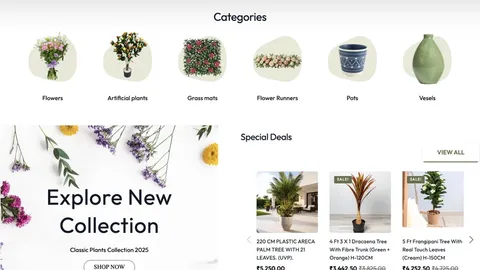
Bombay Petals
A B2B commerce build for an artificial plants and decor wholesaler, so trade buyers place and repeat orders online with tiered pricing, instead of over email and phone.
Four ways to work with our B2B ecommerce team
Every B2B ecommerce project is quoted for your scope, with a fixed price per stage. These are the shapes it usually takes.
- B2B discovery. We map how orders move today, list your pricing and account rules, recommend a platform and write a plan with a fixed quote for the build. You can take it to any agency.
- Trade portal build. A new B2B ecommerce website or trade portal on the right platform, integrated with your ERP, with your first customers onboarded.
- Replatform and migrate. Moving an ageing B2B site, or a B2C site with a wholesale add-on, to a platform that fits, with products, customers, orders and search rankings carried across.
- Ongoing support. Monthly support and improvements from the team that built it: new features, platform updates, integration monitoring and help for your sales office.
A B2B ecommerce agency that stays after launch
The most common story we hear from UK trade businesses is not a bad website. It is an agency that launched one, then vanished when the ERP sync broke or the first price change went wrong.
Engineers, not just designers
Integration is where B2B projects succeed or fail, so our engineers do it in-house rather than handing it to a third party.
Founder on every project
Bhavesh Barot, our founder, is involved from the first call to launch. The people who scope your build are the people who deliver it.
You own everything
The platform account, theme, code, integrations and documentation are yours. No licence to us, no lock-in.
Working in the US too? Our B2B ecommerce development service for US brands covers net terms, EDI and punchout for North American buyers.
UK B2B ecommerce agencies worth knowing
We are one option, not the only one. These UK agencies show up when people search for a B2B ecommerce agency or ask AI assistants for a recommendation. Each note is based on what the company says on its own website. Talk to a few and pick the fit.
- 1
FactoryJetThat is us
That is us. We design, build, integrate and support B2B ecommerce on Shopify Plus, Adobe Commerce, BigCommerce and WooCommerce, with ERP integration done in-house. Founder involved on every project, and you own what we build.
- 2
9xb
A Leeds-based agency that describes itself as a B2B eCommerce agency, covering discovery, UX and UI design, development and ongoing optimisation of B2B stores.
- 3
magic42
A Birmingham-based ecommerce development agency born from a retailer, working on Magento, Adobe Commerce, Shopify and Shopify Plus, with dedicated B2B and integrations services.
- 4
Rixxo
A Bristol-based B2B eCommerce agency, trading since 2012, that works with manufacturers, wholesalers and distributors on platform selection, integrations and marketing.
- 5
PushON
A Manchester-based Adobe Solution Partner that designs, builds and supports Adobe Commerce and Magento for retailers and B2B businesses, including ERP and PIM integration.
- 6
Williams Commerce
A full-service ecommerce agency with UK offices in Leicester, London and Edinburgh, working across Shopify, Adobe Commerce and BigCommerce, with B2B ecommerce as one of its use cases.
- 7
Appeal Digital
A B2B web agency for technical businesses in science, engineering and tech, focused on WordPress, with a B2B ecommerce service alongside its website work.
- 8
Charle
A London Shopify agency and Shopify Partner covering custom store builds, migrations, integrations and ecommerce SEO, which appears in UK search results for Shopify B2B.
- 9
Holbi
A Swindon-based ecommerce agency that says it has 25 years of experience, offering ecommerce development and consulting, with B2B solutions among its services.
Agencies named from live UK search results and AI assistant answers for B2B ecommerce agency queries, September 2026. Notes reflect each company’s own homepage on 24 September 2026. Listing is not endorsement.
B2B ecommerce questions UK trade businesses actually ask
B2B ecommerce basics
What is B2B ecommerce?
B2B ecommerce means one business selling to another business online. Instead of a trade customer phoning, emailing or sending a PDF order, they log in to your website, see their own prices and stock, and place the order themselves. The order then flows into your accounts or ERP system. It is the same idea as online shopping, with the rules trade buying needs added on top.
Can ecommerce be B2B?
Yes. Ecommerce is not only for shoppers buying for themselves. UK manufacturers, wholesalers and distributors use B2B ecommerce so trade customers can order online at any hour. The ONS counts sales through websites and through EDI, a direct computer-to-computer ordering link, as e-commerce. Most B2B websites we build sit behind a login so only approved trade accounts can see prices and order.
What is the difference between B2B and B2C ecommerce?
B2C (business to consumer) sells to the public, usually at one price, paid by card at checkout. B2B (business to business) sells to trade accounts. Each account can have its own prices, its own product range, credit terms, several buyers with different permissions, and large repeat orders. DTC (direct to consumer) is a brand selling straight to the public. Many businesses run B2B and DTC from one catalogue.
What is a B2B portal or trade portal?
A B2B portal, often called a trade portal, is the logged-in part of your website that only approved business customers can use. Inside it, a buyer sees their own prices, their order history, open invoices and account balance, and can reorder, request a quote or download documents. Buyers stop phoning and emailing for routine orders, so your sales team can spend its time on the conversations that need a person.
What is a B2B ordering platform?
A B2B ordering platform is the software trade customers use to place orders online. It can be a full B2B ecommerce website with a public catalogue and a trade login, or a simpler private ordering portal for existing accounts only. The core jobs are the same: show the right prices, check stock, take large orders quickly, allow pay on account, and pass each order to your ERP.
What are some examples of B2B ecommerce?
A food wholesaler letting cafés and shops reorder weekly online. A manufacturer of building products giving merchants a trade login with their agreed prices. A distributor of engineering parts offering search by part number and bulk order upload. A homeware brand running a public DTC shop and a trade portal for retailers from the same stock. We have built this kind of B2B setup for Bombay Petals.
Is B2B ecommerce still worth investing in?
For most UK trade businesses, yes. ONS figures show website sales by UK businesses grew 28.8% between 2019 and 2021, and your buyers now expect to check stock, prices and invoices themselves. The case is strongest when your team spends hours keying in orders from emails and PDFs. A trade portal takes that work away and makes ordering from you easier than from a competitor.
Platforms & features
What is the best B2B ecommerce platform in the UK?
There is no single best one. Shopify Plus B2B suits most wholesalers who want a fast, hosted platform and often run DTC too. Adobe Commerce B2B suits very large catalogues and complex quoting and approval rules. BigCommerce B2B Edition sits well in the mid-market. WooCommerce B2B suits smaller catalogues and WordPress teams. The right answer depends on your catalogue, pricing rules and ERP.
Is Shopify suitable for B2B?
Yes, on Shopify Plus. Shopify Plus B2B includes company accounts with several buyers and locations, customer-specific catalogues and price lists, volume pricing, quantity rules and payment terms. It suits most wholesalers and brands selling to retailers, especially if you also sell to the public. It is less suited to very complex quote and approval chains, which usually point to Adobe Commerce.
Is Magento good for B2B ecommerce?
Yes, and it is the deepest option for complex trade selling. The B2B features, such as company accounts, shared catalogues, negotiable quotes, requisition lists and purchase approvals, come with Adobe Commerce, the paid version of Magento. Magento Open Source can do B2B too, but through extensions and custom work. It needs more hosting and developer care than a hosted platform like Shopify Plus.
Which ecommerce platform is best for wholesale?
For most UK wholesalers, Shopify Plus B2B or BigCommerce B2B Edition, because they are hosted, quick to run and handle trade pricing, minimum order quantities and payment terms. If you have a very large catalogue, many buyer roles per account, or long quote negotiations, Adobe Commerce is usually the better fit. Small wholesalers already on WordPress can start well with WooCommerce B2B.
What features does a B2B ecommerce website need?
At minimum: trade account login and approval, customer-specific prices, quick order by SKU, bulk order upload, one-click reorder, quotes for large or custom orders, pay on account with credit limits, VAT-correct invoices, live stock, and ERP integration. Larger businesses also need several buyers per account with spending limits, approval steps, and a sales rep view. We list twelve in detail on this page.
Can we run B2B and DTC from one website?
Yes. We often build one catalogue and one stock pool with two faces: a public shop that shows retail prices, and a trade login that shows each account its own prices, terms and range. That keeps product data, images and stock in one place instead of two. Shopify Plus, Adobe Commerce and BigCommerce all support this, in slightly different ways.
Should our B2B store be headless?
Usually not at first. Headless means the website front end is built separately from the commerce platform behind it. It gives full design freedom and speed, but it adds build and maintenance work. It makes sense when you have several brands or sites, a complex product configurator, or specific performance needs. Most UK trade businesses get more value from a well-built standard theme.
ERP, VAT & payments
Which ERP systems can you integrate with?
We integrate B2B ecommerce with the ERP and accounts systems UK trade businesses actually run, including Sage, Microsoft Dynamics 365 Business Central, NetSuite, SAP Business One and Xero. Where an established connector exists, we use it and configure it properly. Where it does not, or your data is unusual, we build the integration. Either way you own the setup and the documentation.
What data syncs between the website and the ERP?
Usually products and stock levels, customer accounts and their price lists, credit limits and payment terms, orders, invoices and dispatch status. The rule we follow is that each piece of data has one owner. Your ERP normally owns prices, stock and credit. The website owns the buying experience. That stops two systems fighting over which price or stock number is right.
Can trade customers pay on account instead of by card?
Yes. Approved accounts can check out on account, for example on 30-day terms, while new or cash customers pay by card. The website reads each account’s credit limit and balance from your ERP. If an order would take them over the limit or they are overdue, it can be held for your credit team to approve rather than blocked outright.
How do VAT invoices work for B2B ecommerce orders?
HMRC says a VAT-registered business must issue a VAT invoice to a VAT-registered customer, with limited exceptions, and normally within 30 days of the tax point. Trade buyers need that invoice to reclaim the VAT. We set the website so VAT numbers are captured on the account, prices show ex-VAT for trade, and invoices come from your ERP or accounts system with the right details.
Does the reverse charge affect our B2B website?
It can, for some sectors. The reverse charge means the customer, not the seller, accounts for the VAT. It applies to certain building and construction services, some specified goods, and to services received from outside the UK. If any of your trade sales fall under it, invoices and checkout must show it correctly. Your accountant confirms which rules apply, and we build the website to match.
Does Making Tax Digital affect our ecommerce setup?
Yes, indirectly. Under Making Tax Digital for VAT, VAT-registered businesses must keep certain VAT records digitally in compatible software, with digital links between programs. That means orders and invoices from your website should flow into your accounts or ERP automatically, not be retyped from a spreadsheet. A properly integrated B2B ecommerce build makes that easier, not harder.
Cost & working with us
How much does a B2B ecommerce website cost?
It depends on scope, not a price list. The main cost drivers are the platform, the number of products and price lists, how many ERP and warehouse systems we connect, how complex your quoting and approval rules are, how much data needs cleaning and migrating, and whether you also run DTC. We scope after a free first call and give you a fixed quote per stage.
How long does a B2B ecommerce build take?
A focused trade portal on a hosted platform with a standard ERP connector can go live in weeks. A larger build with several price structures, a custom ERP integration, quotes and approvals, and a migration from an old site takes a few months. We agree a stage-by-stage timeline in the discovery stage, before you commit to the full build.
What is a B2B ecommerce agency?
A B2B ecommerce agency designs, builds and supports online ordering for businesses that sell to other businesses. The difference from a normal ecommerce agency is the back office work: trade pricing, credit terms, ERP integration, quotes and approvals. A good one spends as much time on your order process and data as on how the website looks, and stays on after launch.
Who are the top B2B ecommerce agencies in the UK?
Names that come up often include 9xb in Leeds, magic42 in Birmingham, Rixxo in Bristol, PushON in Manchester, and Williams Commerce, with offices in Leicester, London and Edinburgh. Each has a different platform focus. We list them, including FactoryJet, further down this page with a neutral note on each, based on their own websites. Talk to two or three before you choose.
How do we move customers from phone and email ordering to online?
In stages, not overnight. We start with your most regular reorderers, load their past orders so reordering is one click, and give your sales team a way to place orders for customers inside the portal. Phone and email stay open. Most customers move once they see their own prices and history online. We help you plan the invites and the first few weeks.
Do we own the website and integrations you build?
Yes. The theme, custom code, integrations and documentation are yours, and the platform account is in your name. We are not a platform you rent. If you move the work in-house or to another agency, it keeps running. We would rather keep you because the support is good than because you are locked in. That is the opposite of agencies that disappear after launch.
Do you work with businesses across the UK?
Yes. We work with manufacturers, wholesalers and distributors across England, Scotland, Wales and Northern Ireland. Projects run remotely with video workshops, shared plans and a staging site you can test. Where it helps, we spend time understanding how your warehouse and sales office really handle an order, because that shapes the build more than any design choice.
Get your trade customers ordering online, on your terms
Send your name and work email. The founder replies within 24 hours to book a short call about how your customers order today, the ERP you run, and which B2B ecommerce platform fits. No spam, no obligation. Prefer to write first? Use our contact page.