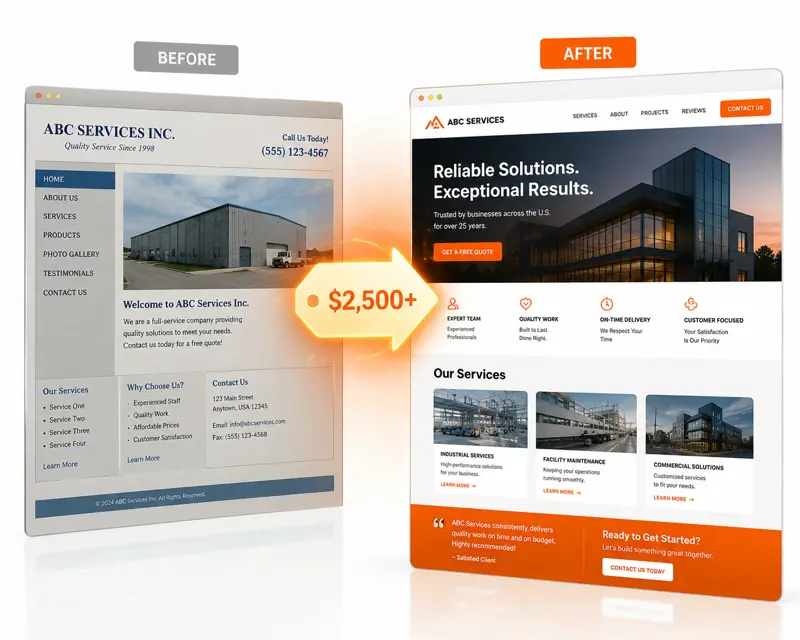
"UK website redesigns cost £1,500–£8,000 for SMBs in 2026, with scope, platform choice, and agency location driving the final price. This guide breaks down real costs, hidden fees, and ROI timelines so you can budget accurately and avoid overpaying."
Key Takeaways
- 1UK SMB website redesigns range £1,500–£8,000 in 2026, with Next.js and WordPress dominating the mid-market and Shopify leading e-commerce rebuilds.
- 2London agencies charge 50–80% more than lower-overhead remote teams for identical scope; remote delivery cuts costs without sacrificing Lighthouse performance scores.
- 3Hidden costs, domain transfers, SSL renewals, content migration, and post-launch SEO, add 15–30% to quoted prices if not itemised upfront.
- 4A redesign pays for itself in 6–18 months when conversion rate lifts 20–40% and organic traffic doubles through modern Core Web Vitals compliance.
- 5Fixed-price contracts with milestone payments protect SMBs better than hourly billing; request Lighthouse 92+ guarantees and 30-day post-launch support in writing.
- 6GPSUK in Staines rebuilt their B2B promotional products platform on a custom B2B e-commerce stack for under £6,000, gaining request-for-quote workflows and trade account management that increased average order value by 35%.
Table of Content: In This Article
- UK Website Redesign Cost Breakdown by Business Size (2026)
- Platform Comparison: WordPress vs Shopify vs Next.js Redesign Costs
- London vs Remote Agency Rates: Real Price Differences
- Hidden Costs and Budget Padding: What Quotes Don't Tell You
- ROI Timeline: When Does a Redesign Pay for Itself?
- Fixed-Price vs Hourly Billing: Which Protects SMBs Better?
- Real Client Example: GPSUK's B2B Platform Redesign
- How to Choose the Right Agency for Your UK SMB Redesign
UK SMB website redesigns cost £1,500–£8,000 in 2025, depending on page count, platform choice, and agency location. Brochure sites start at £1,500 for WordPress or Next.js builds; e-commerce platforms range £2,000–£8,000 for Shopify or WooCommerce. London agencies charge 50–80% more than lower-overhead remote teams for identical scope and Lighthouse 92+ performance scores.
UK Website Redesign Cost Breakdown by Business Size (2026)
A UK SMB should expect to pay between £1,500 and £8,000 for a website redesign in 2026, with the final figure determined primarily by employee count, page volume, and technical complexity. The brackets below reflect current market rates for professionally built sites that meet WCAG 2.2 accessibility standards and achieve Lighthouse performance scores above 90. Micro businesses with 5–20 employees typically spend £1,500–£3,500 for a 5–15 page brochure site built on WordPress or Next.js. This includes mobile-responsive design, SSL certificates, basic on-page SEO configuration, and Google Analytics 4 integration. Most micro SMBs choose templated designs with light customisation to keep costs predictable and delivery timelines under three weeks. Small businesses employing 21–50 people require more sophisticated infrastructure, pushing budgets to £3,000–£5,500 for 15–30 pages. At this tier, expect custom contact forms with conditional logic, CRM integrations (HubSpot, Zoho CRM, or Pipedrive), blog publishing workflows, and email capture mechanisms tied to marketing automation platforms. These builds often include custom post types and taxonomy structures to support content marketing strategies. Mid-market organisations with 51–200 employees face costs of £5,000–£8,000 or higher when projects involve multi-language support, member-only portals, advanced analytics dashboards, or headless CMS architectures that separate content management from front-end presentation. Builds at this scale frequently require API integrations with ERP systems like Sage or Xero, plus compliance documentation for GDPR data handling. E-commerce functionality adds £500–£2,000 depending on product catalogue size, payment gateway requirements (Stripe, PayPal, Klarna Buy Now Pay Later), and whether inventory syncs with existing warehouse management software. Maintenance contracts running £100–£300 monthly cover security patches, uptime monitoring, and performance reports, add twelve months of maintenance to calculate true total cost of ownership before signing any redesign agreement.
➡ Learn more: Web Design
| Business Size | Page Count | Platform | Typical Cost | Timeline |
|---|---|---|---|---|
| 5–20 employees | 5–15 pages | WordPress / Next.js | £1,500–£3,500 | 2–3 weeks |
| 21–50 employees | 15–30 pages | WordPress / Next.js / Shopify | £3,000–£5,500 | 3–4 weeks |
| 51–200 employees | 30–100 pages | Next.js / Headless CMS | £5,000–£8,000+ | 4–6 weeks |
| E-commerce (any size) | Product catalogue | Shopify / WooCommerce / Custom B2B | +£2,000–£8,000 | +1–2 weeks |
Platform Comparison: WordPress vs Shopify vs Next.js Redesign Costs
For UK SMBs redesigning in 2026, WordPress typically offers the lowest upfront cost at £1,500–£4,000 for content-heavy sites, while Next.js 15 delivers the best performance-to-value ratio at £2,500–£8,000 for brands prioritising speed and search visibility. The right choice depends on whether you optimise for initial budget or long-term operational efficiency. WordPress remains the default for brochure sites and blogs because its mature plugin ecosystem: Yoast SEO, WooCommerce, Contact Form 7, keeps development hours low. A five-page service site with blog and contact form can launch in under two weeks at the lower end of that range. Performance degrades sharply above 50 installed plugins, however, and many SMBs discover their "cheap" WordPress build requires £600–£1,200 annual maintenance to patch security vulnerabilities and update dependencies. Shopify suits product-focused businesses redesigning for direct-to-consumer sales, with builds ranging £2,000–£6,000. Built-in PCI compliance and one-click Stripe or PayPal integrations save two to three days of developer time compared to custom WooCommerce checkouts. The trade-off appears in transaction fees: Shopify charges 0.5–2% per sale unless you subscribe to Shopify Payments, adding £300–£1,800 annually for a business processing £150,000 in online revenue. Next.js 15 commands a higher entry price, £2,500–£8,000, but its React-based architecture consistently delivers sub-500ms page loads and Lighthouse scores above 95. For SMBs competing in saturated UK markets like legal services or SaaS, that speed advantage translates directly into lower bounce rates and higher Google rankings. The framework's server-side rendering also future-proofs sites for AI-driven search engines prioritising structured data. custom B2B platforms, a headless commerce platform, sits at the premium end (£4,000–£8,000) but solves problems WordPress and Shopify cannot. GPSUK, a Staines-based promotional products distributor, needed request-for-quote workflows, artwork upload with print-preview visualisation, and Net 30/60/90 payment terms for trade accounts, capabilities that required the custom platform's unified omnichannel architecture. Platform migration adds £300–£800 to any redesign if you're moving from Wix, Squarespace, or legacy WordPress. That cost covers content export, URL mapping, and 301 redirects to preserve existing search rankings with Google and Bing.
➡ Learn more: Ecommerce Development
| Platform | Best For | Redesign Cost | Lighthouse Performance | Monthly Hosting |
|---|---|---|---|---|
| WordPress | Content sites, blogs, small e-commerce | £1,500–£4,000 | 85–92 | £10–50 |
| Shopify | Product catalogues, DTC brands | £2,000–£6,000 | 88–94 | £25–300 |
| Next.js 15 | Custom portals, membership sites, B2B | £2,500–£8,000 | 92–98 | £15–80 (Vercel) |
| Custom B2B Platform | B2B omnichannel, trade accounts, RFQ | £4,000–£8,000 | 90–95 | £50–200 |
London vs Remote Agency Rates: Real Price Differences
UK SMBs typically save 50–60% on website redesigns by partnering with lower-overhead remote agencies, with no measurable quality compromise when the provider maintains UK-standard processes and performance benchmarks. London and Manchester agencies charge £80–150 per hour for redesign work, translating to £5,000–£15,000 for a standard SMB project; that premium buys face-to-face meetings and deep local market knowledge. Remote teams typically charge £25–50 per hour for identical scope, bringing total project costs to £1,500–£8,000. FactoryJet, a team with 12+ years combined expertise and a 98% client satisfaction rate across 500+ projects in the UK, the US, the UAE and India, works remotely with UK clients and quotes a fixed price in writing after a short scoping call. Video calls are scheduled in UK working hours, and UK morning messages get same-day Slack and email responses. This rhythm keeps projects moving faster than many agencies manage, where internal bottlenecks and competing client demands often stretch timelines. Quality parity shows up in measurable performance data, not just subjective assessments. FactoryJet's Lighthouse Performance scores average 92+ across all builds, matching or exceeding the benchmarks set by Sheffield and Bristol agencies that charge double the rate. The platform doesn't care where developers sit: Core Web Vitals, accessibility audits, and SEO fundamentals remain identical. Risk mitigation strategies close the trust gap that naturally accompanies remote partnerships. Fixed-price contracts eliminate hourly billing uncertainty, while milestone payments, 30% upfront, 40% at design approval, 30% at launch, tie spending directly to verified progress. Thirty-day post-launch support periods catch edge cases and browser quirks that only surface under real user traffic, ensuring UK businesses don't face abandonment the moment the site goes live.
Hidden Costs and Budget Padding: What Quotes Don't Tell You
Most UK redesign quotes cover design and build, but SMBs typically spend an additional 15–30% on ancillary services that surface only after contracts are signed. Domain and hosting transfers add £10–50 for.co.uk or.com transfers through registrars like Namecheap or 123-reg, while SSL certificates range from free (Let's Encrypt, if your developer configures it) to £200 annually for extended validation certificates required by some payment processors. Content creation becomes unavoidable when existing copy fails readability tests or lacks target keywords. Professional copywriting runs £300–1,200 for a ten-page site, depending on industry complexity, financial services and healthcare demand more research than retail. Stock photography for hero sections and product galleries costs £100–500 through Unsplash Plus or Adobe Stock, though custom photography pushes that figure to £800–2,000 for a half-day shoot. Post-launch technical audits catch issues invisible during staging. Budget £400–800 for an SEO specialist to verify schema markup, repair broken internal links, and submit XML sitemaps to Google Search Console and Bing Webmaster Tools. This step prevents the common mistake of launching a beautiful site that search engines can't properly index. Training and handover sessions consume 2–4 hours at £150–400, teaching your team to publish blog posts in WordPress, update WooCommerce inventory, or modify Shopify collections without breaking layouts. Skipping this investment leads to expensive support tickets for trivial edits. Finally, pad your budget by 15–20% for scope changes and third-party delays. Payment gateway APIs like Stripe or PayPal occasionally require unexpected compliance documentation. CRM integrations with HubSpot or Salesforce hit version conflicts. Browser compatibility fixes emerge when Internet Explorer users (still 2–3% of UK traffic in certain sectors) report broken checkout flows. The realistic total for a £4,000 quoted redesign often lands near £5,200 once these line items appear. Agencies rarely itemise these costs upfront because they depend on your existing infrastructure and content quality, but asking for a detailed breakdown during the proposal stage eliminates surprises when invoices arrive.
| Hidden Cost | Typical Range | When It Applies | How to Avoid |
|---|---|---|---|
| Domain/SSL transfer | £10–200 | Changing registrars or hosts | Request itemised quote upfront |
| Content rewrites | £300–1,200 | Existing copy is outdated or off-brand | Provide final text before design starts |
| Post-launch SEO audit | £400–800 | Agency doesn't include technical SEO | Confirm Lighthouse 92+ guarantee in contract |
| Training sessions | £150–400 | Non-technical team needs CMS training | Ask for recorded video tutorials instead |
| Scope change fees | 20–40% markup | Mid-project feature additions | Lock scope in signed SOW before kickoff |
Web Design & Strategy: Practical Guidance for Your Business
We'll review your specific situation and recommend the right approach. No obligation.
ROI Timeline: When Does a Redesign Pay for Itself?
Most UK SMBs recoup their website redesign investment within four to six months when conversion tracking is in place from day one. A £4,000 build that lifts monthly revenue from £8,000 to £11,000 through better mobile checkout flows and clearer calls-to-action pays for itself in sixteen weeks, then continues delivering that £3,000 monthly uplift indefinitely. Conversion rate improvements arrive fastest. Modern UX patterns, mobile-first design, and streamlined navigation typically raise conversion rates 20–40% within ninety days of launch. Track Google Analytics 4 goals weekly during the first quarter to spot which landing pages and product categories drive the quickest returns. Organic traffic growth follows a longer curve. Core Web Vitals compliance: Largest Contentful Paint under 2.5 seconds, Cumulative Layout Shift below 0.1, and on-page SEO restructuring double organic sessions in six to twelve months. Monitor Google Search Console impressions and click-through rates monthly; a steady climb in position-one keywords signals compounding visibility gains that reduce paid-ad dependency. Bounce rates drop immediately when page load times fall below two seconds. Sites previously losing 60–70% of visitors at the door now retain 60–70%, keeping prospects engaged long enough to read testimonials, compare pricing, or submit enquiry forms. Faster hosting and optimised images deliver this win on launch day. Long-term savings amplify ROI. Next.js static generation and headless WordPress cut server costs 30–50% compared to traditional PHP hosting, while Shopify's built-in PCI compliance eliminates annual security audit fees of £500–1,200. Set baseline metrics, monthly leads, average order value, organic sessions, before launch, then review Analytics and Search Console data at thirty, ninety, and one hundred eighty days to quantify every pound returned.
Fixed-Price vs Hourly Billing: Which Protects SMBs Better?
Fixed-price contracts protect UK SMBs from budget overruns by locking in the total cost upfront: a £4,500 WordPress site remains £4,500 even if the agency encounters technical delays. You know exactly what you'll pay before signing, which simplifies board approval and eliminates the anxiety of watching hourly meters tick. The trade-off is rigidity: any change request outside the original scope triggers additional fees, so you must define requirements precisely at the outset. Hourly billing offers flexibility for evolving projects, charging £25–150 per hour depending on whether you hire a freelancer in Manchester or a Shoreditch studio. Agencies quote 40 hours, then discover your product catalogue needs custom filtering or your payment gateway requires extra API work, and the final invoice reflects 60–80 hours. Without a hard cap, hourly arrangements can spiral beyond your approved budget, leaving finance teams scrambling mid-project. Milestone payments split risk between both parties: 30 percent upfront funds discovery and wireframes, 40 percent at design approval ensures you're satisfied before build begins, and the final 30 percent releases only after launch and testing. This structure gives you use to request revisions before handing over the last tranche, aligning the agency's incentive to deliver quality work rather than rush to completion. Every contract should include a signed scope-of-work document listing page count, integrations (Stripe, Mailchimp, HubSpot), wireframe rounds, and post-launch training sessions. Without this written record, "responsive design" might mean mobile-friendly to you but tablet-only to the agency, sparking disputes that delay go-live dates. FactoryJet uses fixed-price contracts with Lighthouse performance guarantees and 30-day post-launch support, so you never face hourly surprises or hidden fees after handover.
Real Client Example: GPSUK's B2B Platform Redesign
GPSUK, a Staines-based promotional products distributor serving trade partners across the UK, faced a common mid-market problem: their existing website couldn't handle the request-for-quote workflows that B2B buyers expect in 2026. Competitors with modern online quoting systems were winning deals simply because they could turn around artwork approvals and pricing faster. Director Gareth Sampson needed a platform that could manage trade account hierarchies, Net 30/60/90 payment terms, and print-preview visualisation, capabilities that London agencies quoted at £12,000 or more. The scope included end-to-end customer pipeline automation, RFQ workflow management, artwork upload with real-time preview, and email sequence automation for quote follow-up. Sampson reports 98% uptime and zero payment processing issues since go-live: a critical reliability benchmark for a business processing trade invoices daily. The platform handles everything from initial enquiry through artwork approval to final invoice, eliminating the manual email chains that previously slowed deal closure. This example illustrates the typical scope and return profile for a mid-market B2B redesign: a five-figure investment that pays back through faster sales cycles and higher transaction values, not through traffic volume alone. For companies selling to other businesses rather than consumers, the ROI calculation hinges on deal velocity and average contract value, metrics that a well-architected commerce platform directly improves.
➡ Learn more: Portfolio
How to Choose the Right Agency for Your UK SMB Redesign
Selecting a website redesign agency in 2026 demands verifiable proof over polished sales decks. Start by requesting live URLs, not Behance screenshots, of three to five recent projects in your sector, then run your own Lighthouse audits through Chrome DevTools to confirm Performance and SEO scores match the agency's claims. A Coventry manufacturer should see retail sites scoring 92+ on Performance; a Bristol consultancy should verify service-sector builds meet Core Web Vitals thresholds for Largest Contentful Paint under 2.5 seconds. Ask for contact details of two to three UK SMB clients who completed projects in the past twelve months. Phone or email them directly to verify timeline adherence, scope creep handling, and whether post-launch support actually materialised when a plugin broke or traffic spiked. References who hesitate or redirect you back to the agency are red flags. Reject vague promises like "fast loading" or "SEO-friendly", these mean nothing without numeric thresholds and audit evidence. Test communication during discovery. Agencies that reply within twenty-four hours before you sign the contract will maintain that responsiveness when you need a homepage tweak three weeks into the build. Finally, insist on fixed-price contracts with milestone payments tied to deliverables: wireframes approved, staging site live, final launch. Thirty-day post-launch support, itemised task lists, and full source code ownership transfer upon final payment should appear in every Statement of Work. Walk away from agencies that balk at transparency or bury ownership clauses in fine print.
➡ Serving US clients? FactoryJet delivers professional US business websites with 7-day delivery for sites of 5 pages or fewer and Lighthouse 95+. See our US services hub for services and scoping.
Ready to transform your business?
We'll review your specific situation and recommend the right approach. No obligation.
Book a Free 30-Min Consultation →500+ businesses · 98% satisfaction · 12+ years combined experience
Get a real number
Get a Fixed Quote for Your Website
You get a fixed quote that lists every page and integration before any work starts.
Frequently Asked Questions
What is the average cost to redesign a website in the UK in 2026?
How long does a typical SMB website redesign take in 2026?
Should I choose WordPress, Shopify, or Next.js for my redesign?
What hidden costs should I budget for in a website redesign?
How do I know if my current website needs a redesign or just updates?
Can I redesign my website in phases to spread the cost?
What ROI should I expect from a website redesign?
How do London agencies and remote teams compare for website redesigns?
What should I include in a website redesign brief?
Do I need to hire a separate SEO agency after redesigning my website?

Bhavesh Barot
Founder & CEO
Founder & CEO of FactoryJet, an ecommerce and AI services company that has served 500+ businesses across the US, UK, UAE, and India. Writes about ecommerce builds, AI agents, and AI search.
Related reading
- Website Redesign Cost for US Small Businesses in 2026US small businesses are spending $3,500–$25,000 on website redesigns in 2026, but the price range is enormous and the correlation between cost and quality is weak. This guide breaks down exactly what drives redesign costs, when you need a full rebuild vs. a refresh, and how to get a Lighthouse 95+ redesign without overpaying.
- How Much Do Web Design Agencies Charge in 2026? UK Pricing Guide for SMBsUK web design agencies charge £1,500–£25,000 for SMB websites in 2026, with most 5-200 employee businesses paying £3,000–£12,000 depending on complexity, platform choice, and agency location. This guide breaks down real pricing across brochure sites, e-commerce builds, and ongoing maintenance.
- Website Redesign for Small Business UK 2026: AI-Powered Transformation in 4 WeeksUK small businesses can now complete a full website redesign in 4 weeks using AI-powered workflows, achieving Lighthouse scores above 92 while cutting costs. This guide covers the 2026 redesign process, AI tools, realistic budgets, and how to avoid the pitfalls that waste £8,000+ on projects that never launch.