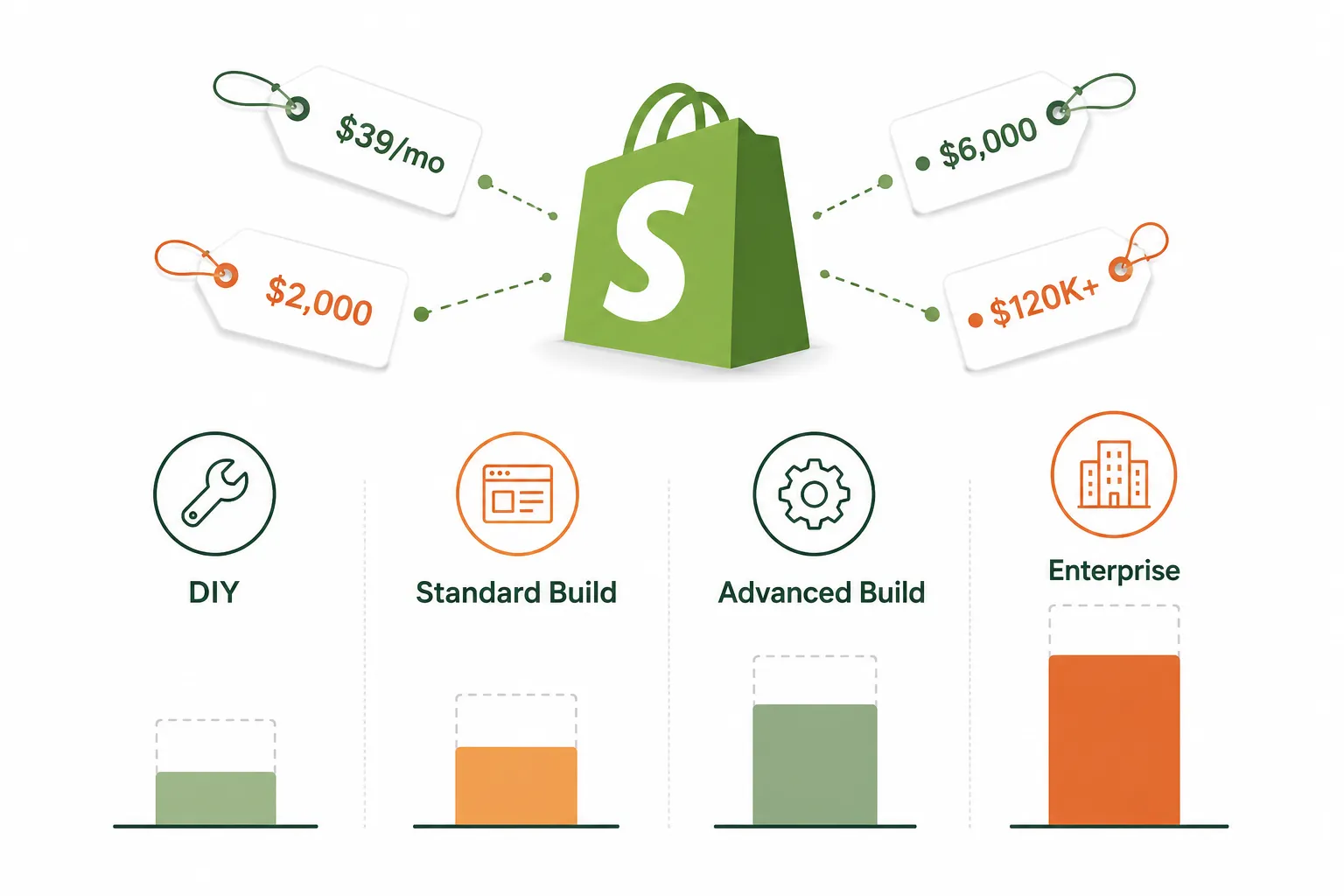
"Off-the-shelf Shopify themes get a US brand from $0 to its first $500K. Past that, the same template that helped you launch starts capping your conversion rate, your brand differentiation, and your Lighthouse score. This guide walks through the four Shopify theme tiers, when a custom theme actually pays back, the real build process, and what US brands should budget in 2026."
Key Takeaways
- 1Free and paid Shopify themes (Dawn, Refresh, Out of the Sandbox) get a US brand from launch to roughly $500K-$1M in annual revenue, above that, theme limits start costing more in lost conversion than a custom build would have.
- 2Six clear signals tell a US brand it's time to invest in a custom Shopify theme: brand differentiation pressure, custom checkout UX needs, multi-language or geo-routing, complex product configurators, a Lighthouse 95+ performance goal, and non-standard merchandising like subscription bundles or B2B portals.
- 3A custom Shopify theme in 2026 runs $5,000 for a focused build on Online Store 2.0 to $50,000+ for a headless Hydrogen storefront on Shopify Plus: most US DTC brands land in the $10,000-$25,000 range.
- 4Online Store 2.0 with JSON templates and sections-everywhere is the right architecture for 90% of custom Shopify themes; Hydrogen is reserved for brands above $5M/year where a 0.5% conversion lift justifies the extra build and maintenance cost.
- 5The typical custom theme build is 6 weeks: discovery and brand audit (week 1), wireframes and component inventory (weeks 1-2), Liquid scaffolding (weeks 2-3), section-by-section build (weeks 3-5), QA and performance (weeks 5-6), migration and launch (week 6).
- 6Custom themes need ongoing maintenance as Shopify ships features (Online Store 2.0, Markets, Bundles, Checkout Extensibility), budget $300-$1,500/month for a US retainer or expect quarterly catch-up projects.
- 7FactoryJet builds custom Shopify themes and Hydrogen storefronts for US DTC and B2B brands with full code ownership on launch day and Lighthouse 95+ as a delivery standard, not a stretch goal.
Table of Contents
- Why Off-the-Shelf Themes Hit a Ceiling at $500K+
- The Four Shopify Theme Tiers: A Maturity Ladder
- When a Custom Shopify Theme Actually Pays Back (Six Signals)
- Liquid (Online Store 2.0) vs Hydrogen, Which Stack to Choose
- The 6-Week Custom Shopify Theme Build Process
- Real US Cost Breakdown for 2026
- The Maintenance Reality Nobody Warns You About
- What FactoryJet Builds
Every US brand on Shopify starts the same way: a free theme like Dawn or Refresh, a Theme Store template for $180-$380, or a premium theme from Out of the Sandbox. That setup works, sometimes for years. The question this guide answers is the one most brand operators put off until it's overdue: when does a custom Shopify theme stop being a vanity spend and start being the highest-ROI investment your store can make? We'll walk through the four theme tiers, the six honest signals that tell a brand it's time, the real build process, what to budget in USD, and the maintenance reality nobody warns you about. If you want the productized version, our full Shopify development service for US brands sits at the end.
Why Off-the-Shelf Themes Hit a Ceiling at $500K+
A US DTC brand doing $200K-$500K in annual revenue on a paid Shopify theme is usually getting fair value. The theme handles a clean product page, a serviceable cart, and a checkout that converts at industry average (around 1.4% across DTC). At that revenue band, the conversion uplift a custom theme would deliver is often smaller in absolute dollars than the cost to build it. Stick with the template.
Past roughly $500K-$1M in annual revenue, three pressures compound. Brand differentiation stops being a "nice to have" and starts being a moat: your customers are comparing you to direct competitors with $5M-$50M in revenue who have invested in storefront craft. Conversion optimization hits the template's ceiling. You've run CRO tests, you've tried four different upsell apps, and your add-to-cart rate has plateaued. Performance becomes a hard problem, Lighthouse Performance on mobile is stuck in the 50s-70s because the theme ships JavaScript for features you don't use, and you can't surgically remove it without breaking sections.
At that point a custom Shopify theme often pays for itself within 6-12 months. A 0.3% conversion rate lift on $2M of annual traffic is $6,000/year. A 0.5% lift is $10,000/year. Combine that with cart abandonment recovery, mobile performance gains, and brand-driven repeat purchase rate, and the math usually clears a $15,000-$25,000 build inside a single fiscal year.
The Four Shopify Theme Tiers: A Maturity Ladder
Think of Shopify themes as a four-rung ladder. Most US brands climb in order. The question is when to jump rungs and when to skip.
| Tier | Example | Cost (USD) | Right for |
|---|---|---|---|
| 1, Free theme | Dawn, Refresh, Crave, Sense, Studio | $0 | Pre-revenue and brands under $200K/year proving the catalog |
| 2, Paid Theme Store theme | Impulse, Prestige, Empire | $180-$380 one-time | Brands $200K-$1M with light brand customization needs |
| 3, Premium third-party theme | Out of the Sandbox, Pixel Union, Archetype | $300-$500 one-time | Brands $500K-$2M wanting editorial design + section flexibility |
| 4, Custom theme | Bespoke Liquid build, or Hydrogen on Plus | $5,000-$50,000+ | Brands $1M+ with brand, UX, or performance differentiation needs |
Tiers 1 and 2 are configuration projects, you can launch in days. Tier 3 is a customization project, typically 3-6 weeks if you're hiring a developer to tailor a premium theme to your brand. Tier 4 is a design and engineering project: the build process and cost we walk through in this guide.
When a Custom Shopify Theme Actually Pays Back (Six Signals)
We work with US brand operators every month who are wondering whether they're ready for tier 4. Here's the honest decision framework. You need at least two of these six signals to justify the spend, and if you have four or more, you're probably overdue.
1. Brand differentiation is a competitive moat. If you're in luxury, craft DTC, fashion, or a category where shoppers can spot a generic template at 50 yards (think Aesop, Glossier, Allbirds), a stock theme actively undercuts your brand equity. Your storefront is the most consistent customer touchpoint you own, it has to look like you, not like Dawn with your logo on it.
2. You need a custom checkout or cart UX. Standard Shopify locks the checkout itself unless you're on Plus, but everything leading to it, cart drawer, mini-cart, upsell at cart, dynamic shipping previews, gift message flows, is fully customizable in a theme. If you've outgrown your theme's cart and your conversion data says cart-to-checkout is your worst funnel step, this alone can justify a custom build.
3. Multi-language or geo-specific UX. Shopify Markets handles currency and language at the platform level, but real geo-specific storefronts, different homepage hero per region, different product mix surfaced for EU vs US visitors, different shipping promise per market, need theme-level routing logic. A custom theme bakes this in cleanly; bolting it onto a stock template usually creates an unmaintainable mess.
4. Complex product configurators. Size + color + material + monogram + add-on accessory configurators don't fit standard Shopify variant UIs cleanly. Custom configurators (built with metafields and Liquid, or with a small React island in a Liquid theme) are bread-and-butter custom-theme work. If your AOV depends on customers building their own bundle, this is a custom-theme problem.
5. A Lighthouse 95+ performance ceiling. Most stock and premium themes ship JavaScript and CSS for features you don't use, quick-view modals, carousel libraries, animation engines. They cap mobile Lighthouse Performance somewhere in the 60-80 range. Custom themes start from a clean Liquid base and ship only what your store actually uses, regularly scoring 95+ on mobile. That's not just a vanity metric. It's a measurable conversion and SEO lift on US searches.
6. Non-standard merchandising. Subscription bundles, build-a-box flows, B2B wholesale portals, RFQ workflows, custom pricing per customer segment, member-only product access, these all live on top of Shopify's data model but need theme-level UX to work cleanly. If your business model is anything other than "single SKUs sold one at a time," custom theming usually pays for itself in the first quarter.
For the broader ecommerce decision (Shopify vs WooCommerce vs custom platform), our US ecommerce development overview walks through every option with US-specific cost numbers.
Liquid (Online Store 2.0) vs Hydrogen, Which Stack to Choose
Once you've decided a custom theme is the right call, the next decision is the architecture. There are two real options in 2026.
Online Store 2.0 with Liquid + JSON templates. This is what 90% of custom Shopify themes use. You build in Liquid (Shopify's templating language), structure your pages with JSON templates, and ship sections-everywhere editability so your marketing team can rearrange the homepage, add a hero section, or launch a new landing page without touching code. Metafields handle extended product data. The full Shopify App Store ecosystem works out of the box. Lighthouse Performance 95+ is achievable with disciplined engineering. This is the default choice for US DTC brands doing under $5M/year.
Hydrogen + Oxygen (or Hydrogen on Vercel). Hydrogen is Shopify's React/Remix framework for headless storefronts. You build the front end as a React app and connect to Shopify's Storefront API for products, cart, and checkout. You get sub-1-second page loads, full design freedom (anything React can do), and component reuse if you also ship native apps. The trade-offs: higher build cost (typically 2-3x a Liquid build), more complex maintenance, and you lose the "marketing team can edit without a developer" benefit unless you also build a custom CMS layer. Hydrogen is the right call for brands above $5M/year where a 0.5% conversion lift is $25K+ annually, or for brands with in-house React engineering teams.
| Factor | Liquid (Online Store 2.0) | Hydrogen (Headless) |
|---|---|---|
| Typical build cost | $5,000-$30,000 | $35,000-$75,000+ |
| Build timeline | 3-6 weeks | 10-14 weeks |
| Marketing edits without a dev | Yes, sections everywhere | Only if you build a CMS layer |
| Performance ceiling | Lighthouse 95+ | Lighthouse 95-100, sub-1s LCP |
| Shopify App Store compatibility | Full | Partial: most apps need integration work |
| Best for revenue band | $500K-$5M/year | $5M+/year |
Our honest recommendation for most US brands evaluating this decision: start with a tight Liquid custom theme on Online Store 2.0. If conversion data 12 months later says you've hit the next performance ceiling, then graduate to Hydrogen with real numbers behind the decision. Brands that start with Hydrogen for "future-proofing" usually overspend by $20K-$40K versus the value delivered.
The 6-Week Custom Shopify Theme Build Process
Here's the actual week-by-week breakdown of how a custom Shopify theme gets built when an agency runs it well. Variations exist (scope, brand maturity, integrations), but the rhythm is consistent.
| Week | Phase | What ships |
|---|---|---|
| Week 1 | Discovery + brand audit | Conversion data review, competitor teardowns, brand guidelines audit, technical scope document |
| Week 1-2 | UX wireframes + component inventory | Low-fi wireframes for homepage, PDP, collection, cart; component inventory (10-20 reusable sections) |
| Week 2-3 | Theme architecture + Liquid scaffolding | Figma high-fidelity designs approved; Liquid theme scaffold with JSON templates, metafields, and section schema |
| Week 3-5 | Section-by-section build | All custom sections built and wired to Figma; product catalog connected; staging store live for review |
| Week 5-6 | QA + performance optimization | Cross-browser/device QA, Lighthouse pass to 95+, Core Web Vitals green, schema validated, checkout flow tested |
| Week 6 | Migration + launch | DNS switch, 301 redirects mapped, Search Console resubmitted, GA4 verified, 30-day post-launch support window opens |
Two phases get under-budgeted in most custom-theme projects. The first is discovery, agencies that skip the conversion-data and brand-audit week to "save time" deliver themes that look great and convert at the same rate as the template you replaced. The second is QA and performance optimization, Lighthouse 95+ on a real Shopify store with apps installed is engineering work, not a checkbox. Agencies that quote a 4-week custom theme are usually skipping one or both of these phases.
Real US Cost Breakdown for 2026
Custom Shopify theme pricing for US brands in 2026 falls into three honest bands. Anyone quoting wildly outside these ranges is either skipping scope or charging US-agency-overhead premiums.
$5,000-$15,000: Focused custom theme. Custom homepage, PDP, collection, and cart on Online Store 2.0. Built on Liquid with 8-12 reusable sections. Brand system needs to exist already (logo, colors, type, photography style). Best fit: US DTC brand at $500K-$1.5M/year that has a clear brand identity and a focused scope.
$15,000-$30,000, Full custom theme. Everything in the focused tier plus extensive PDP variants (configurators, bundles), custom cart drawer with upsells, full set of 15-20 reusable sections for any landing page, deep metafield architecture, Klaviyo integration with custom email templates matching the theme. Best fit: US DTC brand at $1M-$5M/year wanting full design freedom and a marketing-team-editable storefront.
$35,000-$75,000+, Hydrogen + Shopify Plus build. Headless storefront in Hydrogen (React/Remix), connected to Shopify Plus backend, with Checkout Extensibility for custom post-purchase pages, multi-region routing via Shopify Markets, custom CMS layer if marketing-team editability matters. Best fit: US DTC or B2B brand at $5M+/year where the conversion lift and performance gains justify the build cost. See pricing across all our ecommerce tiers on our US pricing page.
For comparison: US Shopify agencies typically quote 2-4x these numbers for the same scope, with project timelines of 3-6 months instead of 6 weeks. For US brands evaluating other platforms in parallel, our WooCommerce development service covers the WooCommerce alternative with real US cost numbers.
The Maintenance Reality Nobody Warns You About
A custom Shopify theme is not a one-time spend. Shopify ships meaningful platform features 2-3 times a year, and your theme has to keep up or fall behind competitors. The last three years alone have brought Online Store 2.0 (JSON templates and sections-everywhere, 2021), Shopify Markets (multi-region selling, 2022), Shopify Bundles (native product bundling, 2023), and Checkout Extensibility (replacing the old checkout.liquid, 2024). Themes that didn't adopt these on rollout are now competitively behind.
Three flavors of ongoing work matter. Shopify platform updates, adopting new features as they ship, typically 8-16 hours of dev work 2-3 times a year. App stack changes, when you switch reviews provider, subscription engine, or analytics tool, the theme needs new integration code, typically 4-8 hours per change. Business changes, new product categories, seasonal landing pages, BFCM-specific templates, A/B test variants, typically 4-12 hours per change.
Budget options for US brands. Retainer with a Shopify developer or agency, $299-$1,500/month covers most ongoing work and gives you a known team. Project-based catch-up, skip the retainer, then run a $3,000-$8,000 project every 6-9 months when something breaks or platform features need adoption. In-house engineer, viable above $10M/year, when ongoing storefront and integration work is more than one engineer's full week.
The brands that underestimate maintenance are usually the same brands that 18 months later wonder why their conversion rate has slipped and their Lighthouse score has drifted. Build the maintenance plan at the same time as the theme itself.
What FactoryJet Builds
FactoryJet has built custom Shopify themes and Hydrogen storefronts for US DTC brands, B2B wholesalers, fashion and apparel companies, and high-AOV home and lifestyle retailers. We work fixed-price, milestone-paid, with full Figma approval before any Liquid is written and a Lighthouse audit run before every handover.
Every custom theme build ships with the same technical foundation: Online Store 2.0 architecture with JSON templates and sections-everywhere, custom sections editable from the Shopify theme editor, metafields-driven extended product data, Lighthouse Performance 95+ and 100 on SEO/Accessibility/Best Practices, Product schema and Core Web Vitals optimization, integration with your existing Klaviyo / Stripe / TaxJar / ShipStation stack, and full code ownership delivered to your GitHub repository on launch day. No vendor lock-in, you can move to any Shopify developer or in-house team afterward.
Every build, from a custom theme to a full store or a Shopify Plus and headless Hydrogen build, gets a fixed price quoted in writing after a short scoping call. See the full scope and timeline on our US Shopify development service page.
Ready to outgrow your Shopify template?
Book a 30-minute store audit. Share your current theme, conversion data, and growth plans. We'll tell you honestly whether a custom theme is the right next move, and give you a fixed quote within 24 hours. No obligation.
Talk to the Founder →Fixed quote after scoping · Lighthouse 95+ · Full code ownership
Custom Shopify Theme, Decision Cheat Sheet
Build custom if any two of these are true:
- Brand differentiation is a real competitive moat
- You need custom checkout or cart UX
- You sell across multiple regions with geo-specific UX
- You run complex product configurators or bundles
- Lighthouse Performance on mobile is stuck below 80
- You're running non-standard merchandising (subscriptions, B2B, RFQ)
Stay on a paid or premium theme if:
- You're under $500K/year in revenue
- Your brand identity is still evolving
- Your conversion rate is at or above DTC average (1.4%) on a stock theme
- You don't have $5K+ to invest without straining cash flow
Planning a store
Tell Us What You Sell, and Where
We reply with what we would build and how long it takes. You see a working draft of your store before you sign.
Frequently Asked Questions
When does a US brand actually need a custom Shopify theme instead of a paid template?
How much does a custom Shopify theme cost for a US brand in 2026?
Should I build my custom Shopify theme on Liquid (Online Store 2.0) or Hydrogen?
How long does a custom Shopify theme build take?
What stack do US Shopify brands actually use alongside a custom theme in 2026?
What ongoing maintenance does a custom Shopify theme need?
Can I customize a premium third-party theme instead of building from scratch?
What's the difference between a custom Shopify theme and a Shopify Plus build?
Does FactoryJet build custom Shopify themes for US brands?

Bhavesh Barot
Founder & CEO
Founder & CEO of FactoryJet, an ecommerce and AI services company that has served 500+ businesses across the US, UK, UAE, and India. Writes about ecommerce builds, AI agents, and AI search.
Related reading
- Boise Shopify Development Guide: What Idaho Small Businesses Need to Know in 2026Boise has quietly become one of the most interesting Shopify markets in the Mountain West: an outdoor-recreation economy, a fast-growing downtown, a craft food and beverage scene, and a tech-fluent customer base that buys from local DTC brands on mobile. This guide breaks down what Idaho small businesses actually need from a Shopify build in 2026, from Treasure Valley pickup logistics to BSU football season traffic spikes to when custom Shopify development beats an off-the-shelf theme.
- How Much Does an Ecommerce Website Cost in 2026? Shopify, WooCommerce, BigCommerce and Custom ComparedWhat a US online store really costs in 2026, priced three ways: a hosted plan you set up yourself, an agency build on Shopify, WooCommerce or BigCommerce, and a custom or headless build. Every number links to its source.
- Shopify Development Cost in 2026: What a Store Really CostsShort answer: a DIY Shopify store costs $468 to $1,068 in year one. A professionally built store for a small US business typically costs $2,000 to $6,000 one time plus $39 to $105 a month. Advanced builds run $6,000 to $20,000, and Shopify Plus or headless builds start around $40,000. Ranges come from Shopify's own pricing and published 2026 agency data.