Websites for Tradies: Quote-Ready Sites That Get Found Locally
Built to turn calls into booked jobs. FactoryJet builds websites for tradies across Australia. Yours loads fast on a phone, shows your licence, reviews and real job photos, has a page for every service you want more of, and sends each enquiry straight into ServiceM8, Tradify, simPRO or your inbox. We set up your Google Business Profile, support the site after launch, and you own it.
What makes a good website for tradies in Australia?
A good website for tradies loads fast on a phone, says your trade and service area in the first screen, shows your licence number, genuine reviews and real job photos, has a page for each main service, and makes it one tap to call or request a quote. Enquiries should land in your job software, and the site should match your Google Business Profile.
Local SEO (search engine optimisation) means showing up when people nearby search for your trade. A Google Business Profile is your free listing in Google Maps and the local results. An integration is a live connection between your website and your job software, so enquiries arrive as jobs instead of emails.
Most tradie website design in Australia comes in two flavours: a template you fill in yourself, or a brochure site that looks fine and never rings. We build the third kind. It is designed around the jobs you actually want, written the way your customers search, connected to the software you already run your business on, and looked after once it is live.
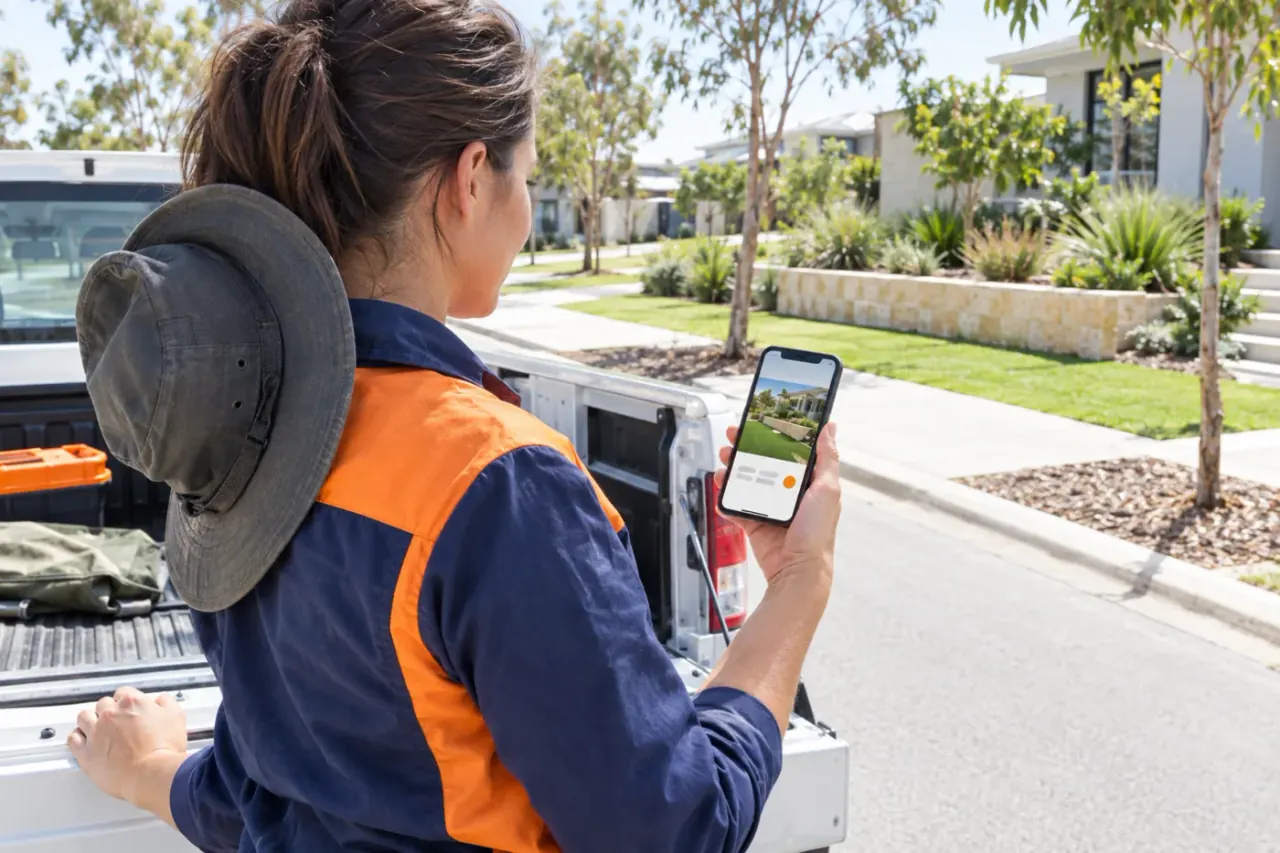
7 things every tradie website needs before it can bring in jobs
Look at the trade business websites that actually bring in work. They share the same seven basics, whether it is a two-van plumbing business in Geelong or a building company in Perth.
Your trade and service area in the first screen. A customer on a phone decides in seconds. "Licensed electrician, Northern Beaches and North Shore" beats a clever slogan every time.
One-tap call and a short job request form. The call button stays visible as people scroll. The form asks for name, suburb, job type and an optional photo. Nothing more.
Your licence number and business name. Shown in plain text in the footer and on your contact page, with a link to your state’s public licence check. In several states it is a legal requirement.
Real photos of real jobs. Before and after shots from your own phone beat stock photos. Customers want to see your work, your ute and your team.
Genuine reviews. Pull in your Google reviews and add named testimonials with the suburb and job type. Recent and specific beats old and vague.
A page for each main service. Hot water, blocked drains, switchboard upgrades, decks, retaining walls. Each page answers the questions customers ask about that job.
A clear line on how quotes work. Free quotes or a call-out fee, how soon you reply, and what happens next. Uncertainty is the main reason people do not get in touch.

A 30-second check: DIY builder, tradie website design, or website plus AI receptionist
Tap the line that sounds most like your business. The answer is honest, even when it is not us.
I have just started out, I work alone and I am booked through referrals.
DIY builder or one pageA simple one-page site on a DIY builder, plus a verified Google Business Profile, is probably enough for now. Put your licence number, service area, a few job photos and a call button on it. Come back when you want to grow.
I rely on hipages or other lead sites and I am tired of competing on every quote.
Own website + local SEOThis is the most common reason tradies call us. A proper site with service pages and a strong Google profile gives you leads nobody else is quoting on. Keep the marketplace for quiet weeks while the site builds up.
I miss calls on the tools and lose jobs to whoever answers first.
Website + AI receptionistYour problem is not traffic, it is catching the enquiries you already get. Pair a clear website with a job request form and an AI receptionist that answers, books into your job software and sends emergencies to your mobile.
I have a team of several techs and we use ServiceM8, Tradify, simPRO or Fergus.
Custom site + integrationEnquiries should land in your job system as leads with the right job type and suburb, not in someone’s inbox. That integration, plus service pages per trade line, is where a custom build pays for itself.
I have a website already, but it is slow, old or never brings in work.
Rebuild or fixSometimes a few fixes are enough: speed, a call button, a job request form and proper service pages. Sometimes a rebuild is faster. We will look at it with you and tell you which, honestly.
Your licence number, reviews and the rules your website has to follow
Most generic web designers do not know that a tradie website is advertising in the eyes of state regulators. That matters, because the rules are specific and they apply online.
New South Wales. NSW Fair Trading requires licensed contractors to include their name and licence number, with the correct category of work, in their advertising. The NSW Government says this covers print, internet, TV and radio, and it names specialist trades including electrical wiring, plumbing, draining, gas fitting, and air conditioning and refrigeration work.
Queensland. The QBCC says advertising must include the name you are licensed under, that you are licensed under the QBCC Act, and your licence number. It lists websites, social media pages and online directories as advertising, and says licence details must be easily legible and reasonably prominent. It also says you must not use the QBCC logo, although you may link to its website.
Other states. Victoria, Western Australia, South Australia, Tasmania and the territories have their own licensing bodies and rules. We put your licence details in plain text in the footer and on the contact page by default, and link to your regulator’s public licence check, which covers the common requirements. Confirm the detail for your trade with your regulator.
Reviews. The ACCC says it is against the law for a business to create fake or misleading reviews or to arrange for others to do so. Incentives must apply whether the review is positive or negative and be disclosed, and hiding genuine negative reviews may mislead customers. We only ever display reviews you have actually received.
Sources: NSW Government, building trade advertisements; QBCC, advertising; ACCC, online reviews. This is general information, not legal advice.
- Licensed business nameexactly as it appears on the licenceFooter
- Licence number and categoryplain text, legible, not an imageFooter
- Link to the public licence checkcustomers can verify youContact
- Regulator logosQBCC says do not use its logoNever
- Reviewsgenuine, unedited, from real jobsReal only
SEO for tradies: showing up in Google Maps, local results and AI answers
Tradie SEO is simpler than most agencies make it sound. When someone searches for a plumber, an electrician or a builder, Google mostly shows two things: the map results, driven by your Google Business Profile, and the normal results, driven by your website. Plumber SEO, electrician SEO and builder SEO all work the same way. You need both halves working together.
Your Google Business Profile. It is free, and it controls how you appear in Maps. If you work at customers’ homes rather than a shopfront, Google treats you as a service-area business: it says to remove your address from the profile and list only your service areas, up to 20 of them, keeping the overall area within about two hours’ drive of your base. Pick the right main category, add your services, upload job photos and keep the reviews coming.
Your website. Each main service gets its own page that answers the questions customers ask about that job. Your business name, service area and contact details match the Google profile exactly. Pages load fast on a phone. Project write-ups mention the real suburbs you worked in, which helps you appear for nearby searches without the thin, copy-paste suburb pages Google tends to ignore.
AI answers. Google now shows AI Overviews on many trade searches, and more people ask ChatGPT to recommend a tradie. Those answers lean on clear service pages, consistent business details and genuine reviews, which is one more reason to get the basics right. Our AI SEO service for Australian businesses goes deeper on this, and our SEO services in Australia cover ongoing local SEO for trades that want to rank across more services and suburbs.
Source: Google Business Profile Help, service-area businesses.
- Google Business Profile completecategory, services, areas, photosWeeks
- Steady genuine reviewsask every happy customerOngoing
- Service pages rankingdepends on trade and cityMonths
- Links from local sitessuppliers, associations, local newsCompounds

SEO for electricians, plumbers and builders: what changes for each trade
The basics above apply to every trade. What differs is how customers search, how urgent the job is and what proof they need before they call. Here is how we shape the site and the keywords for the three trades we are asked about most.
SEO for electricians
Electrician searches split into two groups. Urgent ones, like "emergency electrician" or "power outage" plus a suburb, where the customer calls the first name that looks trustworthy. And planned jobs, like switchboard upgrades, safety switches, lighting, EV chargers and solar batteries, where people read before they ring. We give each planned job its own page that explains the work in plain words, and keep the emergency call button in reach on every page. Your contractor licence number sits in the footer, because regulators expect it and customers check it.
- emergency electrician + suburburgent, map results dominateCall
- switchboard upgrade, safety switchplanned, one page per jobPage
- EV charger installationresearch first, then quotePage
SEO for plumbers
Plumbing has the most urgent searches of any trade: burst pipes, blocked drains, no hot water. Those jobs are mostly won in the Google Maps results, so a complete Google Business Profile with the right main category, real service areas and a steady flow of reviews matters as much as the website. The site then carries the planned work: hot water replacement, gas fitting, leak detection and bathroom renovations, each with its own page, photos and a clear line on call-out fees and response times.
- blocked drain, burst pipe + suburburgent, profile and reviews winMaps
- hot water system replacementcompared on brand and speedPage
- gas fitter, leak detectionlicence category shown clearlyPage
SEO for builders
Builders sell bigger jobs with longer decisions, so the searches are fewer and worth more. People look for "home extension builder", "knockdown rebuild" or "granny flat builder" plus their area, then spend weeks comparing. SEO for builders leans on project pages: each finished job written up with the suburb, the brief, the timeline and plenty of photos. Add a page on how your process works and what to have ready before a quote, and you answer the questions that decide who gets the site visit.
- home extension builder + arealong research, project pages winGallery
- knockdown rebuild, granny flatprocess and timeline questionsPage
- renovation builder reviewsnamed, detailed, recentProof
One site covers all of this. You do not need a separate website for each trade line, and you do not need a copy-paste page for every suburb. If your main goal is ranking in the map results across your area, see our local SEO services in Australia. If you are a small trade business starting from scratch, our small business web design page explains the simplest site that still brings in work.
Your own tradie website vs hipages and lead sites vs a DIY builder vs social media only
Four common ways Australian tradies get found online. Most successful trade businesses use more than one. This compares them on what actually changes for you, not on price.
| What you get | Custom tradie website (FactoryJet) | hipages and lead marketplaces | DIY website builder | Facebook or Instagram only |
|---|---|---|---|---|
| Who owns the customer | You do | Shared with other tradies quoting | You do | The platform controls reach |
| Competing on each lead | Usually no | Often several quotes | Usually no | Usually no |
| Shows up on Google for your services | Built for local SEO | The marketplace ranks, not you | Basic, limited control | Rarely |
| Licence, reviews and job photos | Designed around them | Profile only | If you add them | Scattered in posts |
| Enquiries into ServiceM8 or Tradify | Connected | Separate app to check | Sometimes, by plugin | Manual |
| Builds value over time | Yes, it compounds | Stops when you stop paying | Somewhat | Somewhat |
| Your time to set up | A call and a checklist | Low | Evenings and weekends | Low |
| Help after launch | Same team, ongoing | Platform support | Help articles | None |
| Best for | Steady, direct work you do not share | Filling quiet weeks | Brand-new sole traders | Showing off finished jobs |
Wondering what each option costs? Read our guide to website cost in Australia (2026), which uses third-party market ranges, not our prices.

When a website enquiry lands straight in the job schedule, the office can quote the same day instead of retyping emails.
Website enquiries straight into ServiceM8, Tradify, simPRO or Fergus
Most tradie websites send enquiries to an email inbox. Someone then has to read it, retype the name, address and job details into the job software, and ring back. Every step is a chance for the lead to go cold, and the tradie who replies first usually wins the job.
We connect your website to the software you already run the business on. Tradify has its own website enquiry form that can sit on your site. ServiceM8, simPRO and Fergus can take new leads or jobs through their integrations and developer tools. Either way, each enquiry arrives as a lead or job with the customer’s name, suburb, job type, preferred time and any photos, and the customer gets an instant confirmation.
For bigger teams, we route enquiries by job type or area to the right person, flag urgent jobs, and keep the details consistent so your office can quote the same day. If your software cannot accept enquiries in a clean way, we tell you, and set up the next best option.
Missed calls: pair your tradie website with an AI receptionist
A better website brings in more calls. For a tradie on a roof, under a house or halfway through a switchboard, that can mean more missed calls. Customers with an urgent job rarely leave a voicemail. They ring the next number on the list.
An AI receptionist for tradies answers your business number when you cannot, tells callers it is an automated assistant, takes the address and the problem, books a slot in ServiceM8 or Tradify, and sends real emergencies, like a burst pipe or no power, straight to your mobile. You keep your existing number.
It is optional, and plenty of sole traders do not need it. But if you know you miss calls every day, the website and the receptionist together close the gap between someone finding you and you actually winning the job.
- Job request form on your siteinto your job software, with photosLead
- Call you answertap-to-call from the websiteYou
- Call you missAI receptionist books or takes detailsAI
- Emergency callagreed words, tested before launchYour mobile
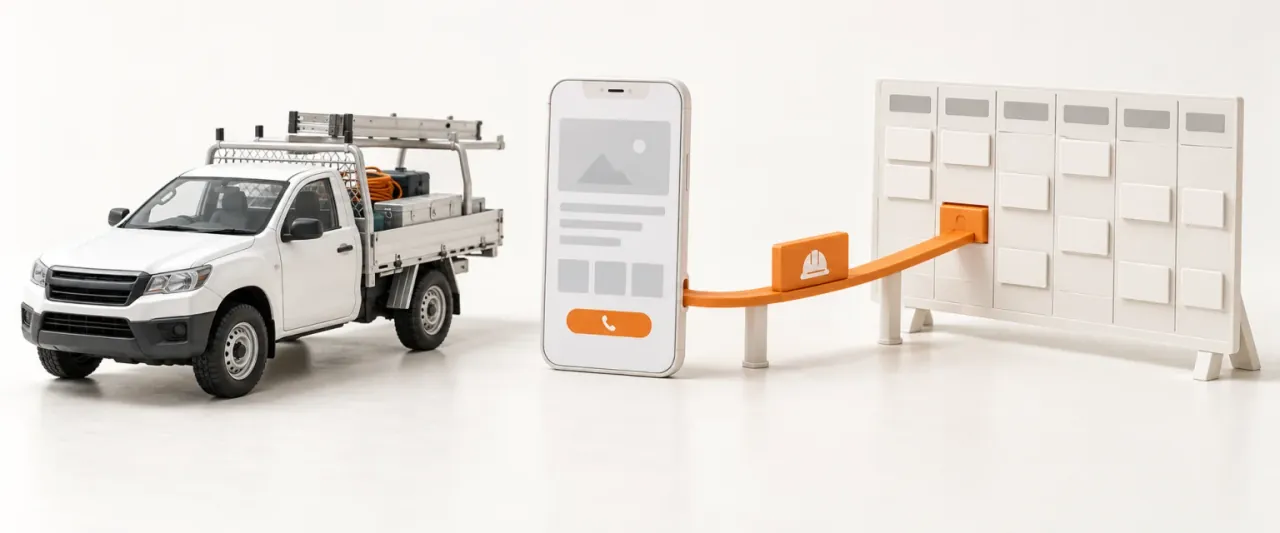
How we build your tradie website, in eight steps
The same path every time, so nothing important is left out and you are not chasing us for updates. Open any step to see what happens in it.

01A short call about your jobs
Which jobs you want more of, which you would rather avoid, the areas you cover, the job software you use and where your work comes from now. This decides the pages and the integration.
02Collect the proof
We send a simple checklist: licence details, ABN and business name, your best job photos, reviews, and any certifications or trade association memberships. Most tradies have more proof on their phone than they think.
03Plan the pages
A home page, a page for each main service, an about page with your licence and team, a projects page and a contact page. We map each service page to the searches people in your area actually use.
04Write and design
We write plain, specific copy in your voice, design a mobile-first layout with a call button that stays in reach, and use your real photos, compressed so pages load quickly on patchy coverage.
05Connect your job system
We connect the job request form to ServiceM8, Tradify, simPRO, Fergus or your inbox, test that a real enquiry arrives with the right details, and set up an instant confirmation to the customer.
06Set up Google properly
Google Business Profile categories, services and service areas, Search Console, analytics that count calls and forms, and matching business details across the main directories.
07Launch and check
We test on real phones, check speed, make sure every call button and form works, and go live. Sites up to five pages have 7-day delivery once your content is in.
08Support after launch
Updates, new service pages, new project photos, security and speed checks, and monthly reporting on the calls and forms your site brings in, if you want us to look after it.
Next step
Want more jobs you do not have to share with five other quotes?
Tell us your trade, the areas you cover and the job software you use. On a short call with the founder, we will look at your current site and Google profile and tell you what would bring in more work first.
Tradie website design for plumbers, electricians, builders and every trade in between
The structure stays the same. What changes is the services, the urgency of the jobs, the licence categories and the questions customers ask. We write each site for the trade, not from a template.
Plumbers and gasfitters
Emergency and planned work side by side: blocked drains, hot water, leaks, gas fitting and bathroom renovations, with the emergency call button front and centre and licence categories shown clearly.
Electricians and solar
Switchboard upgrades, safety inspections, lighting, EV chargers and solar with batteries. Service pages that explain the job in plain words, plus licence and contractor details shown the way regulators expect.
Builders and renovators
Project galleries that sell: extensions, renovations, decks and new homes, with the process, timeline expectations and what to have ready before a quote. Builder website design leans on photos more than any other trade.
HVAC and air conditioning
Split systems, ducted installs and servicing, with seasonal service pages ready before summer and winter peaks, and booking forms that capture the system type and home size up front.
Landscapers and outdoor trades
Landscaping, fencing, paving, concreting and pools. Before and after galleries, suburb-tagged project write-ups and clear quote steps for bigger jobs.
Roofers, painters, cleaners and more
Any trade where customers compare three names on their phone. The same seven basics, shaped around your services and the areas you want to work in.
One site covers every service you offer. We do not build separate copy-paste sites or pages for each trade and suburb, because Google treats those as thin content and they rarely win work. If you also sell parts or supplies online, see our ecommerce development for Australian businesses.
Three ways to work with us on a website for your trade business
Every project is quoted for your scope, with a fixed price for the build and ongoing support shown separately. These are the shapes it usually takes.
Focused starter site.
Up to five pages, with 7-day delivery once your content is in: home, key services, about with licence details, projects and contact, plus Google Business Profile setup.
Full trade site.
A page for every main service, a project gallery, job software integration, local SEO setup and analytics that count calls and forms.
Site plus growth.
Either of the above with ongoing local SEO, new service and project pages, review requests, website maintenance and an optional AI receptionist.
What moves the scope: number of pages, whether we write the copy and source photos, the job software integration, how many services and areas you want to rank for, and the level of support. For Australian market ranges from third-party sources, see our website cost guide and SEO cost guide. We have a 97% on-time delivery record, and we explain every line of the quote on the call.
- website for tradies1,600 searchesThe head term
- tradie website design390 searchesChoosing a designer
- seo for tradies320 searchesGetting found locally
- tradie seo170 searchesSame need, shorter search
- plumber website design140 searchesPlumbers specifically
- plumber seo110 searchesPlumbers ranking locally
- local seo for electricians90 searchesElectricians ranking locally
- seo agency for tradies70 searchesComparing agencies
Source: DataForSEO, Australia, September 2026
Australian companies that build websites for tradies
We are one option, not the only one. These Australian providers show up when people search for websites for tradies or ask AI assistants for a tradie web designer. Some specialise only in trades, others are broader agencies. Each note is based on what the company says on its own website.
FactoryJet
That is usThat is us. We design, build and support tradie websites with local SEO, job system integration and an optional AI receptionist, founder-involved on every project, and you own what we build.
Built4Tradies
An Australian web design firm that says it has built websites for tradespeople and construction businesses since 2005, alongside hosting, logo design and online marketing.
ServiceScale
Builds websites for tradies with a short three-step process, and says its sites can connect to job management tools such as ServiceM8, Tradify, Fergus and Jobber.
Tradie Web Guys
Based in Kingscliff, NSW, offering trade-focused websites plus SEO, Google Ads, Facebook Ads, CRM and AI automation for tradies and contractors.
My Tradie Site
A done-for-you service that builds tradie websites and adds SEO and Google Ads to generate calls and leads.
Digital Nomads HQ
A broader digital agency with a tradie web design service, building mainly on WordPress, with a four-phase process from discovery to launch.
Providers named from live Australian search results and AI Overview citations for tradie website queries, September 2026. Notes reflect each company’s own website on 26 September 2026. Listing is not endorsement.
- Who owns the domain, the site and the content? It should be you, in your business name, from day one.
- Can I see tradie sites you built, on my phone? Check the speed, the call button and whether the licence number is visible.
- Where do enquiries go? Ask to see a test enquiry arrive in your job software, not just an inbox.
- What happens to my Google Business Profile? It should stay in your name, set up properly and linked to the site.
- Are there lock-in contracts? Know what happens to the site if you stop paying for support.
- How will we know it is working? Ask for reporting on calls and forms, not just traffic.
The rest of what we build for Australian trade businesses
A website is usually the first step. These are the natural next ones, built and supported by the same team.
- AI receptionistAnswers your business number while you are on the tools, books into ServiceM8 or Tradify and sends emergencies to your mobile.
- SEO services AustraliaOngoing local SEO for trades that want to rank across more services and suburbs.
- Local SEOGoogle Business Profile, reviews and map rankings for trades that want more calls from their own area.
- AI SEOGet recommended when Australians ask ChatGPT, Perplexity or Google AI for a tradie.
- Website maintenanceUpdates, security, backups and speed checks so your site keeps working after launch.
- AI agentsQuote follow-ups, invoice reminders and admin that runs across your job software and inbox, built and supported by us.
- FactoryJet AustraliaEverything we build for Australian businesses: ecommerce, websites, AI agents and AI search.
Questions Australian tradies ask about websites, SEO and getting more jobs
Replies within 24 hours.
Q01What are some good websites for tradies?
The good ones are simple. They load fast on a phone, say what you do and where in the first line, show your licence number, reviews and real photos of your jobs, and make it one tap to call or send a job request. Look at the best local plumbers, sparkies and builders in your area on your phone: the ones you would call are the ones to learn from.
Q02Do I need a website if I get all my work from word of mouth?
Usually yes, because word of mouth now ends in a search. A neighbour recommends you, and the customer looks you up before calling. If they find nothing, or an old page with no photos, many call the next name. A website backs up the recommendation with your licence, reviews and past jobs. It also keeps working when referrals go quiet.
Q03What should every tradie website include?
Seven things: what you do and the areas you cover, stated in the first screen; a tap-to-call button and a short job request form; your licence number and business name; real photos of finished work; genuine reviews; a page for each main service you offer; and a clear line on how quotes work. Everything else is optional.
Q04Should my tradie website have a page for every service?
Yes, for each main service people search for. A plumber might have separate pages for blocked drains, hot water systems, gas fitting and bathroom renovations. Each page answers the questions customers ask about that job and shows photos of it. That helps Google match you to specific searches, and it helps customers see you do the exact job they need.
Q05How long does it take to build a tradie website?
With FactoryJet, a site of up to five pages has 7-day delivery once we have your content and photos. Larger sites with many service pages, a project gallery or a job system integration take a few weeks. The slowest part is almost always gathering photos, reviews and licence details, so we give you a short checklist on day one.
Q06How much does it cost to pay someone to build a tradie website?
It depends on the number of pages, whether you need copywriting and photos, any integration with ServiceM8, Tradify or simPRO, and whether local SEO is included. We quote a fixed price for your scope after a short call. For typical Australian market ranges from third-party sources, read our guide to website cost in Australia.
Q07What is the best Australian-based website builder?
Most popular website builders used in Australia, such as Wix, Squarespace and GoDaddy, are overseas companies, and some trade job software also offers a simple site. The better question is which fits you. A DIY builder suits a new sole trader with time to tinker. Once you want to rank in several suburbs or connect enquiries to your job software, a custom site is usually worth it.
Q08What website builder do professionals use?
Professional web developers usually build on WordPress, Webflow, Shopify for online stores, or custom code with modern frameworks. We choose based on what you need to do after launch: edit your own content, add service pages, connect a job system or load fast on patchy mobile coverage. You get the logins and the files either way.
Q09Is Wix actually free?
You can build a Wix site for free, but the free plan puts Wix branding on your site and uses a Wix web address rather than your own domain. To use your own business domain and remove the branding you need a paid plan. For a trade business, a free address looks less trustworthy to customers, so most tradies end up paying anyway.
Q10What is the downside to Wix and other DIY builders?
Three common downsides: the site is harder to move if you outgrow the builder, page speed and SEO control are limited compared with a custom build, and your time goes into building instead of working. DIY builders are fine to start. They are less suited to ranking across many suburbs or passing enquiries straight into ServiceM8 or simPRO.
Q11Can ChatGPT build me a website?
ChatGPT and similar tools can draft page copy and even generate a basic page, which is useful for ideas. They cannot register your domain, collect your real job photos, check your licence details, set up your Google Business Profile or connect your job software. A usable tradie website still needs a person to put it together, check it and look after it.
Q12Do I own the website you build?
Yes. The domain, the design, the content, the photos and the code are yours, and the domain and hosting accounts are in your business name. If you later want to manage it yourself or move to another company, you can. We build it, support it if you want us to, and hand you the keys.
Q13Where should tradies advertise?
Start with the free and owned channels: a Google Business Profile, your own website, and asking every happy customer for a review. Then add paid options that suit your trade, such as Google Ads for urgent jobs, lead marketplaces for filling gaps in the calendar, and signage on your ute. Your website ties them together, because every channel ends with the customer checking you out.
Q14What is better than hipages?
For steady work, your own website plus a strong Google Business Profile is usually better long term, because customers contact you directly and nobody else is quoting on the same lead. Marketplaces such as hipages, Airtasker, ServiceSeeking and Oneflare are useful for filling quiet weeks, but you pay for access to customers who are also asking other tradies to quote.
Q15Is hipages or Airtasker better for tradies?
They work differently. hipages is built around trade jobs and connecting homeowners with tradies. Airtasker is a general task marketplace where customers post a job and people make offers, so it covers many small tasks beyond licensed trade work. Which suits you depends on your trade and the size of job you want. Neither replaces your own website, which is the lead you do not share.
Q16What is the best job management software for tradies?
The most common choices in Australia are ServiceM8, Tradify, simPRO, Fergus and AroFlo, and the best one depends on team size and trade. Sole traders and small teams often like ServiceM8 or Tradify. Bigger service and project businesses often need simPRO or AroFlo. Pick the software first, then make sure your website sends enquiries into it.
Q17Can website enquiries go straight into ServiceM8, Tradify or simPRO?
Usually yes, although the method differs. Tradify offers its own website enquiry form you can embed on your site. ServiceM8, simPRO and Fergus can receive new jobs or leads through their integrations and developer tools. We connect your form so each enquiry arrives as a lead or job with the name, suburb, job type and photos, instead of an email someone has to retype.
Q18Can an AI receptionist answer calls while I am on the tools?
Yes. An AI receptionist answers your business number when you cannot, tells callers it is an automated assistant, takes the address and the problem, books a slot in ServiceM8 or Tradify, and sends genuine emergencies straight to your mobile. It pairs well with a tradie website because the site creates more calls. See our AI receptionist page for how we build them.
Q19How do I get more leads as a tradie?
Make it easy to find you and easy to contact you. That means a complete Google Business Profile, a steady flow of genuine reviews, a website with a page for each main service and a one-tap call button, fast replies to every enquiry, and a way to catch calls you miss. Most tradies lose more jobs to slow replies than to weak marketing.
Q20What is SEO for tradies, and does it work for plumbers and electricians?
SEO (search engine optimisation) for tradies means making your website and Google Business Profile show up when people nearby search for your trade, such as "emergency plumber" plus their suburb. It works well for plumbers, electricians and other local trades because customers search with clear intent. It covers service pages, local signals, reviews, site speed and links from local sites.
Q21What are some good SEO keywords for electricians?
The best ones name a job and a place, because that is how customers search: "emergency electrician" plus your suburb, "switchboard upgrade", "safety switch installation", "EV charger installation", "ceiling fan installation" or "solar battery installer" plus your area. Give each planned job its own page. Leave broad terms like "electrician Australia" alone: they are hard to rank for and rarely bring a local job.
Q22What are some effective marketing ideas for plumbers?
Start with the ones that cost time rather than money: a complete Google Business Profile, a review request after every job, before and after photos on your site and profile, and a page for each service you want more of. Then answer the phone fast, or have something answer it for you. Signage on the van, local sponsorships and Google Ads for urgent jobs work well on top.
Q23What is SEO in construction?
For builders and construction trades, SEO means showing up when people in your area search for the projects you build, such as extensions, renovations, granny flats or new homes. Because the jobs are big and the decisions slow, it leans on detailed project pages with photos and suburbs, a clear process page, genuine reviews and a Google Business Profile that matches your licensed business name.
Q24Do electricians, plumbers and builders need different websites?
No, they need the same foundations shaped differently. Plumbers and electricians get a lot of urgent searches, so the call button, response times and the Maps listing matter most. Builders sell fewer, larger jobs, so project galleries and a clear process page matter most. If you do more than one trade, one site with a page per service works better than several separate sites.
Q25How much should I expect to pay for SEO?
It depends on how competitive your trade and area are, how many services and suburbs you want to rank for, and whether content, reviews and links are included. Local SEO for one trade in one region needs far less than city-wide coverage across several services. For typical Australian market ranges from third-party sources, read our SEO cost guide for Australia.
Q26Is SEO still worth it for tradies in 2026?
Yes, because people still search for trades, and those searches carry high intent: someone typing "blocked drain" plus a suburb usually wants it fixed soon. What changed is where answers appear. Google now shows AI Overviews on many searches, and people also ask ChatGPT for recommendations, so your site must answer real questions clearly as well as rank.
Q27How do I show up in the Google Maps results for my area?
Claim and verify your Google Business Profile, choose the right main category, set your service areas, add real photos and your services, and keep reviews coming in. If you work at customers’ homes rather than a shopfront, Google says to remove your address and list only your service areas. Your website should back this up with matching business details.
Q28Is a Google Business Profile free and worth having?
Yes on both counts. Creating and verifying a Google Business Profile is free, and for most tradies it is the single most important free listing they have, because it controls how you appear in Google Maps and the local results. Keep your hours, services, photos and service areas current, and link it to your website.
Q29Do I need a separate page for every suburb I work in?
No. Copying the same page for dozens of suburbs and swapping the name creates thin pages Google tends to ignore. A better approach is strong pages for each main service, a clear service area on your site and Google Business Profile, and project write-ups that mention the real suburbs you worked in. Add a location page only where you have genuinely local content.
Q30How many Google reviews do I need?
There is no magic number. What matters is a steady flow of genuine recent reviews, so ask every happy customer, every week. More reviews than nearby competitors, with detail about the job, help both your ranking and your conversion rate. Reply to every review, good or bad. Never write fake reviews or pay only for positive ones: the ACCC says that can break the law.
Q31How long does SEO take for a tradie business?
A new or neglected site typically starts to show movement for local searches within a few months, and competitive trades in big cities take longer. Google Business Profile changes and new reviews often help sooner than website changes. Anyone promising page one in a couple of weeks is guessing. We report progress monthly against the searches that bring actual jobs.
Q32Can I do local SEO for my trade business myself?
Yes, a lot of it. You can set up your Google Business Profile, ask for reviews, post job photos and keep your details consistent across directories. Where tradies usually need help is the website side: page speed, service page structure, technical setup and content that ranks. Many of our clients handle reviews and photos while we handle the site.
Q33Should my website show my licence number?
In several states it is a legal requirement for advertising, and websites count. NSW requires licensed contractors to show their name and licence number, with the right category of work, in advertising including online. In Queensland, the QBCC says websites and social media pages count as advertising and licence details must be legible and prominent. Check your own state regulator.
Q34Can I use the QBCC or Fair Trading logo on my site?
Not the QBCC logo. The QBCC says licensees must not use its logo in their own promotional material, although you can link to the QBCC website. The safest approach in any state is to show your licence number and category in plain text, and link to the regulator’s public licence check so customers can verify you themselves.
Q35Can I offer customers a discount for leaving a review?
Only with care. The ACCC says any incentive for reviews must apply whether the review is positive or negative, and it must be disclosed so readers know the review was incentivised. It is also against the law to create fake reviews or to hide genuine negative ones. Most tradies do best by simply asking every customer, every time.
Q36Can ChatGPT and Google AI recommend my trade business?
Yes, and it is already happening. When people ask AI assistants for a tradie, the answers draw on websites, reviews and directory listings. Clear service pages, consistent business details, genuine reviews and plain answers to common questions all make you easier to recommend. Our AI SEO work focuses on exactly this for Australian businesses.
A website that wins the job before you pick up the phone
Send your name and work email. The founder replies within 24 hours to book a short call about your trade, the areas you cover, the software you use, and whether a new site, a few fixes or a simple DIY builder is the right fit. No spam, no obligation.