"Raleigh and the broader Research Triangle have quietly become one of the best US markets for Shopify-led DTC brands: a high-income, tech-fluent customer base, a deep NC State and Duke graduate pipeline, and a downtown commerce scene that has matured fast. This 2026 playbook covers what Shopify training actually means for a Raleigh SMB, when training is enough vs when you need ongoing support, the 8-week support model we run for Triangle brands, and how to handle North Carolina sales tax and NCDOR registration without surprises."
Key Takeaways
- 1Raleigh's commerce mix: Downtown, Cameron Village, North Hills, Glenwood South, and the RTP / Durham / Chapel Hill adjacencies, has matured into a real Shopify market with a tech-fluent customer base that buys on mobile and expects fast, well-designed storefronts.
- 2Shopify training is not one thing. It is at least four distinct workstreams, admin training, theme management, app configuration, and ongoing optimization, and most Raleigh SMBs need a tailored mix, not a generic 'Shopify 101' course.
- 3Training, ongoing support, and a hybrid model each fit a different kind of Raleigh operator. Most Triangle SMBs land on the hybrid: an initial training engagement followed by an on-call retainer for the things they would rather not own day-to-day.
- 4An 8-week Raleigh Shopify support engagement should cover discovery, theme and brand alignment, product catalog hygiene, checkout and payments, NC sales tax automation, shipping setup from Raleigh-area carrier hubs, Klaviyo email plus abandoned cart, and a structured launch with a live training session.
- 5North Carolina sales tax is more involved than Idaho or Tennessee: a 4.75% statewide rate plus county add-ons typically landing total rates between 6.75% and 7.5%, but Shopify Tax plus an NCDOR sales and use tax registration handles it cleanly when set up from day one.
- 6Custom Shopify development beats an off-the-shelf theme once a Raleigh brand hits the DIY ceiling on subscriptions, build-your-own-box flows, multi-location pickup, or a B2B wholesale layer. Below that, a properly configured Online Store 2.0 theme is the right answer.
Table of Contents
- Why Raleigh and the Triangle Are Built for Shopify
- What Shopify Training Actually Means
- The Triangle's Small-Business Landscape
- Training vs Support, When Each Matters
- The 8-Week Raleigh Shopify Support Model
- When Custom Shopify Development Beats Off-the-Shelf
- What Training and Support Actually Cost in the Triangle
- What FactoryJet Builds for Raleigh
Raleigh has quietly become one of the most interesting Shopify markets in the Southeast. The Research Triangle metro has cleared 2.1 million people. NC State, Duke, and UNC keep funneling a tech-fluent graduate base into the local economy. Research Triangle Park's biotech and software corridor pulls in high-income transplants who buy from local DTC brands on mobile and expect storefronts that load in under two seconds. Downtown Raleigh, Cameron Village, North Hills, Glenwood South, and the Durham and Chapel Hill adjacencies have matured into a real Triangle commerce scene, apparel, home goods, craft food and drink, wellness, and a fast-growing layer of B2B-meets-DTC brands serving the RTP ecosystem.
This 2026 playbook is built specifically for Raleigh and Triangle SMBs evaluating Shopify training, ongoing support, or both. It assumes you have read the Shopify marketing pages and want the real operator view, what training actually covers, when ongoing support is worth the retainer, how NC sales tax should be configured, and what an 8-week Triangle Shopify support engagement looks like end to end. The brands we see most often on our Raleigh ecommerce development intake calls land somewhere on that hybrid model, and that is the one this guide focuses on.
Why Raleigh and the Triangle Are Built for Shopify
A few overlapping realities make the Triangle stand out for Shopify-led commerce in 2026. The customer base is digitally native: RTP employers, NC State alumni, Duke and UNC professionals, and they have the disposable income to support premium DTC brands without a heavy discount stack. The cost of operating a small business in Wake or Durham County is meaningfully lower than in Charlotte, Atlanta, or DC, which keeps unit economics workable for sub-$5M brands that would struggle in higher-cost metros. And the supplier ecosystem, print fulfillment, photography, packaging, 3PLs along I-40 and I-540, is deep enough that a Raleigh founder can run a national DTC brand without leaving the Triangle.
The local agency market, on the other hand, is built around $15K-plus engagements and 8–16 week build cycles. For a Raleigh SMB doing $500K to $5M and wanting to launch, relaunch, or simply learn to run a Shopify store this quarter, the math frequently does not work locally. That is the gap a focused training and support engagement closes, and Shopify is the right platform for almost every Triangle brand below the Shopify Plus tier.
What Shopify Training Actually Means
Shopify training is not one thing, and most Raleigh founders are surprised by the breadth of it the first time they sit down for a structured session. There are at least four distinct workstreams, and a good training engagement covers all four, tailored to the specific Triangle business, not a generic 'Shopify 101' walkthrough.
Admin training is the operational layer. How to add and edit products without breaking SEO. How to manage variants, inventory, and locations. How to fulfill orders, print packing slips, and process refunds and exchanges without losing the audit trail. How to run sales, customer, and inventory reports, and which numbers matter and which are noise. This is the layer most Raleigh founders think of first, and the easiest to cover in a single live session with a written runbook.
Theme management is the storefront layer. The Online Store 2.0 theme editor is more capable than most non-developers realize, homepage sections can be added, reordered, scheduled to flip on specific dates, and styled with brand colors and fonts without writing any code. A good training session covers how to swap a hero, rotate a featured collection, update navigation, and stage a seasonal banner workflow for the Triangle's spring, summer, and holiday cycles.
App configuration is the stack layer. Shopify Tax for NC plus multi-state nexus. Shopify Payments, Stripe, or PayPal for checkout. Shopify Shipping with USPS, UPS, and FedEx. Klaviyo for email and SMS. Judge.me for reviews with schema markup. Any subscription, bundle, or B2B app you run. A training engagement should leave the founder confident enough to update settings, debug a flow, and read app dashboards without paying $200 for every config tweak.
Ongoing optimization is the analytics layer. The Shopify analytics dashboard, Google Analytics 4, Search Console, Klaviyo reports, they are the same data wearing different clothes, and a Raleigh founder who can read the conversion funnel and identify the top three leakage points each month is in a different category than one who only sees revenue. This is the hardest layer to teach, and the one with the highest ROI when it lands.
The Triangle's Small-Business Landscape
Raleigh's commerce mix clusters into a handful of neighborhoods and submarkets, each with different Shopify implications.
Downtown Raleigh and Glenwood South run on a mix of state-employee daytime traffic, NC State proximity, and a growing layer of evening and weekend dining and retail. Local apparel, gifting, and hospitality-adjacent brands do well here, and Shopify's native local pickup converts walk-by interest into post-visit online orders weeks later.
Cameron Village (now The Village District) and Five Points lean boutique, home goods, and lifestyle: a well-established customer base, heavy gift purchasing, and meaningful bidirectional traffic between physical storefronts and the ecommerce site. The Shopify store here functions as a discovery and gift-shipping surface for a customer who often prefers to buy in person but uses the website to plan.
North Hills and Midtown bring the highest household incomes inside the Beltline, premium DTC, wellness, and home brands shipping nationally from a Raleigh base do particularly well here, and the customer is comfortable spending $80–$200 per order online.
RTP, Cary, Morrisville, and the I-540 corridor are where B2B-meets-DTC plays best, software-adjacent merch, biotech-adjacent equipment resale, professional gifting, and any brand whose customer is a research scientist, software engineer, or RTP-employer corporate buyer. Shopify B2B (on Shopify Plus) or a wholesale layer through an app handles the mixed-channel revenue cleanly.
Durham and Chapel Hill adjacencies add a different flavor: a Duke and UNC alumni gift market, a craft food and beverage scene anchored by American Tobacco Campus and downtown Durham, and a creative-class customer base that buys from local makers. Triangle brands serving across all three counties (Wake, Durham, Orange) should treat the entire metro as the home market.
Training vs Support, When Each Matters
Three engagement shapes fit three different Raleigh operator profiles, and picking the wrong one wastes either money or founder time.
Training fits the owner-operator. If you genuinely want to own the Shopify store day-to-day, add products yourself, edit the theme yourself, run promotions yourself: a one-time training engagement is the right call. It is the right answer for founders who enjoy the operational layer, want to understand exactly how the store works, and can dedicate two to four hours per week to running it. Two to four live sessions over two weeks, plus recorded video and written runbooks, and you are independent.
Ongoing support fits the founder who would rather own the business. If your time is better spent on product, sales, partnerships, or operations than on Shopify admin, a monthly retainer pays for itself in recovered founder hours alone, before you count the conversion-rate lift from active optimization. This is the right answer for Raleigh founders past roughly $750K in revenue, particularly those running a team and a product roadmap in parallel.
Hybrid fits most Triangle SMBs. An initial training engagement gets the founder fluent enough to make day-to-day edits and read the analytics, and a smaller on-call support retainer covers the work the founder would rather not touch (theme code edits, app integrations, monthly performance reviews, Klaviyo flow optimization). Most Raleigh brands we work with land here, and it tends to be the lowest total cost over an 18-month horizon.
The 8-Week Raleigh Shopify Support Model
A structured 8-week Triangle Shopify engagement covers discovery through launch with a live training session at the end. The week-by-week breakdown:
Week 1, Discovery. Audit the existing Shopify store (or scope the new build), map the product catalog, document the current app stack, review analytics if any history exists, and align on goals for the next 90 days. Output: a written discovery doc that drives every later decision.
Week 2, Theme and brand alignment. Pick or refine the Online Store 2.0 theme, configure brand colors and fonts, build the homepage section architecture (hero, featured collection, social proof, secondary sections, footer), and stage the seasonal-banner workflow for the Triangle's annual cycles.
Week 3, Product catalog hygiene. Audit and rewrite product titles for SEO, structure variants and inventory cleanly, optimize product images (1000×1000 minimum, lazy-loaded), add structured descriptions, and tag products for collection automation. This is where most existing Raleigh stores have the most upside.
Week 4, Checkout and payments. Configure Shopify Payments (the right default for Triangle SMBs under roughly $1M/year, zero Shopify transaction fees, instant setup), Apple Pay and Shop Pay for mobile conversion lift, Stripe as a fallback where applicable, and PayPal for the buyer demographics that still expect it.
Week 5, NC sales tax automation. Register with the North Carolina Department of Revenue (NCDOR) for a sales and use tax account, add the account number to Shopify Tax, configure Wake County and any other relevant local rates (Triangle totals typically land at 7.25%), and enable multi-state economic nexus tracking from day one. Optionally layer in TaxJar for higher-volume Triangle brands shipping to many states.
Week 6, Shipping setup. Configure shipping zones for USPS Priority (the price-competitive default for Raleigh-area sub-2-pound packages out of the Brier Creek and downtown post office hubs), UPS Ground from the Garner and RTP UPS facilities, and FedEx Ground from the Morrisville and downtown FedEx hubs. Negotiated rates flow through Shopify Shipping automatically. Add local pickup if there is a physical storefront in Downtown Raleigh, Cameron Village, North Hills, or any Triangle location.
Week 7, Klaviyo email and abandoned cart. Wire up the four highest-ROI flows: welcome sequence for new subscribers, abandoned cart (three emails over 72 hours), browse abandonment for engaged visitors who did not add to cart, and post-purchase thank-you and review-request. For most Triangle brands between $500K and $5M, those four flows alone recover 8% to 15% of otherwise-lost revenue.
Week 8: Launch, handoff, and live training. Final QA pass on mobile and desktop, Lighthouse mobile Performance verified above 90, Google Analytics 4 and Search Console connected, JSON-LD schema in place, and a live two-hour training session with the founder (and any operator team), recorded with written runbooks for everything covered.
When Custom Shopify Development Beats Off-the-Shelf
A properly configured Online Store 2.0 theme covers more ground than most Raleigh founders assume, and the mistake we see most often is paying $200 for a premium theme and then spending $5,000 on customization to make it do something the theme was never built to do. A free or $180 theme with custom CSS and a few section-level extensions delivers the same outcome at a fraction of the cost. Custom Shopify development earns its keep at four specific thresholds and not really before.
Subscription products with non-trivial styling. A Triangle coffee roaster running a monthly subscription, a Durham wellness brand on a quarterly drop, a Raleigh apparel brand running a member program: Recharge or Bold can power the billing, but the subscription selection, pause, swap, and skip UI is where off-the-shelf themes break down. Custom development here is the difference between a 12% subscription opt-in rate and a 28% one.
Bundle and build-your-own-box flows. A Triangle food brand offering a build-your-own gift box. A North Hills home-goods boutique running curated seasonal bundles. A Cary outdoor brand letting customers configure a starter kit. The product configurator, pricing logic, and add-to-cart UX usually need custom Shopify section development.
Multi-location local pickup with different operational rules. A Downtown Raleigh storefront plus a Durham warehouse, with different hours, different eligible zip-code radii, and different notification messaging: the configuration goes beyond what theme defaults handle gracefully.
B2B wholesale layers on the same store. Custom pricing rules, tax-exempt customer groups, and net-30 invoicing on the same Shopify store as the retail front. Shopify Plus solves a lot of this natively, but a custom layer is sometimes the better path for a sub-Plus-tier Triangle brand. Our broader custom ecommerce development service covers both Shopify and platform-agnostic builds, with the platform recommendation made during discovery rather than assumed.
What Training and Support Actually Cost in the Triangle
Realistic 2026 pricing for Raleigh and Triangle SMBs: a one-time Shopify training and setup engagement runs $2,499 to $5,999 depending on whether you are launching a new store, auditing and cleaning an existing one, or migrating from WooCommerce, Squarespace, BigCommerce, or a custom platform. Ongoing monthly support retainers typically run $1,500 to $3,500 per month, scoped around hours and scope rather than fixed deliverables.
The $1,500/month tier covers maintenance, light theme edits, app version updates, monthly performance review, and reactive support for breakage. It is the right fit for Raleigh founders who run the store themselves day-to-day but want a partner on call.
The $3,500/month tier covers active optimization: A/B tests, conversion-rate work, Klaviyo flow improvements, new section development, schema updates, and quarterly strategic reviews. It is the right fit for Triangle brands past roughly $1M in revenue where the founder's time is better spent on product, sales, or partnerships than on Shopify admin.
Triangle local agencies typically quote $10,000–$25,000 for an equivalent setup engagement with timelines running 8–16 weeks, and $4,000–$8,000/month for ongoing support. The technical work is the same: the pricing difference is structural, not a quality difference. For Raleigh brands evaluating a broader web presence alongside the Shopify build, our Raleigh web design service covers the marketing-site side with the same delivery pace.
What FactoryJet Builds for Raleigh
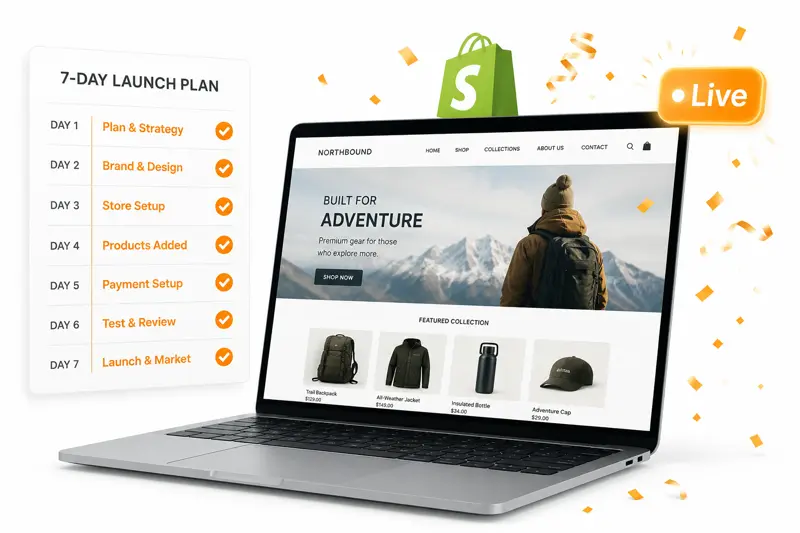
FactoryJet runs Shopify training and support engagements for Raleigh and Triangle SMBs alongside 7-day delivery for new builds. The standard launch ships with theme customization on Online Store 2.0, NC sales tax through Shopify Tax with NCDOR registration support, payment gateway setup, USPS, UPS, and FedEx shipping zones from Raleigh-area hubs, local pickup if you have a Triangle storefront, Product and Organization JSON-LD schema, Klaviyo abandoned cart, and Lighthouse mobile Performance above 90 on launch.
The 8-week support model layers on top: a structured engagement covering discovery, theme and brand alignment, product catalog hygiene, checkout and payments, NC tax automation, shipping, Klaviyo, and a live training session at handoff. Most Triangle SMBs end up combining the 7-day launch with the 8-week support and training wrapper, because the launch covers the build and the wrapper covers the part that decides whether the store actually grows revenue over the next 12 months.
Bigger projects, 500+ SKU catalogs, custom subscription flows, bundle configurators, B2B wholesale layers, or migrations from WooCommerce or BigCommerce, run two to four weeks and are scoped during discovery. The pricing stays transparent. 7-day delivery applies to standard Shopify builds with client assets ready at kickoff.
Talk to the founder directly, Bhavesh runs every Raleigh discovery call himself. Book a 30-minute slot at calendly.com/bhavesh-factoryjet or email me.
➡ See Raleigh Shopify development and support packages
Raleigh Shopify Training and Support Checklist
Before signing any Triangle Shopify training or support engagement, confirm:
- NCDOR sales and use tax registration completed and added to Shopify Tax
- Multi-state economic nexus tracking enabled from day one
- Shopify Online Store 2.0 theme with scheduled sections and collections in place
- Local pickup configured if there is a Downtown Raleigh, Cameron Village, North Hills, Cary, or Durham storefront
- USPS, UPS, and FedEx zones configured for Raleigh-area carrier hubs
- Klaviyo welcome, abandoned cart, browse abandonment, and post-purchase flows live
- Product and Organization JSON-LD schema in place from launch
- Lighthouse mobile Performance above 90 (verifiable at pagespeed.web.dev)
- Written runbooks and recorded training video delivered at handoff
Planning a store
Tell Us What You Sell, and Where
We reply with what we would build and how long it takes. You see a working draft of your store before you sign.
Frequently Asked Questions
What does Shopify training actually cover for a Raleigh small business?
When should a Raleigh SMB hire ongoing Shopify support instead of doing training?
How does North Carolina sales tax work on a Raleigh Shopify store?
How much does Shopify training and ongoing support cost for a Raleigh business?
Should a Raleigh business set up Klaviyo at the same time as Shopify?
When does custom Shopify development beat an off-the-shelf theme for a Triangle brand?
How long does an 8-week Raleigh Shopify support engagement actually take?
What is a realistic Shopify timeline if a Raleigh business just needs the store launched?

Bhavesh Barot
Founder & CEO
Founder & CEO of FactoryJet, an ecommerce and AI services company that has served 500+ businesses across the US, UK, UAE, and India. Writes about ecommerce builds, AI agents, and AI search.
Related reading
- Boise Shopify Development Guide: What Idaho Small Businesses Need to Know in 2026Boise has quietly become one of the most interesting Shopify markets in the Mountain West: an outdoor-recreation economy, a fast-growing downtown, a craft food and beverage scene, and a tech-fluent customer base that buys from local DTC brands on mobile. This guide breaks down what Idaho small businesses actually need from a Shopify build in 2026, from Treasure Valley pickup logistics to BSU football season traffic spikes to when custom Shopify development beats an off-the-shelf theme.
- How to Launch a Shopify Store in 7 Days for US Small BusinessesLaunching a Shopify store in 7 days is achievable for US small businesses with the right process. This guide breaks down the exact daily timeline, what's included in a professional 7-day Shopify setup, what kills timelines, and why a properly run build still ships with Lighthouse 100/100 and full product setup.
- Shopify vs WooCommerce for US Small Businesses in 2026: The Honest ComparisonShopify gets a US small business selling in days with managed hosting, Stripe-powered checkout, and a deep app store. WooCommerce costs less long-term and gives you full ownership, but you'll own the hosting, plugins, and security too. Here's how to pick the right one for your store in 2026.