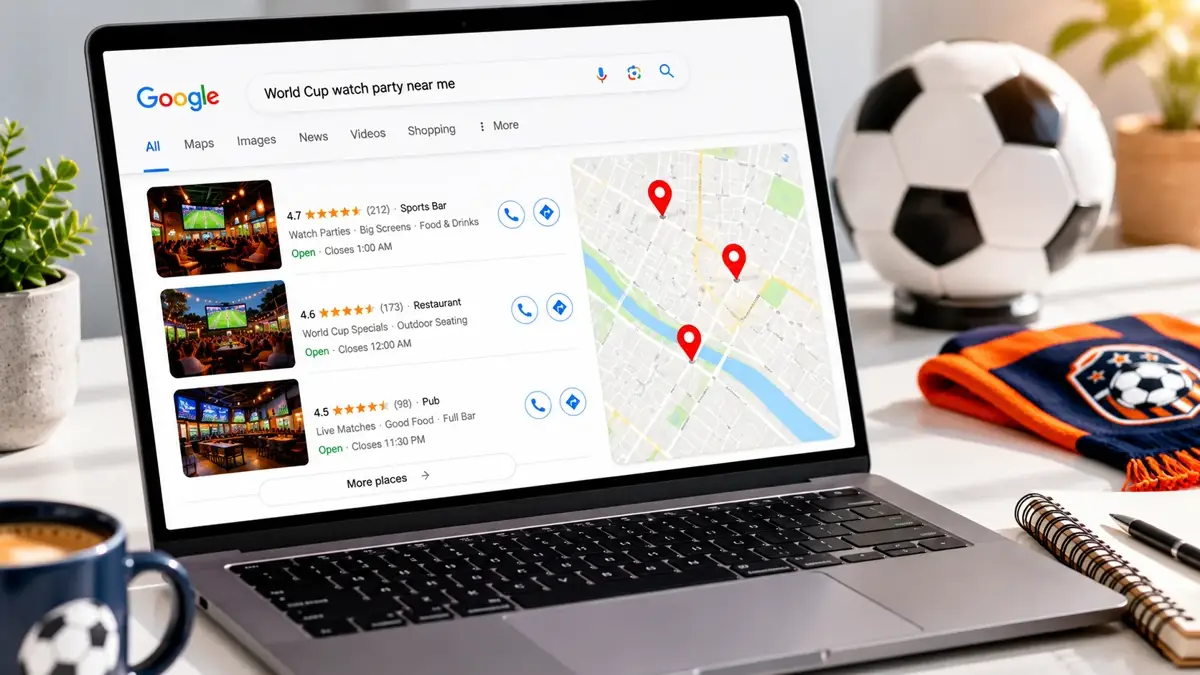
"FIFA World Cup 2026 starts June 11. Here are 7 SEO moves US, UK, and Australian small businesses can execute in days to capture search traffic through July 19. None requires a developer."
Key Takeaways
- 1A page published this week and indexed by next week has three to four weeks of group stage traffic, then catches the highest-volume window: the knockout rounds beginning July 4.
- 2GBP event posts appear in the local pack, knowledge panel, and Maps for relevant queries. It is the highest-return-per-hour task on this list, and free.
- 3AI Overviews now appear in 30 to 49% of searches. FAQPage schema on your highest-traffic page makes you eligible every match day through July 19.
- 4A single quote in a local publication (Dallas Morning News, Miami Herald, Manchester Evening News) does more for local SEO than six months of generic directory submissions.
- 5"Morocco World Cup watch party London" and similar diaspora queries have near-zero competition and high purchase intent. One page wins this lane entirely.
- 6Pages published after July 1 have very little runway. Publish now and submit via Google Search Console immediately.
Search interest for major sporting events spikes sharply during match days in host countries. The 2022 Qatar World Cup reached 5 billion viewers globally, according to FIFA's published figures. The 2026 tournament (48 teams, 104 matches, three host countries) is larger. It starts June 11.
Most small businesses in the US, UK, and Australia have not created a single piece of content targeting World Cup search traffic. That gap is the opportunity.
SEO is not a slow game for event-driven search. A page published this week and indexed by next week has three to four weeks of group stage traffic, then catches the highest-volume window: the knockout rounds beginning July 4. Here are seven moves that will get you there.
Quick Answer
The seven SEO moves for World Cup 2026 are: create a local event landing page, post to your Google Business Profile, add Event schema to match-day promotions, retrofit a FAQ block for AI Overviews, get a local press quote, target diaspora community searches, and publish before July 4 to catch the knockout-round traffic surge. Each takes one to four hours. None requires a developer.
Move 1: Create a Landing Page Targeting “[Your City] World Cup Watch Party”
Right now, if you search “World Cup watch party Dallas” or “World Cup watch party Manchester,” Google returns a thin mix of generic event listing sites and social posts. There are almost no locally optimized business pages targeting these phrases.
This is a meaningful gap. “World Cup watch party [city]” searches will run from June 11 through July 19. In the US, search intent is strongest in the 11 host cities: Dallas, Houston, Miami, Atlanta, Los Angeles, Seattle, Boston, Kansas City, Philadelphia, the San Francisco Bay Area, and New York/New Jersey. In the UK, the query angle is pubs, sports bars, and fan zones. In Australia, it is venues showing matches live during early morning kickoff times.
The page does not need to be long. A 400 to 600-word page with a clear title tag, a match schedule reference, and a call to action (book a table, reserve a spot, order a watch party bundle) will outrank listing sites in local search for most mid-size cities because those sites have no local authority signals. Your Google Business Profile does.
Publish the page. Submit it to Google Search Console for indexing. Done in a day.
Move 2: Add a World Cup Event Post to Your Google Business Profile Today
Google Business Profile event posts appear in the local pack, in the knowledge panel, and in Maps search results. They are one of the most underused SEO tools small businesses have, and they are free.
Create an event post on your GBP for any World Cup-related offering: a watch party night, a limited-time merchandise drop, a promotional deal running through the tournament. The post needs a title, a date range (June 11 to July 19 or specific match dates), a brief description, and a call to action button.
GBP posts from active businesses get surfaced in local search results for relevant queries. A post titled “World Cup Watch Parties Every Match Day: Book Your Table” running June 11 to July 19 will appear when someone searches “sports bar near me World Cup” in your city. That is a free appearance in local pack results for a high-intent search.
This takes 15 minutes. It is the highest-return-per-hour SEO task on this list.
Move 3: Add Event Structured Data to Any Match-Day Promotion
Google's Events rich result surfaces in both the standard search results and in the “upcoming events” carousel that appears for event-intent queries. To get your events there, you need Event schema markup on your page.
The markup is not complicated. At minimum it requires: @type: Event, an event name, a start date, a location with your business address, and a description. For online events or watch parties, use eventAttendanceMode: MixedEventAttendanceMode if customers can join in person or follow online.
For any page announcing a World Cup promotion, a match-day special, or a watch event, add this schema and you become eligible for the events carousel. Competing businesses without this markup will not appear there regardless of their content quality.
If you are a FactoryJet client or work with any competent web developer, this takes one to two hours. If your site runs on WordPress, there are free plugins that generate Event schema without code.
Move 4: Add a World Cup FAQ Block to One Existing High-Traffic Page
AI Overviews (Google's generative search summaries) now appear in 30 to 49% of searches. They pull heavily from pages with answer-first FAQ blocks and FAQPage schema. For time-sensitive, event-driven queries (“where can I watch World Cup 2026 in Austin?”, “best World Cup deals near me”), AI Overviews source from locally relevant content with structured FAQ markup.
Pick one existing page on your site that gets real traffic. A restaurant homepage, a sports bar events page, a retail store landing page. Add four to six FAQ entries answering the most common World Cup questions for your business: “Are you showing World Cup matches?”, “Do I need a reservation for World Cup games?”, “What World Cup specials are you running?” Write answers in plain, direct sentences. Add FAQPage schema to the page markup.
This is a one-time task that pays off every match day through July 19.
Move 5: Get Quoted in at Least One Local World Cup News Story This Week
Local newspapers, city blogs, and regional business publications are actively writing World Cup stories right now. “How local businesses are preparing for the World Cup” is a story every city editor in a host market wants to run before June 11.
A single quote in a local publication from your city generates a citation from a high-domain-authority local news source. One citation from the Dallas Morning News, the Miami Herald, the Manchester Evening News, or The Sydney Morning Herald does more for your local SEO in one afternoon than six months of generic directory submissions.
The pitch is one paragraph: who you are, what you are doing for the World Cup, why local readers care. Send it to the business or lifestyle editor of your local paper this week. Even a short mention with a link to your website is a legitimate local SEO asset.
Move 6: Create Content Targeting Your City's Diaspora Fan Communities
This is the most overlooked World Cup SEO angle for US, UK, and Australian businesses.
The 2026 tournament includes 48 nations. The US, UK, and Australia all have large, organized communities with roots in nations competing for the Cup. In the US: Mexican, Brazilian, Colombian, Salvadoran, Honduran, Jamaican, and Moroccan communities among many others. In the UK: South Asian, Nigerian, Ghanaian, Polish, and Latin American communities. In Australia: Greek, Italian, Croatian, Lebanese, Chilean, and Vietnamese communities.
These communities search for match viewing locations and fan merchandise specific to their home nations. “Morocco World Cup watch party London” or “Colombia World Cup merchandise near me Denver” are queries where the competition is essentially zero and the purchase intent is high.
A single page or GBP post targeting the specific match schedules and fan interests of the two or three largest diaspora communities in your city gives you visibility in a search lane that no large national retailer has bothered to optimize for.
Move 7: Publish Everything Before July 4 to Catch the Knockout-Round Surge
Group stage matches run June 11 to July 2. Round of 16 begins July 4. Quarterfinals: July 8. Semifinals: July 14 to 15. Final: July 19.
Search volume for World Cup-related terms does not stay flat. It compounds as the stakes rise. The group stage generates steady baseline interest. The knockout rounds generate 3 to 4x the search volume because the emotional stakes for individual matches increase and the audience grows as casual viewers begin following the tournament.
Pages and GBP content published this week have three weeks to be indexed and establish topical relevance before July 4. Pages published July 3 will be indexed around the time the tournament ends.
Publish now. Submit URLs via Google Search Console immediately after publishing. For the UK audience specifically, England's participation in the knockout stages will drive a significant search spike in UK local intent queries if they advance. The same applies to the Socceroos for Australian searches.
World Cup 2026 SEO: Regional Opportunity Breakdown
| Market | Top Search Opportunity | Peak Traffic Window | Example Target Query | Existing Competition |
|---|---|---|---|---|
| United States (host) | “[City] World Cup watch party” + host venue searches | June 11 to July 19 | “World Cup watch party Dallas 2026” | Very low |
| United Kingdom | England match pubs + fan zones | June 12 to July 19 | “World Cup pub near me London” | Low to medium |
| Australia | Venue searches (early kickoff times) | June 11 to July 19 | “where to watch World Cup 2026 Sydney” | Low |
| All three markets | Diaspora community fan searches | June 11 to July 19 | “Morocco World Cup watch party [city]” | Near zero |
| All three markets | Merchandise + local delivery | July 4 to 19 (knockout) | “World Cup jersey same day [city]” | Very low |
Need someone to implement this in days, not weeks?
FactoryJet has built SEO pages, event landing pages, and schema-optimized content for US, UK, and Australian clients on fast timelines. The knockout rounds start July 4. If you start now, every move on this list is live with time to index and rank.
Book a 30-Minute Call With BhaveshWhat You Should Have Done Months Ago (And Can Still Partially Fix)
Most of these moves would have delivered stronger results if they were in place 60 to 90 days before the tournament. If you had published a “World Cup 2026 watch party [city]” page in March, it would have 90 days of indexing history and potentially a few backlinks by now.
That ship has sailed. What has not sailed is the three to four weeks between now and the quarterfinals. Content published this week is eligible for the highest-traffic stretch of the tournament. It is not a perfect situation. It is still a better situation than doing nothing.
The businesses that will look back on the World Cup as a missed opportunity are the ones that read this and do not publish anything before June 11. The ones that act this week capture traffic through July 19 and come away with event pages, GBP posts, and local citations that continue to benefit their SEO long after the Final whistle.
FactoryJet can handle the page builds, schema markup, and GBP optimization if you need a team to execute rather than a list to follow. The World Cup ecommerce playbook covers the store-launch angle for businesses selling merchandise. For SEO implementation built specifically for your market, the US SEO service page shows what a full engagement covers.
Three Weeks. Seven Moves. Do the Math.
The World Cup runs 39 days. The highest-intent search traffic arrives during the knockout rounds starting July 4. If you publish this week, your pages have three weeks to index and establish local relevance before that traffic spike arrives.
FactoryJet implements SEO pages, Event schema, GBP optimization, and local landing pages for US, UK, and Australian clients. The US SEO service page covers what a full engagement looks like. Businesses in host cities like Tampa have a particularly strong local search angle during the tournament. If you want to discuss what the next 72 hours should look like for your specific business, book a 30-minute strategy call with Bhavesh , no pitch, just a plan.
Bhavesh Barot is the founder of FactoryJet, a web development and SEO agency serving US, UK, and Australian small businesses. FactoryJet has launched 500+ websites and SEO campaigns for clients across three continents. Book a strategy call here.
Want this done for you?
Get a free, no-pitch plan for your site.
Tell us where to send it. Bhavesh, the founder, reviews every request himself and replies within 24 hours, often the same day. Most sites ship in about 7 days.
Frequently Asked Questions
When is the best time to publish World Cup SEO content?
Does creating a World Cup page help my general local SEO?
How long does it take Google to index a new page?
Can a restaurant or bar rank for "World Cup watch party near me" without a separate landing page?
What is the correct Event schema for a watch party?
Should I target "World Cup 2026" or just "World Cup"?
Do GBP event posts actually appear in search results?
What is the difference between an Event post and a regular GBP post?
How do I target diaspora community searches without sounding forced?
Is it worth doing World Cup SEO if my city is not a host venue?
How much traffic can I realistically expect from a well-optimized World Cup page?
Does World Cup content help my site after July 19?
Should I create World Cup content in multiple languages?
What is the best way to get a local press quote for World Cup coverage?
Can I use FIFA's official branding in my SEO content?
How do I add FAQPage schema to my website?
What if I do not have time to do all 7 moves?
Does World Cup SEO work for service businesses, or only retail?
Is this worth the effort for a business with no existing SEO?
What analytics should I track during the World Cup?
How is World Cup SEO different from standard local SEO?
Should I delete my World Cup page after July 19?
Bhavesh Barot
Founder & CEO
Founder & CEO of FactoryJet, a web design and e-commerce agency serving 500+ US, UK, and UAE businesses. Expert in small business website strategy, Shopify development, and Core Web Vitals optimization.