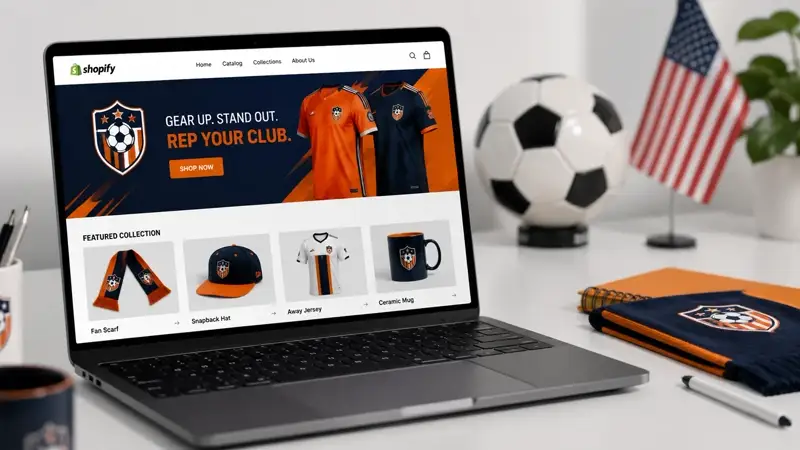
"MetLife Stadium in New Jersey hosts the FIFA World Cup 2026 Final on July 19. Most US small businesses will watch this unfold from the sidelines. The ones that don't are building Shopify stores right now. This is their playbook."
Key Takeaways
- 1The tournament runs 39 days, not one weekend. A store launched this week covers group stage and the highest-spending knockout rounds: quarterfinals July 4–5, semifinals July 8–9, and the Final July 19.
- 2National flags and country color combinations are not trademark-protected. Fan merchandise in national colors needs no FIFA license. A product category with almost no retail competition.
- 3Over 70% of e-commerce traffic during live sporting events originates from mobile devices. Mobile checkout testing is not optional. It decides whether a halftime browser converts or bounces.
- 4Digital products (watch party planning kits, bracket prediction guides, sweepstakes templates) are the margin play: instant delivery, zero fulfillment overhead, same-day launch.
- 5A realistic scenario with a $1,500 paid social budget over 6 weeks: 300–600 orders at $45 AOV = $13,500–$27,000 gross revenue. Conservative estimate for a store with competent traffic spend.
- 6After July 19, your flash-sale store is a permanent Shopify channel ready for NFL preseason (August), college football (September), and the fall holiday cycle.
MetLife Stadium in New Jersey hosts the FIFA World Cup 2026 Final on July 19. Before that, 104 matches run across 16 venues in three countries (the US, Canada, and Mexico), with 11 of those venues on US soil. According to FIFA's official communications, the 2022 Qatar World Cup reached over 5 billion viewers globally. With 48 teams competing in 2026, up from 32 in Qatar, that number is only going higher.
Most US small businesses will watch this unfold from the sidelines, the same way they watched every Super Bowl and March Madness roll through without capturing a dollar of the spending. The ones that don't watch from the sidelines are building Shopify stores right now.
This is the playbook for those businesses.
Quick Answer
It is not too late to launch a profitable World Cup flash-sale store. The tournament runs June 11 through July 19. The highest-spending windows are the quarterfinals (July 4 to 5), semifinals (July 8 to 9), and Final (July 19). A functional 5-to-10-product Shopify store can go live in 5 to 7 business days. If you start this week, you have full coverage of every elimination match.
Why This Is the Biggest US Retail Moment Since the 1994 World Cup
The United States co-hosted FIFA's World Cup in 1994. Most American small business owners were children. The 2026 tournament is the first time since then that the US is a host country, and the scale is categorically different.
Here's what makes 2026 structurally different from every other sporting event US businesses deal with:
The host cities are the cities where your customers already live.The 11 US venues span Dallas (AT&T Stadium), Houston (NRG Stadium), Atlanta (Mercedes-Benz Stadium), Miami (Hard Rock Stadium), Los Angeles (SoFi Stadium), Seattle (Lumen Field), Boston (Gillette Stadium), Kansas City (Arrowhead Stadium), Philadelphia (Lincoln Financial Field), the San Francisco Bay Area (Levi's Stadium), and New York/New Jersey (MetLife Stadium). These aren't fringe markets. They're the retail corridors where American commerce runs.
It runs 39 days, not one weekend.The Super Bowl is one city, one game, one 72-hour spending window. The World Cup is 39 days. Group stage games plus knockout rounds plus the Final. That's six weeks of sustained fan spending, and your store can be live for all of it.
FIFA's 2026 expansion to 48 teams means more nations with passionate fan bases in the US diaspora. Communities that trace roots to African, Asian, Latin American, and European nations are active buyers during matches that involve their home countries. A store selling merchandise for non-traditional soccer markets (like Morocco, Japan, South Korea, Nigeria, or Ecuador) will face almost no competition from established US retailers.
The economic case is real. FIFA's own economic impact study for the 2026 tournament projected $5 billion in direct US economic activity across host cities over the tournament period, cited in the bid documents submitted to Congress ahead of the hosting decision. That money flows somewhere. For small businesses with a functioning online store, a meaningful fraction of it can flow to you.
What Actually Sells During a World Cup (and Who Should Sell It)
“Jerseys” is the obvious answer, and it's correct. It's also just the start. The full opportunity map looks like this:
| Product Category | Avg Order Value | Who Should Sell It | Realistic Lead Time |
|---|---|---|---|
| Fan apparel (scarves, flags, country colors) | $20 to $55 | Any small retailer | 3 to 5 days |
| Team jerseys and kits (licensed via print-on-demand) | $45 to $95 | Sports retailers, print-on-demand shops | 1 to 7 days |
| Watch party bundles and party supplies | $60 to $150 | Event companies, party supply retailers | 2 to 5 days |
| Restaurant and bar World Cup packages | $150 to $400 | F&B businesses | 1 to 3 days |
| Sports accessories (hats, bags, enamel pins, keychains) | $25 to $75 | Accessories brands, boutiques | 3 to 7 days |
| Corporate hospitality and watch event packages | $500 to $5,000 | B2B service businesses | 7 to 14 days |
| Digital products (prediction guides, sweepstakes kits, PDF planners) | $15 to $49 | Content creators, consultants | Same day |
| Local city experiences and fan tour packages | $75 to $300 | Tourism operators, hospitality businesses in host cities | 2 to 5 days |
Range estimates based on Shopify's merchant commerce trend reports and National Retail Federation sports merchandise category data.
The non-obvious opportunity is digital products and bundles. If sourcing physical inventory in time is not realistic for your business, a $29 World Cup watch party planning kit or a $49 fan bracket sweepstakes template clears serious margin with zero fulfillment overhead. There is no shipping delay on a PDF. The store goes live today, the product sells today, and the revenue hits your account today.
A 7-Day Shopify Store Is Real. Here's What's Actually in It.
People hear “7-day website build” and assume something thrown together. That's not how it works at FactoryJet, and it's not how any competent Shopify developer approaches an event commerce build.
Here's what a 7-day flash-sale store actually contains:
Days 1 to 2: Strategy session, product catalog review, Shopify plan selection, domain connection, payment gateway configuration (Shopify Payments, Stripe, or PayPal depending on your needs), and shipping zones set. The store skeleton exists by end of Day 2.
Days 3 to 4: Theme customization to match your brand rather than a generic out-of-box Shopify look. Product pages built with optimized image placement, clear variant selectors, and mobile-first layout. Collection pages structured for browsing. The store looks like yours, not like a template.
Days 5 to 6:Flash-sale mechanics installed. Countdown timer tied to game dates. Discount code system configured. Email capture popup with offer. Abandoned cart recovery email flow activated. If you're running paid ads, UTM tracking and Google Analytics 4 connected.
Day 7: Test orders placed across mobile and desktop. Page speed verified. Cross-device checkout tested. Store reviewed, approved, and launched.
What you don't get in 7 days: multi-warehouse inventory integrations, custom loyalty points systems, complex B2B pricing tiers, or external ERP connections. For a flash-sale store targeting a 6-week tournament window, none of those are needed anyway. You need fast, clean, and converting.
For platform choice: if you're weighing Shopify against WooCommerce for a time-sensitive build, the Shopify vs. WooCommerce comparison for US small businesses breaks down the full cost and setup difference. For an event store with a hard deadline, Shopify wins on setup speed every time.
FactoryJet's e-commerce development service has launched stores for US clients on this timeline. The 7-day window is not a marketing claim. It's a production schedule.
The quarterfinals start July 4. Your store needs to be live before then.
FactoryJet has launched Shopify stores for US small businesses in 7 days flat — product catalog, mobile checkout, email capture, countdown timers, and abandoned cart recovery all wired up before launch. If you start this week, you cover the full knockout round spending surge from quarterfinals (July 4–5) through the Final on July 19.
Book a 30-Minute Call: Build My World Cup Store →The 3 Mistakes That Kill World Cup Flash Sales Before They Start
Mistake 1: Assuming you needed to launch on June 11.
The opening match generates buzz. It does not generate the tournament's biggest purchase volume. Look at the bracket: group stage (June 11 to July 2), round of 16 (July 4 to 7), quarterfinals (July 8 to 9), semifinals (July 14 to 15), Final (July 19). The deeper the tournament goes, the higher the emotional stakes, and the higher the purchase intent.
A store launched by June 21 has four weeks of runway before the quarterfinals. That is not a compromised position. That is a good position.
Mistake 2: Selling licensed merchandise without understanding US trademark law.
FIFA's official branding (the FIFA badge, the World Cup trophy artwork, the “FIFA World Cup 2026” wordmark, and official team crests) is fully protected intellectual property under US trademark law. Selling merchandise that uses these marks without authorization will get your store reported to FIFA's legal team, your listings removed, and in serious cases, your Shopify account suspended.
The legal path forward is straightforward. Work with a FIFA-licensed manufacturer, use a print-on-demand platform that holds the official license (Fanatics holds broad rights in the US), or sell fan merchandise that uses national flags and country colors without official crests or logos. National flags are not trademark-protected. Country color combinations are not trademark-protected. This is a meaningful product category all on its own.
Mistake 3: Treating mobile checkout as a “nice to have.”
Over 70% of e-commerce traffic during live sporting events originates from mobile devices. Fans are watching matches on their TVs and shopping on their phones during halftime. If your checkout flow takes more than three taps to complete on an iPhone, or if your product pages take more than three seconds to load on a 4G connection, you're losing buyers at the peak moment of their purchase intent.
Every store FactoryJet builds goes through mobile checkout testing before launch. Not as a final polish step. As a core build requirement.
Ready to build your World Cup store?
FactoryJet has launched Shopify stores for US small businesses in 7 days. The quarterfinals start July 4. If you begin this week, your store is live and generating sales 12 days before the highest-spending stretch of the tournament.
Book a 30-Minute Call: No Pitch, Just a PlanHow to Drive Traffic to Your World Cup Store in the Next 30 Days
The store is half the job. Traffic is the other half. Here's where to focus, ranked by speed-to-impact:
Google Shopping adsare the fastest lever. Target World Cup merchandise search terms. These campaigns go live within 24 to 48 hours of setup. For a 5-week tournament window with a $1,000 to $2,500 budget, you're visible for every commercial intent search in your geography.
Organic social content starting now.Post your product lineup, your watch party recommendations, and your local angle. If you're in Dallas, Houston, Miami, Atlanta, or any of the other 11 US host cities, lean into it explicitly. A small business in Dallas selling fan merchandise for a Dallas-hosted match is a story with inherent social appeal. Use it.
Email to your existing list. If you have a customer list of even 300 to 500 people, a three-email campaign (store launch, halftime of a key match, Final countdown) will outperform paid channels on ROI. Your existing customers already trust you. That trust converts.
Local press outreach.“Local business launches World Cup store” is a story that local newspapers, city blogs, and neighborhood newsletters actively want to publish right now. One well-targeted email to the business editor of your city paper costs nothing and can drive more traffic than three weeks of Instagram posts.
For FactoryJet clients in key US markets, including Nashville, Miami, Dallas, Houston, and Atlanta, we specifically build location-aware content into store launch plans so the local angle is part of the store's messaging from day one, not a retrofit.
Build Your World Cup Store Before the Quarterfinals
The quarterfinals start July 4. That is 27 days from today.
A store launched this week is live with a full two weeks of group stage traffic before the knockout rounds begin. After July 19, you have a permanent Shopify store ready for NFL season, back-to-school, and Black Friday. This campaign is not a one-time project. It's the moment you build infrastructure your business runs on for the next decade.
FactoryJet has launched over 500 business websites and stores for clients in the US and internationally. We know exactly what a 7-day Shopify build looks like and what it takes to make it convert.
Book a 30-Minute Call With Bhavesh
You'll leave with a specific product recommendation, a realistic store timeline, and a launch plan written for your business. The call is free. The opportunity is not going to repeat itself for another 30 years.
Bhavesh Barot is the founder of FactoryJet, a web development and e-commerce agency serving US small businesses. FactoryJet has launched 500+ stores and websites for clients across the US, UK, and India. Book a strategy call here.
Want this done for you?
Get a free, no-pitch plan for your site.
Tell us where to send it. Bhavesh, the founder, reviews every request himself and replies within 24 hours, often the same day. Most sites ship in about 7 days.
Frequently Asked Questions
When does FIFA World Cup 2026 start?
Which US cities are hosting World Cup 2026 games?
What's the biggest e-commerce opportunity for US small businesses during World Cup 2026?
Can I really build a Shopify store in 7 days?
What products sell best during a World Cup?
Do I need a license to sell World Cup merchandise?
How much does it cost to build a flash-sale Shopify store?
Is it too late to launch a store for World Cup 2026?
What platform should I use for a flash-sale store?
How important is mobile checkout for World Cup shoppers?
Can a restaurant or bar use e-commerce to benefit from the World Cup?
What's the most important page on a flash-sale store?
How do I handle shipping for World Cup orders?
What if I don't sell physical products? Can I still make money from the World Cup?
How much can I realistically make from a World Cup flash-sale store?
Should I start a whole new store or add World Cup products to my existing website?
How early should I start promoting my World Cup deals?
What happens to my store after the World Cup ends on July 19?
How does FactoryJet build a store in 7 days without cutting corners?
Do I need to be in a World Cup host city to benefit from the tournament?
Should I hire a US agency or a specialized e-commerce team for this build?
What if my products arrive late? Can I do pre-orders on Shopify?
Can I build a flash-sale store in 7 days myself, without hiring anyone?
Is there a specific app or plugin I should use for a World Cup flash-sale store?

Bhavesh Barot
Founder & CEO
Founder & CEO of FactoryJet, a web design and e-commerce agency serving 500+ US, UK, and UAE businesses. Expert in small business website strategy, Shopify development, and Core Web Vitals optimization.