"Webflow gives a US small business a visually polished site with managed hosting and zero plugin chaos, but it caps out fast on content depth and integrations. WordPress costs less long-term, scales further, and runs on the world's largest plugin ecosystem, but you own the maintenance. This 2026 guide maps each platform to the team, budget, and content rhythm you actually have."
Key Takeaways
- 1Webflow wins for design-led marketing sites under 50 pages where a non-technical owner or designer maintains the site and plugin sprawl is the thing you want to avoid most.
- 2WordPress wins for content-heavy sites (50+ blog posts, multilingual, membership, learning, complex forms) and for any project where total budget is under $10,000.
- 3Real US pricing in 2026: Webflow Site plans run $15/month (Basic) and from $25/month (Premium) billed yearly, hosting included, with a $2,500/month Team plan and custom Enterprise pricing above that; WordPress is free software plus $5-$100/month hosting plus $0-$500 in one-time themes/plugins plus $5,000-$50,000 in build.
- 4Three-year total cost of ownership for a typical SMB marketing site: Webflow lands $4,500-$15,000 with a professional build; WordPress lands $8,000-$40,000 once you add agency build, maintenance retainer, and premium plugins.
- 5Webflow's design freedom and clean code are real advantages: its CMS caps (20,000 items and 40 Collections on Premium, no CMS at all on Basic) and paid-add-on multilingual support are real ceilings.
- 6The headless option is mature on both sides in 2026: Webflow as a CMS with a Next.js front end via the Webflow API, or WordPress headless with the REST API or WPGraphQL.
- 7FactoryJet builds on both platforms and recommends the one that matches your team's strengths, not the one we feel like selling that quarter.
Table of Contents
- The Short Answer for US Small Businesses
- Side-by-Side: 12 Factors That Actually Decide It
- When Webflow Wins for US SMBs
- When WordPress Wins for US SMBs
- Real US Pricing in 2026: All-In Math
- The Headless Option on Both Sides
- Migration Paths Between the Two
- What FactoryJet Builds on Both Sides
Webflow and WordPress are both legitimate choices for a US small business in 2026, and the "which is better" debate misses the point. They're solving slightly different problems for slightly different teams. Webflow is a managed, design-first platform that trades ecosystem breadth for clean execution. WordPress is an open-source CMS that trades managed convenience for a 60,000-plugin ecosystem and lower long-term cost. The right call comes down to your team, your content rhythm, and your budget, not which platform a Reddit thread told you to prefer.
We've already covered what Webflow is and how its pricing works. This guide is the head-to-head: 12 factors with real US numbers, the scenarios where each platform clearly wins, the headless paths if you want both, and the migration math if you're already on one and considering the other.
The Short Answer for US Small Businesses
Pick Webflowif your site is a brand-led marketing presence under 50 pages, your owner or designer maintains it directly, you want zero plugin maintenance, and your budget supports $14-$39/month in platform fees plus a one-time $3,000-$15,000 build. The visual editor is the best in the industry for designers, the hosting is fully managed, and you'll never patch a security vulnerability at 2 AM.
Pick WordPressif you publish content frequently, need multilingual, run any kind of membership, learning, or community functionality, want a 60,000-plugin ecosystem on tap, or your total budget is under $10,000. WordPress still powers roughly 43% of the web for good reason, it's mature, extensible, and dramatically cheaper at scale.
For most US SMBs spending less than $5,000 on a marketing site, WordPress is the financially correct call. For DTC brands, design studios, and B2B SaaS companies where the visual storytelling on the homepage is the pitch, Webflow is often worth the higher all-in cost.
Side-by-Side: 12 Factors That Actually Decide It
| Factor | Webflow | WordPress |
|---|---|---|
| Pricing model | $15/month Basic, from $25/month Premium (billed yearly, hosting included) | Free software + $5-$100/month hosting |
| Hosting | Managed AWS-backed CDN (included) | You choose (WP Engine, Kinsta, Pressable, etc.) |
| Design freedom | Pixel-perfect visual editor; full CSS control | Theme-driven; full freedom with custom theme |
| Ease of use (editor, post-launch) | Excellent, in-place edits, no admin dashboard | Good, Gutenberg block editor in /wp-admin |
| Scalability (page count) | 300 static pages on Basic; 20,000 CMS items on Premium | No practical limit on posts or pages |
| Plugin / integration ecosystem | Webflow Apps + Marketplace (curated, smaller) | 60,000+ plugins in official repo |
| Performance (Lighthouse mobile) | 90-100 out of the box (clean code, CDN) | 60-90 typical; 95+ with care and good hosting |
| SEO control | Strong, full meta, schema, OG, canonical control | Strong, Yoast / Rank Math + native blog |
| Content editor UX | Editor mode (in-place); CMS collections | Gutenberg blocks, custom post types, taxonomies |
| Multilingual support | Webflow Localization ($9+/mo per locale) | WPML / Polylang / TranslatePress (mature) |
| Ecommerce (native) | Webflow Ecommerce ($29-$235/mo, <500 products) | WooCommerce (free plugin, unlimited products) |
| 3-year TCO (typical SMB site) | $4,500-$15,000 | $8,000-$40,000 |
A quick note on that last row: Webflow looks cheaper in 3-year TCO at the low end because the platform fee includes hosting, security, and updates. WordPress totals higher once you add a maintenance retainer (which most SMB owners eventually pay because they stop running plugin updates themselves). The TCO flips above 50,000 monthly visits or on multilingual / multi-locale builds, at that point WordPress wins on cost again.
When Webflow Wins for US Small Businesses
Webflow is the right call in five or six specific situations. Each one comes back to the same theme: you want design polish and managed simplicity, and you don't need (or want) the WordPress plugin ecosystem.
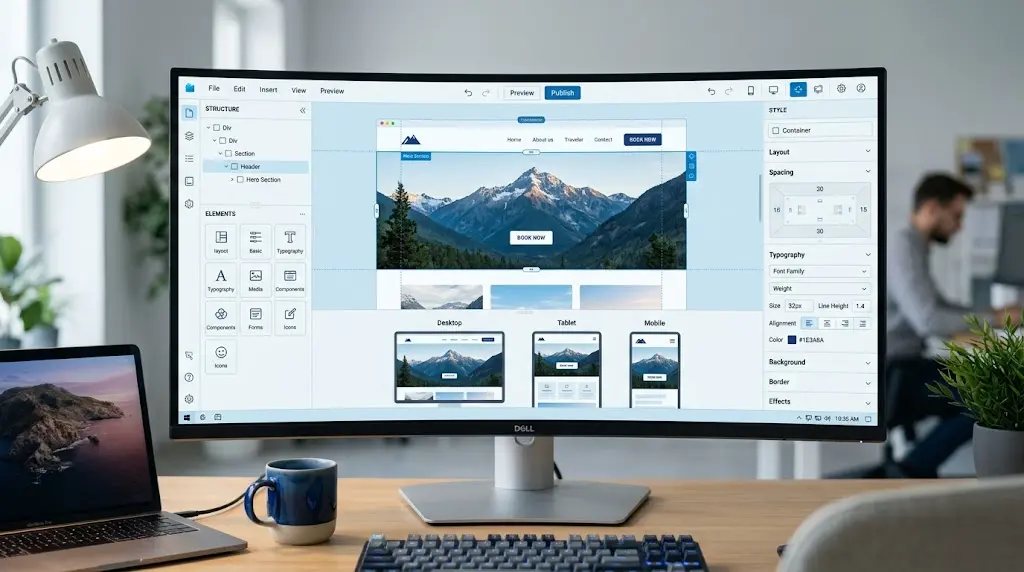
1. Designer-led brands where the visual is the strategy.Boutique studios, fashion brands, restaurants with a strong identity, architecture firms, creative agencies, premium DTC brands. If the marketing pitch is "our brand feels different," Webflow's visual editor and clean code execution lets your designer build exactly what they sketched without a developer in the loop.
2. Marketing sites under 50 pages with no big blog.If your site is 10-30 pages plus a light blog and you publish a few posts a month, Webflow is right-sized. The static page cap and CMS item limits don't bite at this scale, and the maintenance savings are real.
3. No in-house dev and no appetite for plugin maintenance. Webflow has zero plugin update cycles, zero PHP version migrations, and zero hosting decisions. You pay the monthly Site plan and the platform handles security, updates, backups, and uptime. For a 2-5 person US SMB with no technical staff, the cognitive offload is significant.
4. Owner or marketing manager will edit the site directly.Webflow's in-place Editor mode is genuinely the easiest post-launch editing experience in the industry. Click any text, change it, hit publish. No dashboard, no learning curve, no breaking the layout. For owners who want to update the team page or swap hero copy themselves on a Tuesday afternoon, this matters.
5. Performance is non-negotiable and you don't want to fight for it. Webflow ships with clean semantic HTML, a global CDN, and lazy-loaded images by default. You can hit Lighthouse 90-100 mobile with no special configuration. WordPress can hit those numbers too, but it takes a properly built theme, a good host, and ongoing discipline.
6. You want a fast, low-risk launch with a 7-day window.For a polished design-led brand site of 5-15 pages, Webflow and WordPress are both realistic in a 7-day timeline. Webflow tends to be slightly faster because there's no hosting setup or plugin selection, you go straight from design to launch.
See our US web design service overview for how we scope Webflow and WordPress builds against each other.
Still deciding which platform to build on?
The platform matters less than whether the build is fast, accessible and easy for your team to run. FactoryJet builds on Webflow, WordPress and custom Next.js, and recommends the fit rather than pushing one option.
See web design services →When WordPress Wins for US Small Businesses
WordPress is the right call in a different set of scenarios: most of them tied to content depth, ecosystem needs, or budget reality.
1. Content-heavy or blog-led acquisition. If your business runs on SEO content, publishes weekly, has 50+ blog posts already (or plans to within a year), or needs custom post types and taxonomies, WordPress is built exactly for this. The Gutenberg editor, native categories and tags, scheduled publishing, editor roles, and Yoast/Rank Math integration are mature in a way no other CMS matches at the same price.
2. Multilingual sites with 3+ languages.WordPress's multilingual options (WPML, Polylang, TranslatePress) are battle-tested across millions of sites. They handle translated URL structures, hreflang tags, language switchers, and SEO setup cleanly. Webflow Localization is improving but is still pricier per locale and thinner on features.
3. Complex functionality: membership, learning, forums, custom forms.If you need a paid membership area (MemberPress, Paid Memberships Pro), a learning management system (LearnDash, Tutor LMS), a forum (bbPress, Asgaros), or complex multi-step forms with conditional logic and integrations (Gravity Forms, WPForms, Formidable), WordPress has best-in-class plugins for each. Webflow has integrations with third-party SaaS like Memberstack and Outseta, but you're paying separate subscriptions and stitching tools together.
4. Budget under $10,000 for the full build.A professional WordPress build for a US SMB runs $5,000-$15,000 with a custom theme; the same scope on Webflow tends to come in $1,000-$3,000 higher because of the platform's required Site plan and the design time. If budget is the binding constraint, WordPress almost always stretches further.
5. Plugin ecosystem optionality you might need later.Even if you don't need a booking system, donation processor, real estate listing manager, restaurant menu builder, or job board today, WordPress having a mature plugin for each is real future-proofing. Webflow's ecosystem is growing but doesn't yet have a plugin for every niche use case.
6. You already run WordPress somewhere else.If your blog is on WordPress, your nonprofit chapter is on WordPress, or a sister brand uses it, staying on WordPress means one set of editor training, one maintenance retainer, and one set of plugins to reason about. Mixing platforms across the same business is usually more friction than it's worth.
See our US WordPress development packages for scope and 7-day delivery details.
Real US Pricing in 2026: All-In Math
Both platforms have surface pricing and real pricing. Here's what a US SMB actually pays in 2026, with the line items that don't show up on the marketing page.
Webflow real pricing. Site plans: Basic $15/month (no CMS, up to 300 static pages, 10 GB bandwidth), Premium from $25/month (Webflow CMS with 20,000 items and 40 Collections, 50 GB bandwidth, more bandwidth costs extra). Those are billed-yearly prices; billed monthly, Basic is $25 and Premium starts at $39. Above them, the Team plan is $2,500/month on an annual contract and Enterprise is custom. All site plans include hosting and CDN. Ecommerce plans are Standard $29/month (500 items, 2% transaction fee), Plus $74/month and Advanced $212/month, billed yearly (Webflow pricing, checked 26 Sep 2026). A professional Webflow build for a US SMB typically runs $3,000-$15,000 depending on page count, custom interactions, and CMS structure. Three-year all-in for a typical SMB marketing site: $4,500-$15,000.
WordPress real pricing.Software is free. Hosting: shared $5-$30/month (good enough for a brochure site), managed $30-$100/month (WP Engine, Kinsta, Pressable, recommended for any serious site). One-time costs: premium theme $0-$100, premium plugins $0-$400 total (Yoast Premium, Gravity Forms, a backup tool, etc.). Build: $5,000-$50,000 depending on agency and scope; budget $5,000-$15,000 for a typical SMB marketing site. Ongoing: $99-$249/month maintenance retainer if you outsource it, or 2-4 hours/month of internal time if you do it yourself (most owners don't sustain this). Three-year all-in for a typical SMB site with maintenance: $8,000-$40,000.
Webflow looks more expensive on the monthly platform fee and ends up cheaper or comparable once you bake in WordPress's real maintenance cost. Beyond 50,000 monthly visitors or on multilingual builds, WordPress wins on cost again. Below that, the platforms are closer than the sticker prices suggest.
See our FactoryJet US pricing for what we charge to build on either platform.
The Headless Option on Both Sides
Headless is the architecture where the CMS handles content and a separate front end renders the site. Both Webflow and WordPress support this in 2026, and for the right SMB, it's the best of both worlds.
Webflow as a CMS with a Next.js front end.You build your content model in Webflow CMS (collections, fields, references), use the Webflow Editor for content updates, and consume the data via the Webflow Data API into a Next.js or Astro front end hosted on Vercel or Netlify. You get Webflow's editor UX for non-technical content updates plus Next.js's performance and design freedom. Typical SMB build: $12,000-$35,000.
WordPress headless with REST API or WPGraphQL.WordPress runs the back end (familiar editor, custom post types, taxonomies, user management), and a Next.js front end fetches content via the REST API or WPGraphQL. Lighthouse 100/100 is achievable, the editor team stays in WordPress, and you have full design control. This stack is now production-mature with WP Engine's Atlas, Vercel integrations, and WPGraphQL. Typical SMB build: $15,000-$45,000.
Both headless paths are real, both are overkill for a 10-page brochure site, and both make sense when content team comfort matters and performance is non-negotiable. For a deeper dive on the WordPress headless side, see our companion comparison: Custom Web Development vs WordPress for US Small Businesses. For custom application work that goes beyond either CMS, see our US web application development service.
Migration Paths Between the Two
Migrating between Webflow and WordPress is real work in both directions, but neither is impossible. The right approach depends on how you treat SEO equity and how much of the design needs to survive the move.
WordPress to Webflow.This is the harder direction because Webflow doesn't accept a WordPress export file natively. The workflow: export your WordPress content as XML, convert to CSV, import into Webflow CMS collections. Rebuild the design in Webflow's visual editor (the design itself does not transfer). Map every old URL to a new URL with 301 redirects (Webflow supports this via its hosting panel or via Cloudflare in front). Submit the updated sitemap to Google Search Console and monitor coverage for 60-90 days. A 30-100 page migration runs $4,000-$12,000 for a professional service that preserves SEO equity. Done right, Google transfers ranking signals within 3-6 months. Done sloppily, you can lose 40-70% of organic traffic permanently.
Webflow to WordPress.Easier on the content side (export Webflow CMS as CSV, import with WP All Import), harder on the design side (you rebuild the theme in WordPress, since Webflow exports HTML/CSS but not a full WordPress theme). Same SEO discipline applies: 301 redirect map for every URL, sitemap submission, schema preserved. Budget $3,000-$10,000 for a 30-100 page Webflow-to-WordPress migration. Most US SMBs do this when they outgrow Webflow's CMS limits, need multilingual, or want to add functionality (membership, learning, forum) that Webflow can't cover natively.
A practical recommendation: don't migrate platforms because of FOMO. Migrate because you've hit a hard limit (Webflow CMS cap, multilingual need, plugin requirement) or because the math changed (Webflow is now cheaper than your WordPress retainer, or WordPress hosting is now cheaper than your Webflow plan at scale). For related comparison reading, see our Shopify vs WooCommerce for US Small Businesses guide.
What FactoryJet Builds on Both Sides
FactoryJet builds both Webflow and WordPress sites for US small businesses. We don't prefer one commercially, we recommend whichever fits your team, content rhythm, and budget. Roughly 60% of our US SMB marketing-site clients are correctly served by WordPress; 30% are better served by Webflow; 10% land on the headless path.
Webflow builds: Custom design (no purchased templates), Webflow CMS collections structured for your content, Lighthouse 90+ mobile scores, WCAG 2.2 Level AA accessibility, full on-page SEO (meta, schema, OG, canonical control), Webflow Editor training for your team, and Site plan setup on the right tier for your scale. 7-day delivery on standard 5-page builds when content is provided at kickoff. Fixed price quoted in writing after scoping.
WordPress builds: Custom theme development (no themeforest), Lighthouse 90+ mobile scores, WCAG 2.2 Level AA accessibility, full SEO configuration (Yoast or Rank Math + schema markup), managed hosting setup on WP Engine, Kinsta, or Pressable, and editor training for your team. 7-day delivery on standard 5-page builds. Fixed price quoted in writing after scoping. See WordPress development packages for full scope.
Headless builds: Webflow + Next.js or WordPress + Next.js with WPGraphQL. The editor experience your team already knows, paired with the performance and design freedom of a custom front end. Scoped and quoted at a fixed price before work starts.
Every build ships with the same technical foundation regardless of platform: Lighthouse 90+ mobile, WCAG 2.2 Level AA accessibility, Organization and LocalBusiness JSON-LD schema, Core Web Vitals green, GA4 and Search Console configured, and full code and data ownership transferred to you at final payment.
Still not sure: Webflow or WordPress?
Book a 30-minute conversation. Share your team size, content plans, and budget, we'll recommend the right platform and give you a fixed quote within 24 hours. No obligation.
Talk to the Founder →Fixed quote after scoping · 7-day delivery for sites of 5 pages or fewer · Lighthouse 90+
Quick Decision Cheat Sheet for US SMBs
Pick Webflow if any of these are true:
- Site is a design-led marketing presence under 50 pages
- You have no developer on staff and don't want plugin maintenance
- Your designer or owner will maintain content directly
- Lighthouse performance matters and you want it out of the box
- Budget supports $14-$39/month platform fee + $3,000-$15,000 build
Pick WordPress if any of these are true:
- You publish content frequently or have 50+ pages / blog posts
- You need multilingual support (3+ languages)
- You need membership, learning, forum, or complex form functionality
- Total budget is under $10,000
- You already run WordPress for another property
Planning a website
Tell Us What Your Website Needs to Do
You get a fixed quote that lists every page and integration before any work starts.
Frequently Asked Questions
Should a US small business choose Webflow or WordPress in 2026?
How much does Webflow really cost vs WordPress for a US SMB?
Is Webflow really better for SEO than WordPress in 2026?
Can I do a multilingual site on Webflow like I can on WordPress?
Which is better for ecommerce in the US, Webflow or WordPress?
Can I migrate from WordPress to Webflow (or vice versa)?
Does Webflow have plugins like WordPress does?
Is Webflow easier to edit than WordPress for a non-technical owner?
What does FactoryJet recommend for a US SMB choosing between the two?
Should I switch from WordPress to Webflow?
Why are people moving away from WordPress?
Is WordPress outdated in 2026, and what is replacing it?
What are the downsides and limitations of Webflow?
Do professionals use Webflow?
What is WordPress's biggest competitor?
Is there a cheaper alternative to WordPress?
Which is better, Wix or Webflow?
Is Webflow worth it in 2026?
Will AI replace Webflow?
What does WordPress actually require to run?

Bhavesh Barot
Founder & CEO
Founder & CEO of FactoryJet, an ecommerce and AI services company that has served 500+ businesses across the US, UK, UAE, and India. Writes about ecommerce builds, AI agents, and AI search.
Related reading
- Shopify vs WooCommerce for US Small Businesses in 2026: The Honest ComparisonShopify gets a US small business selling in days with managed hosting, Stripe-powered checkout, and a deep app store. WooCommerce costs less long-term and gives you full ownership, but you'll own the hosting, plugins, and security too. Here's how to pick the right one for your store in 2026.
- Best Lead Generation Websites for Small Businesses in 2026: Platform Comparison & ROI AnalysisThe best lead generation websites for small businesses in 2026 combine conversion-optimised design, integrated CRM workflows, and AI-powered chat to capture and qualify leads automatically. This guide compares 12 platforms by cost, features, and real ROI data to help you choose the right solution.
- Custom Web Development vs WordPress for US Small Businesses: When to Choose What in 2026WordPress powers roughly 43% of the web for good reason: it is fast to launch, cheap to maintain, and well-suited to most US small business sites. Custom web development wins when your product is the website itself. This guide maps the decision to your business model with real US pricing, three-year cost math, and the questions that actually separate the two.
- What is Webflow? A Complete Guide with Features and ComparisonCompare Webflow with WordPress, Wix & Framer. Learn Webflow features, pricing, pros, and when to use it in this complete 2026 guide.