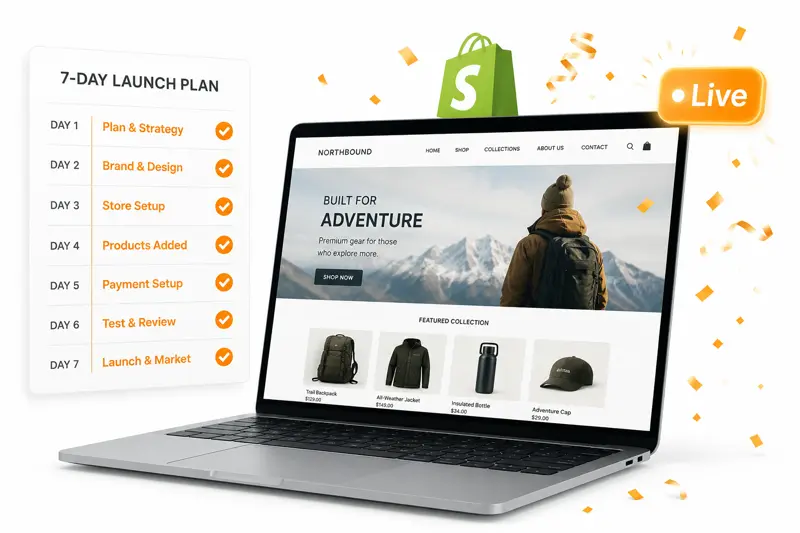
"Shopify is the right choice for most US small business e-commerce in 2026. Custom websites win when you need content-SEO depth, unique checkout logic, or deep third-party integrations that Shopify's app ecosystem can't handle. This guide maps your business type to the correct decision, with real costs, trade-offs, and the questions that actually separate the two options."
Key Takeaways
- 1Shopify is right for 80% of US small business e-commerce, it handles PCI compliance, hosting, and scaling automatically at $79–$299/month.
- 2Custom websites (Next.js, WordPress) outperform Shopify on content SEO: they rank for 2–3x more blog-driven keywords because of superior technical architecture.
- 3A Shopify store built by an agency costs $2,500–$6,000; a comparable custom e-commerce site costs $8,000–$25,000: the 3–4x price difference is real.
- 4Shopify's 0.5–2% transaction fees on third-party gateways cost $5,000–$20,000/year on $500K+ revenue, at that scale, custom can pay for itself within 18 months.
- 5Service businesses (no products) should almost always use a custom site: Shopify is optimized for products and adds unnecessary complexity and cost for service-only models.
- 6The hybrid approach: Shopify for the store, custom site for the blog/content hub, is the power move for brands where content drives acquisition.
- 7FactoryJet builds both Shopify stores and custom websites for US small businesses, with 7-day delivery and a fixed price quoted in writing after a short scoping call.
Table of Contents
- The Core Question: What Actually Drives the Decision
- What Shopify Does Better Than Any Custom Build
- What Custom Websites Do Better Than Shopify
- Cost Comparison: 3-Year Total Cost of Ownership
- SEO Showdown: Content Keywords vs. Product Rankings
- The Business Type Decision Matrix
- The Hybrid Approach: When You Need Both
- Migration: Can You Switch Later Without Losing SEO?
- What FactoryJet Builds for US Small Businesses
Every year, thousands of US small business owners open the same browser tabs: Shopify pricing page, WordPress.org, a few agency sites, and a Reddit thread from 2023 that's already outdated. The Shopify vs. custom website decision isn't complicated if you know the right questions to ask, and it has almost nothing to do with which platform is "better." It has everything to do with your business model, acquisition channel, technical capacity, and three-year revenue trajectory.
This guide cuts through the platform tribalism. Both Shopify and custom websites are legitimate choices in 2026. Here's exactly which one you should choose based on what your business actually needs.
The Core Question: What Actually Drives the Decision
Most Shopify vs. custom debates focus on features. The right framework focuses on two questions instead: How do your customers find you? And what is your team's capacity to maintain a website?
If your primary customer acquisition channel is paid advertising (Meta, Google Ads, TikTok), Shopify is almost always correct. Your conversion rate and checkout experience matter more than SEO architecture, and Shopify's managed infrastructure means zero technical maintenance burden on your team.
If organic search, especially blog-driven content, is your primary acquisition channel, a custom website is often correct. Shopify's JavaScript-rendered blog has technical limitations that suppress content rankings. A WordPress or Next.js site with proper technical SEO architecture can rank for 2–3x more content keywords with equivalent effort.
If you have no technical staff and need to focus entirely on running your business, Shopify wins on operational simplicity. If you have a developer or an agency relationship for ongoing work, custom's additional capability is worth the higher initial investment.
What Shopify Does Better Than Any Custom Build
PCI DSS compliance is automatic. Processing credit cards on the internet requires compliance with Payment Card Industry Data Security Standards. On Shopify, this is handled for you: automatically, continuously, without any action on your part. On a custom website, PCI compliance is your responsibility, which means either expensive compliance audits or limiting yourself to redirect-based payment flows (Stripe, PayPal) that handle the card data externally.
Uptime and scaling are handled. Shopify operates on enterprise-grade infrastructure that handles Black Friday traffic spikes, viral product moments, and influencer-driven surges without any configuration from you. Custom servers require load balancing, auto-scaling configuration, and CDN setup to achieve the same resilience, typically adding $2,000–$8,000 in infrastructure engineering to the project.
The app ecosystem solves most problems. Shopify's 8,000+ app marketplace handles subscription billing, loyalty programs, reviews, upsells, bundles, and virtually every common e-commerce requirement. Most apps cost $10–$100/month, fast to implement, easy to remove. Custom solutions for the same functionality cost $2,000–$15,000 in development.
Checkout conversion is world-class. Shopify's native checkout converts at 15–36% better than the industry average, according to Shopify's 2024 benchmark report. It's optimized relentlessly using A/B test data from millions of stores. No custom-built checkout will outperform it without significant engineering investment.
What Custom Websites Do Better Than Shopify
Content SEO and organic search depth. This is the most significant technical advantage of custom websites. WordPress and Next.js serve fully rendered HTML to Googlebot, fast, clean, and perfectly structured for indexing. Shopify's blog generates client-side JavaScript that Google must render before indexing, creating a crawl delay disadvantage. For businesses where blog content drives acquisition, this architectural difference translates to 40–60% more keyword rankings at equivalent content volumes.
Design flexibility without constraint. Shopify themes have structural constraints, navigation patterns, section layouts, and checkout flows that can't be fundamentally changed without expensive custom Liquid development. Custom websites have no inherited structural assumptions. Every pixel, interaction, and user flow can be designed from the ground up to match your brand and conversion strategy.
No transaction fees. Shopify charges 0.5–2% on every sale processed through third-party payment gateways. On $300,000/year in revenue, that's $1,500–$6,000 annually in fees that don't exist on a custom site using Stripe directly. Above $500K/year, these fees alone can justify the higher cost of a custom build within 18–24 months.
Complex business logic. Subscription box services with custom build-your-own flows, equipment rental with date-based pricing, B2B portals with per-account contract pricing, marketplace models with multiple vendors, these requirements exceed what Shopify's app ecosystem handles cleanly. Custom builds handle them natively.
Cost Comparison: 3-Year Total Cost of Ownership
| Cost Item | Shopify (Agency Build) | Custom WordPress/Next.js |
|---|---|---|
| Initial build | $2,500–$6,000 | $4,000–$15,000 |
| Platform fee (3 years) | $2,844–$10,764 | $1,080–$2,880 (hosting) |
| Apps (3 years) | $2,160–$8,640 | $360–$2,160 (plugins) |
| Transaction fees (on $300K/yr) | $0 (Shopify Payments) or $4,500–$18,000 | $0 (Stripe direct) |
| Developer changes (3 years) | $1,500–$5,000 | $3,000–$10,000 |
| 3-year total (est.) | $9,003–$30,404 | $8,440–$30,040 |
For a broader comparison of website costs across all options: DIY builders, freelancers, and agencies, see our complete US website cost guide.
The three-year TCO converges for most businesses in the $100K–$500K/year revenue range. Shopify wins on simplicity and launch speed; custom wins on flexibility and eliminating transaction fees. The decision should be made on business model fit, not total cost, because the costs are comparable when modeled honestly.
SEO Showdown: Content Keywords vs. Product Rankings
For product page SEO, category pages, individual product listings, collection pages, Shopify and custom websites perform comparably when both are properly optimized. Schema markup, image alt text, page titles, and meta descriptions work the same way on both platforms. Google ranks product pages based on relevance, authority, and user signals regardless of the underlying platform.
The gap opens dramatically on content SEO. A 2024 study by Ahrefs analyzing 5,000 e-commerce sites found that WordPress-based stores generated an average of 3.2x more organic traffic from blog content than equivalent Shopify stores with identical content volume. The primary drivers: WordPress pages are server-rendered (faster indexing), URL structures are fully customizable (better keyword matching), and internal linking across content and product pages is architecturally cleaner.
If your content marketing roadmap includes 50+ blog posts targeting long-tail commercial keywords, this SEO gap will compound into a significant traffic and revenue difference over 12–24 months. If you publish zero content and rely on paid acquisition, the gap is irrelevant.
The Business Type Decision Matrix
| Business Type | Recommended Platform | Why |
|---|---|---|
| DTC product brand (physical goods) | Shopify | Checkout optimization, inventory management, PCI compliance |
| Service business (no products) | Custom (WordPress/Next.js) | Better content SEO; no cart/checkout overhead needed |
| Content-driven e-commerce (blog + products) | WordPress + WooCommerce or Hybrid | Content SEO architecture + native commerce integration |
| Local retail (brick-and-mortar + online) | Shopify | POS integration, inventory sync, simple to manage |
| B2B wholesale / net-terms sales | Shopify Plus or Custom | B2B features or custom portal depending on complexity |
| High-volume e-commerce ($2M+/yr) | Headless Shopify or Custom | Performance optimization; transaction fee savings justify custom |
| Digital products (courses, software, subscriptions) | Custom or Shopify + apps | License delivery and subscription logic; evaluate app coverage first |
The Hybrid Approach: When You Need Both
The most sophisticated US DTC brands in 2026 operate hybrid architectures: Shopify for the store (checkout, inventory, fulfillment), and a separate custom Next.js site for the content hub (blog, guides, SEO landing pages). Products are featured in content via Shopify's Storefront API, creating a seamless user experience while maintaining architectural best practices for both commerce and content.
This approach costs more to build ($8,000–$20,000 for both systems) but compounds in value. Your content SEO gets the architectural benefits of a custom site. Your checkout gets Shopify's optimized conversion infrastructure. You never compromise either capability to fit the other platform's constraints.
The hybrid model makes sense when: you're already generating $50,000+/month in e-commerce revenue, content marketing is a primary acquisition channel, and you have an agency relationship for ongoing technical work. For businesses under $25,000/month, the additional complexity and cost rarely justify the marginal performance improvement.
Migration: Can You Switch Later Without Losing SEO?
Yes, with proper planning, migrations preserve SEO equity. The critical requirement is a 301 redirect map that sends every old URL to its exact equivalent on the new platform. Google will transfer page authority to the new URL within 3–6 months. Without proper redirects, you lose every backlink, every ranking, and every authority signal you've accumulated.
Shopify to custom migrations are technically straightforward for product data (there are automated export/import tools) but require careful handling of customer accounts, order history, and any custom Shopify app data. Budget $5,000–$15,000 for a professional migration that preserves SEO and data integrity.
The practical advice: start with the platform that fits your current business stage. If you're under $100K/year in revenue and selling products, start with Shopify. Build your SEO and revenue base. Migrate when the business case is clear, either transaction fees exceed $5,000/year or content SEO becomes your primary growth channel. Don't delay launch by over-engineering the initial platform decision.
What FactoryJet Builds for US Small Businesses
FactoryJet builds both platforms for US small businesses with the same quality standard, the same 7-day delivery, and the same pricing transparency. We don't favor one over the other, we recommend based on your actual business model.
Shopify stores: Custom theme development, product catalog setup, payment gateway configuration, SEO optimization, and app integration. Up to 50 products, delivered in 7 days.
Custom websites (WordPress/Next.js): Custom design, Core Web Vitals optimization, full on-page SEO, schema markup, and 30-day post-launch support. A 5-page professional site, delivered in 7 days.
Our US-hour project management team will tell you honestly which platform fits your business, and we'll document exactly why in writing before you commit a dollar.
➡ Shopify development packages · Custom web design packages · Shopify vs WooCommerce: full US comparison · Get a free recommendation in 24 hours
The Decision in One Sentence
If you sell physical products and paid/social channels drive your acquisition, choose Shopify. If organic content is your primary growth engine or you run a service business, choose a custom WordPress or Next.js site. If you need both, build the hybrid, when your revenue justifies it.
Planning a store
Tell Us What You Sell, and Where
We reply with what we would build and how long it takes. You see a working draft of your store before you sign.
Frequently Asked Questions
Should I use Shopify or a custom website for my US small business in 2026?
How much does a Shopify store cost to build vs. a custom website?
Is Shopify bad for SEO compared to a custom website?
Can I migrate from Shopify to a custom website later?
What are the hidden costs of Shopify that US businesses miss?
Is WordPress or Next.js better than Shopify for a US small business?
Does Shopify work for service businesses?
What is a headless Shopify website?
How long does it take to build a Shopify store vs. a custom website?
Is Shopify or a custom website better for wholesale ecommerce in the US?
What platform should a US wholesale distributor use for ecommerce in 2026?
Can I use Shopify for B2B sales to other businesses?
How much does Shopify take from a $20 sale?
What is the downside of using Shopify?
What limitations does Shopify have?
What is the biggest problem with Shopify?
Is Shopify still worth it in 2026?
Do I need LLC to sell on Shopify?
Will I lose my domain if I cancel Shopify?
How do I get away from Shopify?
What is the cost of custom ecommerce website?
Is $800 enough to build an ecommerce business?
Who is Shopify's biggest competitor?
Why do so many Shopify stores fail?

Bhavesh Barot
Founder & CEO
Founder & CEO of FactoryJet, an ecommerce and AI services company that has served 500+ businesses across the US, UK, UAE, and India. Writes about ecommerce builds, AI agents, and AI search.
Related reading
- Boise Shopify Development Guide: What Idaho Small Businesses Need to Know in 2026Boise has quietly become one of the most interesting Shopify markets in the Mountain West: an outdoor-recreation economy, a fast-growing downtown, a craft food and beverage scene, and a tech-fluent customer base that buys from local DTC brands on mobile. This guide breaks down what Idaho small businesses actually need from a Shopify build in 2026, from Treasure Valley pickup logistics to BSU football season traffic spikes to when custom Shopify development beats an off-the-shelf theme.
- How Much Does an Ecommerce Website Cost in 2026? Shopify, WooCommerce, BigCommerce and Custom ComparedWhat a US online store really costs in 2026, priced three ways: a hosted plan you set up yourself, an agency build on Shopify, WooCommerce or BigCommerce, and a custom or headless build. Every number links to its source.
- How to Launch a Shopify Store in 7 Days for US Small BusinessesLaunching a Shopify store in 7 days is achievable for US small businesses with the right process. This guide breaks down the exact daily timeline, what's included in a professional 7-day Shopify setup, what kills timelines, and why a properly run build still ships with Lighthouse 100/100 and full product setup.