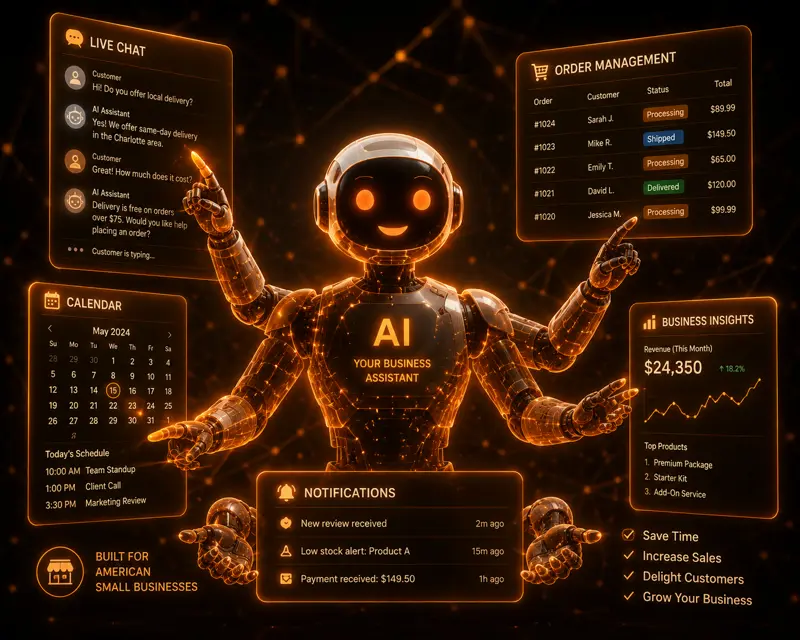
"Small businesses can build AI agents through DIY platforms like Voiceflow and Botpress (£0-£500/month) or hire agencies for custom solutions (£3,000-£15,000). This guide compares both approaches across cost, time, capability, and maintenance to help you choose the right path for your business needs."
Key Takeaways
- 1DIY platforms like Voiceflow, Botpress, and Make.com cost £0-£500/month but require 40-80 hours of learning and setup time for basic agents.
- 2Agency-built AI agents start at £3,000 for simple chatbots and £8,000-£15,000 for complex multi-channel agents with CRM integration and custom workflows.
- 3DIY works best for simple FAQ bots and lead capture forms; agencies handle complex workflows, voice agents, and systems requiring GDPR compliance documentation.
- 4Maintenance costs differ dramatically: DIY requires 5-10 hours monthly of your team's time, while agency maintenance plans run £150-£400/month with guaranteed uptime.
- 5Hybrid approaches exist: agencies can build the foundation (£3,000-£5,000) then train your team to manage content updates, saving 40-60% on long-term costs.
- 6UK small businesses using AI agents report 35-50% reduction in routine enquiry handling time, freeing staff for higher-value customer interactions.
- 7The break-even point for agency vs DIY typically occurs at 12-18 months when factoring in opportunity cost of internal team time spent learning and maintaining platforms.
Table of Content: In This Article
- Understanding AI Agents for Small Business: What You're Actually Building
- DIY Approach: Platforms, Costs, and Realistic Time Investment
- Agency Approach: What You Get, What You Pay, and Delivery Timelines
- Side-by-Side Comparison: DIY vs Agency Across 8 Decision Factors
- When DIY Makes Sense (and When It Doesn't)
- Choosing the Right Agency Partner: Red Flags and Green Flags
- Hybrid Model: Agency Foundation with In-House Management
- Real Cost Breakdown: 3-Year Total Cost of Ownership
- Making Your Decision: Framework for Choosing DIY, Agency, or Hybrid
Small businesses build AI agents through DIY platforms like Voiceflow or Botpress for £0–£500 monthly plus 40–80 setup hours, or hire agencies for £3,000–£15,000 with 2–10 week delivery times. DIY suits simple FAQ bots; agencies handle complex workflows, CRM integrations, and compliance requirements that demand technical expertise.
Understanding AI Agents for Small Business: What You're Actually Building
An AI agent is a software program that handles specific business tasks autonomously, answering customer questions, qualifying leads, booking appointments, or processing orders, using natural language understanding rather than rigid scripted responses. The full definition and a cost breakdown live in what an AI agent is and what it costs; this page is about who should build yours. For a Manchester plumbing firm or a Brighton boutique, this means enquiries get answered at 2am on Sunday, leads get qualified before your sales team sees them, and appointment slots fill themselves without phone tag. Small business AI agents typically fall into four categories. Customer support chatbots answer FAQs around the clock, handling "What are your opening hours?" or "Do you deliver to Brighton?" without human intervention. Lead qualification agents screen enquiries before human follow-up, asking budget questions and capturing contact details with 40-60% better completion rates than static web forms. Booking agents manage calendar appointments directly, syncing with Google Calendar or Outlook to eliminate double-bookings. Workflow automation agents connect multiple systems, when a lead qualifies, the agent creates a CRM record, sends a Slack notification, and schedules a follow-up email. Unlike traditional chatbots that match keywords, 2026 AI agents use large language models like GPT-4, Claude, or Gemini to understand context. They handle follow-up questions, maintain conversation memory across multiple interactions, and adapt responses based on previous exchanges. Ask "Do you offer emergency callouts?" and the agent remembers you're in Bristol when you follow up with "What's your coverage area?" Realistic capabilities for £3,000-£8,000 budgets include handling 60-80% of routine enquiries without escalation, capturing qualified leads while you sleep, and reducing first-response time from hours to seconds. Your agent won't replace your entire customer service team, but it will filter out tyre-kickers, answer repetitive questions, and ensure genuine prospects never wait for basic information. That's the practical difference between an overwhelmed inbox and a business that responds instantly, every time.
DIY Approach: Platforms, Costs, and Realistic Time Investment
Building an AI agent yourself in 2026 means choosing the right platform, carving out significant learning time, and budgeting for costs that extend well beyond the monthly subscription fee. For UK small businesses testing the waters, four platforms dominate the accessible end of the market: Voiceflow (£40-£125/month) offers the most intuitive visual conversation builder, Botpress (free to £50/month) gives you open-source flexibility with self-hosting options, Chatbase (£19-£99/month) gets a website chatbot live fastest, and Make.com (£9-£29/month) excels at connecting AI responses to your existing CRM or email tools. The time investment catches most business owners off guard. Expect 40-60 hours to learn your chosen platform and deploy a basic FAQ agent that answers common questions. A lead qualification agent that routes prospects to your sales team and logs data in your CRM typically demands 80-120 hours of design, testing, and integration work. Multi-channel agents handling voice calls, WhatsApp, and email with complex conditional logic push past 150 hours before you've refined the experience enough for customer-facing deployment. Platform fees represent only the visible portion of your total cost. OpenAI API usage runs £0.002 to £0.06 per conversation depending on model choice and conversation length, modest for a handful of daily interactions, but a £200+ monthly line item once you're handling hundreds of customer queries. Self-hosted solutions add £15-£50/month in server costs. Each third-party integration (Stripe for payments, Calendly for bookings, HubSpot for contact management) typically costs £10-£40/month per connection. Factor in 5-10 hours monthly for maintenance, prompt refinement, and troubleshooting when integrations break after vendor updates. The skill barrier sits lower than most expect for simple agents. You need a basic grasp of conversation design (how people actually phrase questions), the ability to write clear prompts that guide AI responses, and familiarity with API concepts if you're connecting external tools. No coding knowledge is required for straightforward FAQ bots, but JavaScript or Python skills become valuable once you're building custom functions or handling sensitive data transformations. The real requirement is patience, testing dozens of conversation paths, refining responses based on real user confusion, and iterating until the agent genuinely helps rather than frustrates.
Agency Approach: What You Get, What You Pay, and Delivery Timelines
An agency-built AI agent in 2026 typically costs between £3,000 and £15,000 depending on complexity, with most small businesses landing in the £5,000–£8,000 range for a production-ready solution delivered in four to six weeks. Entry-level packages start around £3,000 and deliver a website chatbot trained on 20 to 30 intent patterns, common questions like pricing, opening hours, or service availability. These agents capture leads through structured forms, integrate with one CRM platform such as HubSpot or Zoho, and include two refinement rounds plus 30 days of post-launch support. Agencies typically deliver these in two to three weeks, including conversation design and basic documentation. Mid-tier builds expand deployment across multiple channels. A £5,000–£8,000 agent runs on your website, WhatsApp Business API, and Facebook Messenger simultaneously, using advanced lead qualification logic to score prospects before they reach your sales team. These projects include calendar integration for automated booking, custom conversation flows tailored to your service model, and GDPR-compliant data handling with audit trails. Support extends to 60 days, and delivery takes four to six weeks including user acceptance testing. Complex agents costing £10,000–£15,000 add voice capabilities through Twilio or similar platforms, multi-language support for international markets, and integration with three or more backend systems: your CRM, inventory database, and payment gateway, for example. These include custom workflow automation, intelligent handoff to human agents when the AI reaches confidence thresholds, and a comprehensive analytics dashboard tracking conversation success rates. Delivery spans six to ten weeks with 90 days of managed support. The agency advantage lies in what happens behind the interface. Professional teams conduct user research to map real conversation patterns, produce security and compliance documentation required by UK data protection standards, run load testing to ensure the agent handles traffic spikes, train your staff on daily management, and provide uptime SLAs, typically 99.5% availability with defined response protocols when issues arise.
➡ Learn more: Ai Agent Development
Side-by-Side Comparison: DIY vs Agency Across 8 Decision Factors
When small businesses weigh DIY against agency-built AI agents, the decision hinges on eight factors that produce starkly different outcomes depending on your starting position and goals. Initial cost favours DIY, open-source frameworks like LangChain or Rasa cost nothing beyond developer time, while agency builds start around £3,000. But time to launch flips that advantage: a capable internal team might spend eight weeks prototyping and testing a booking agent, whereas an agency delivers production-ready systems in two to four weeks. Technical capability separates the approaches most sharply. DIY requires fluency in Python, API integration, prompt engineering, and vector databases. Agencies arrive with those skills embedded, plus experience across dozens of deployment scenarios that prevent costly missteps. Maintenance burden grows heavier with DIY over time. Model updates, security patches, and edge-case handling fall entirely on your team. Agency contracts typically include monitoring, updates, and bug fixes within monthly retainers starting at £99. Scalability follows a similar pattern, self-built agents often require architectural rewrites when query volume doubles, while agency solutions anticipate growth from initial design. Compliance handling becomes critical for any agent touching customer data: GDPR, accessibility standards, and sector-specific regulations like FCA guidelines for financial services. Agencies navigate these requirements as standard practice; DIY teams learn through trial and expensive error. Support quality matters most when systems fail at peak hours. DIY means your team troubleshoots alone. Agency partnerships provide dedicated channels and service-level agreements. Total three-year cost often surprises: a £5,000 agency build plus £1,200 annual maintenance totals £8,600, while DIY's hidden costs, developer hours, failed experiments, opportunity cost, frequently exceed £12,000 for equivalent capability. The right choice depends on your use case complexity, existing technical capacity, budget constraints, and tolerance for risk in customer-facing technology.
| Factor | DIY Approach | Agency Approach |
|---|---|---|
| Initial Cost | £0-£500/month platform + 40-80 hours internal time | £3,000-£15,000 one-time build fee |
| Time to Launch | 4-8 weeks for simple agent (learning + building) | 2-10 weeks depending on complexity |
| Technical Capability | Simple FAQ bots and lead capture; struggles with complex workflows | Full capability: voice, multi-channel, complex integrations, custom logic |
| Maintenance Burden | 5-10 hours/month of your team's time | £150-£400/month with guaranteed SLA |
| Scalability | Manual effort to add channels or features; platform limits apply | Designed for growth; add features without rebuilding |
| GDPR Compliance | You're responsible for configuration and documentation | Delivered compliant with privacy policy language and DPA |
| Support Quality | Community forums or 24-48hr email on paid plans | 2-4 hour response SLA on maintenance plans |
| 3-Year Total Cost | £5,000-£12,000 (platform fees + 180-360 hours internal time) | £8,000-£20,000 (build + 36 months maintenance) |
Emerging Tech: Practical Guidance for Your Business
We'll review your specific situation and recommend the right approach. No obligation.
When DIY Makes Sense (and When It Doesn't)
DIY AI agent development makes strategic sense when you're validating demand before committing serious budget, when you have a technically capable team member who can dedicate 10+ hours weekly to the project, or when your use case centers on straightforward FAQ answering or basic lead capture. If you're comfortable with 70-80% accuracy rather than 95%+ precision, and occasional downtime during your learning curve won't damage customer relationships, platforms like Voiceflow or Botpress offer reasonable starting points. A Manchester retailer might successfully deploy a simple product availability chatbot this way, accepting that some queries will require human handoff. The DIY approach hits hard limits when requirements escalate beyond basic text interactions. Voice capabilities, integration with legacy ERP systems, or GDPR-compliant documentation for regulated industries quickly exceed what small teams can manage alongside their primary responsibilities. If your agent faces customers directly and quality must be flawless from launch, think mortgage inquiries or medical appointment scheduling: the reputational risk of a learning-curve failure outweighs any cost savings. Ongoing maintenance becomes the hidden burden: security patches, API updates, and performance optimization demand consistent technical attention most small businesses can't sustain. Clear red flags signal when agency partnership becomes necessary rather than optional. If you've invested 60+ hours in DIY attempts with disappointing results, you're burning opportunity cost that professional delivery would have already recouped. Agents handling payment details, personal health information, or other sensitive data require security architecture beyond typical small business capability. Multi-language support, custom API integration work, or scenarios where downtime directly costs revenue: a booking system going offline during peak season, for instance: all justify professional implementation. The smartest validation approach splits the difference: spend 20-30 hours building a basic DIY prototype to clarify your actual requirements, pain points, and success metrics. This learning investment crystallizes your specifications whether you ultimately continue DIY or engage an agency with far clearer direction. You'll know precisely what questions to ask and which capabilities matter most for your specific business context.
Choosing the Right Agency Partner: Red Flags and Green Flags
Evaluating AI agent agencies requires looking beyond marketing promises to examine concrete evidence of capability and transparency. A trustworthy partner demonstrates working examples of agents they've built for businesses similar to yours, provides fixed-price quotes with itemised deliverables, and explains maintenance requirements before you sign anything. They should offer training sessions for your team, include GDPR compliance documentation as standard, and maintain UK-based support channels that match your operating hours. Watch for warning signs that suggest an inexperienced or opportunistic provider. Agencies that respond to pricing enquiries with only "it depends on your requirements" without offering ballpark figures often lack standardised processes. Be sceptical of promises around 100% accuracy or "fully autonomous" agents, competent developers know AI systems require fallback protocols and human oversight. If an agency can't articulate how they handle edge cases or refuses to discuss what happens when their agent encounters unfamiliar queries, they likely haven't stress-tested their implementations. Proprietary platforms that prevent data export create vendor lock-in, and monthly retainers without defined deliverables can become expensive without delivering proportional value. Ask direct questions before committing. Request to see three agents the agency has deployed for businesses in your sector or with similar customer interaction patterns. Enquire specifically about fallback mechanisms: "What happens when the agent can't answer a question?" Confirm their approach to GDPR data subject access requests, which require structured data retrieval within 30 days under UK regulations. Clarify what post-launch support includes, bug fixes, performance monitoring, and content updates should be specified. Verify whether you can export conversation logs and training data, ensuring you retain ownership of customer interactions. FactoryJet's AI agent builds begin at £3,000 for straightforward chatbot implementations, with the final figure written into a scope document before work starts. Every project includes 30 to 90 days of post-launch support, full conversation data exports in standard formats, and optional team training sessions designed to reduce your long-term maintenance costs. For requirements specific to your business operations, reach out to [email protected].
➡ Learn more: AI Chatbot Development
Hybrid Model: Agency Foundation with In-House Management
Yes, you can split the work, agencies build the technical foundation while your team manages day-to-day content updates, cutting costs by 40-60% compared to full ongoing agency management. This hybrid model works when an agency handles the initial conversation design, CRM integrations, GDPR-compliant architecture, and security configuration (typically £3,000-£5,000 upfront), then trains your staff to update FAQ responses, add new conversation paths, and review performance logs without touching the underlying code. The agency's role becomes quarterly performance reviews and light technical support, usually 2-4 hours monthly at £150-£250. Your team handles content changes: updating responses when product details shift, adding new conversation branches for seasonal offerings, reviewing chat logs to spot gaps in the agent's knowledge, and basic troubleshooting using the documentation provided during handover. This requires 3-5 hours monthly from someone already familiar with your products and customer questions. Hybrid models suit businesses with existing marketing or customer service staff who can dedicate 5-8 hours monthly to agent management. They work especially well when content changes frequently, think seasonal inventory updates, evolving service packages, or regulatory changes that affect customer-facing information. A Nottingham-based home services company might update their agent's pricing and availability weekly during peak season, while the agency ensures the booking integration with their Jobber CRM stays functional and secure. This approach makes sense when budgets can't sustain £300-£400 monthly for full management but still need professional architecture. The agency ensures your agent won't leak customer data, break under load, or fail to escalate complex queries properly. You ensure the agent's answers stay current without waiting for agency turnaround times. The division of labour mirrors how many SMBs already manage WordPress sites, developers build the structure, internal teams update the content.
Real Cost Breakdown: 3-Year Total Cost of Ownership
When you factor in platform fees, internal time, and ongoing maintenance, a DIY AI agent costs £9,000–£20,400 over three years, while a full-service agency build runs £10,400–£22,400, and a hybrid approach lands between £9,600–£15,800. The difference isn't as stark as it first appears, and the hidden costs matter more than the sticker price. DIY builders face £1,800–£6,000 in platform subscriptions across three years, but the real expense is internal time. Building and maintaining an agent demands 180–360 hours of staff attention, which translates to £7,200–£14,400 in opportunity cost at £40 per hour. That's time your team isn't spending on revenue-generating work, and there's no guarantee the final product will perform reliably or scale as your business grows. Full-service agency builds start at £5,000–£8,000, then add £150–£400 monthly for hosting, monitoring, and updates. Over 36 months, maintenance totals £5,400–£14,400, bringing the three-year cost to £10,400–£22,400. You get professional-grade quality, SLA guarantees, and predictable uptime without draining internal resources. Hybrid models split the difference: £3,000–£5,000 for the initial build, £1,800–£3,600 for quarterly agency reviews, and £4,800–£7,200 in internal management time. This approach works well for businesses with technical staff who can handle day-to-day tweaks but need expert oversight for complex updates. Break-even happens faster than most expect. If your AI agent saves 10 hours of staff time weekly, worth £400 at £40 per hour: an agency build pays for itself in 13–26 weeks, while DIY takes 23–51 weeks once you account for learning curves. Most UK small businesses hit break-even within 12–18 months, regardless of which path they choose, making the decision less about total cost and more about speed, quality, and internal capacity.
Making Your Decision: Framework for Choosing DIY, Agency, or Hybrid
Start by mapping your use case to realistic capability requirements. A simple FAQ bot handling under 30 questions sits comfortably in DIY territory using platforms like Voiceflow or Botpress. You're essentially building a decision tree with natural language triggers. Lead qualification that needs CRM integration moves into hybrid or agency territory because you're connecting systems that must talk reliably without dropping data. Voice agents or multi-system workflows that touch your accounting software, booking system, and email platform simultaneously require agency expertise from the start: the integration complexity alone will consume weeks of troubleshooting if you lack technical experience. Assess your internal capacity with brutal honesty. If no one on your team can dedicate 10+ hours weekly for 6-8 weeks straight, your DIY project will stall at the 60% mark and never launch. We've seen this pattern repeatedly across UK small businesses, enthusiasm carries the first fortnight, then daily operations reclaim attention and the half-built agent sits abandoned. Better to invest in an agency foundation than waste three months on a project that never reaches customers. Consider risk tolerance carefully for customer-facing deployments. An agent that represents your brand to prospects or existing customers requires professional quality from day one. The DIY learning curve means your early versions will misunderstand requests, provide inconsistent answers, or fail ungracefully: each interaction potentially damaging customer trust you've spent years building. Internal tools tolerate imperfection during learning phases; customer-facing agents don't. Budget reality shapes your path more than preferences. If you have £3,000-£5,000 available, agency or hybrid delivers better ROI when factoring opportunity cost of internal time: your hours are worth something even if not invoiced. If budget sits under £1,000, DIY becomes your only option but set expectations accordingly: you're buying learning experience as much as working software. Most UK small businesses succeed with this sequence: start with agency foundation including team training, manage content updates in-house for 6-12 months, then decide whether to continue hybrid or move to full agency management based on actual time investment and results. This approach delivers working software quickly while building internal capability gradually.
➡ Ready to deploy AI agents for your US business? FactoryJet AI Agents for US businesses, built and delivered in 2–4 weeks from $2,999. Also explore our full US services hub.
Ready to transform your business?
We'll review your specific situation and recommend the right approach. No obligation.
Book a Free 30-Min Consultation →500+ businesses · 98% satisfaction · 12+ years combined experience
Want this done for you?
Get a free, no-pitch plan for your site.
Tell us where to send it. Bhavesh, the founder, reviews every request himself and replies within 24 hours, often the same day. Most sites ship in about 7 days.
Frequently Asked Questions
What's the realistic cost to build an AI agent for a small business in 2026?
Can I really build an AI agent myself without coding experience?
Which DIY platforms are best for UK small businesses in 2026?
How long does it take to build a functional AI agent?
What's included in a £3,000 agency-built AI agent?
Do I need to maintain an AI agent after launch?
Can an AI agent integrate with my existing CRM and booking system?
What happens if my DIY AI agent breaks or stops working?
Should I start with DIY and upgrade to agency later?
How do I measure ROI on an AI agent investment?
Are AI agents GDPR-compliant by default?
Can an AI agent handle phone calls, not just chat?

Bhavesh Barot
Founder & CEO
Founder & CEO of FactoryJet, a web design and e-commerce agency serving 500+ US, UK, and UAE businesses. Expert in small business website strategy, Shopify development, and Core Web Vitals optimization.
Related reading
- AI Agents for US Small Businesses: What They Are and How to Get StartedAI agents for US small businesses in 2026 are no longer experimental. They are production-ready tools that automate lead qualification, customer support, appointment scheduling, and sales follow-up. This guide explains what AI agents actually do, real ROI examples for SMBs, what they cost, and how to implement them without a technical team.
- AI Automation Services for Small Businesses in 2026: UK Agency Selection GuideUK small businesses can automate customer support, sales, and operations using AI agents from £3,000, with ROI typically achieved within 3-6 months through reduced staffing costs and 24/7 availability. This guide covers vetting criteria, pricing models, and implementation timelines for choosing the right AI automation partner.
- Best Web Design Agency for US Small Businesses in 2026: What to Look ForThe best web design agency for a US small business in 2026 scores above 90 on Lighthouse, delivers in under 4 weeks, provides transparent fixed pricing, and supplies verifiable US client references, not just a polished portfolio. This guide gives you the exact criteria, the questions to ask, and the red flags that predict expensive mistakes.