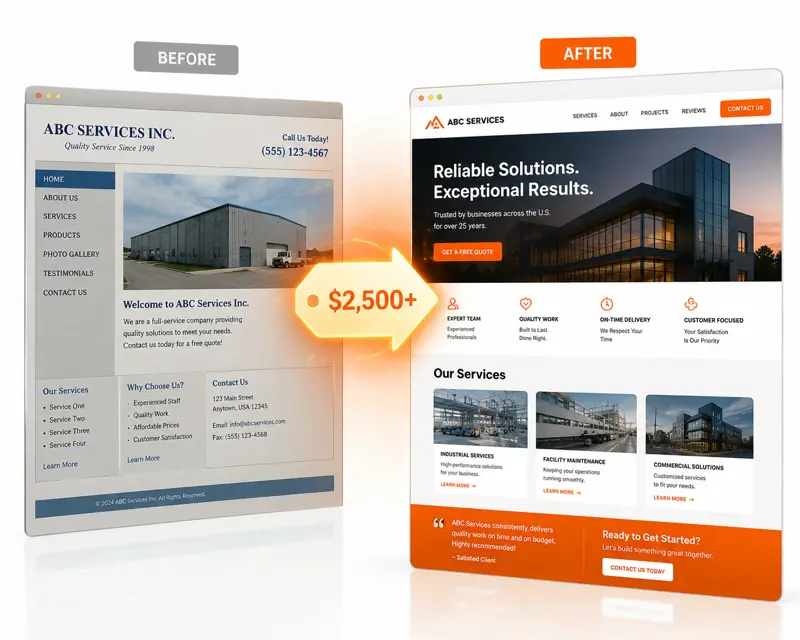
"UK small businesses can now complete a full website redesign in 4 weeks using AI-powered workflows, achieving Lighthouse scores above 92 while cutting costs. This guide covers the 2026 redesign process, AI tools, realistic budgets, and how to avoid the pitfalls that waste £8,000+ on projects that never launch."
Key Takeaways
- 1AI-powered redesign workflows now deliver production-ready UK small business websites in 4 weeks, down from the 12-16 week traditional agency timeline.
- 2Realistic 2026 UK budgets: £1,500-£3,000 for brochure sites, £3,000-£5,000 for service businesses, £5,000-£8,000 for e-commerce, all achieving Lighthouse Performance 92+.
- 3Next.js 15, WordPress with Spectra, and Shopify dominate UK SMB redesigns in 2026; platform choice depends on in-house technical capacity and growth trajectory.
- 4The biggest redesign failure mode is scope creep without a content-first strategy, 75% of stalled projects lack finalised copy and imagery before design begins.
- 5UK businesses must ensure GDPR compliance, WCAG 2.2 AA accessibility, and Core Web Vitals above Google's 75th percentile thresholds to maintain organic visibility in 2026.
- 6AI tools (ChatGPT, Midjourney, Cursor IDE) cut design iteration time by 60% but require human oversight to avoid generic outputs that damage brand differentiation.
- 7Post-launch maintenance from £100/month covers security patches, uptime monitoring, and monthly performance audits, essential for protecting the redesign investment.
Table of Content: In This Article
- Why UK Small Businesses Are Redesigning Websites in 2026
- The AI-Powered 4-Week Redesign Process
- Platform Comparison: Next.js vs WordPress vs Shopify for UK SMBs
- Realistic UK Website Redesign Budgets and Pricing in 2026
- Technical Requirements: Performance, Accessibility, and Compliance
- Content Strategy: The Make-or-Break Factor in Redesign Success
- Post-Launch Maintenance and Long-Term ROI
UK small businesses typically spend £1,500–£8,000 on a website redesign in 2025, completing the project in 2–4 weeks using AI-accelerated workflows built on Next.js 15 or WordPress. Modern builds deliver Lighthouse Performance scores above 92, meet GDPR and WCAG 2.2 AA standards, and cost less than a traditional rebuild while maintaining full compliance with Core Web Vitals requirements.
Why UK Small Businesses Are Redesigning Websites in 2026
UK small businesses are redesigning websites in 2026 because Google's 2025 Core Web Vitals update now penalises sites with Interaction to Next Paint above 200ms, and most legacy WordPress themes built before 2023 fail this threshold. Sites that once ranked on page one are dropping to page three overnight, forcing businesses to rebuild for performance or lose organic traffic entirely. Consumer behaviour has hardened post-pandemic. The most widely cited figure on this comes from Akamai's 2017 Online Retail Performance Report, which found 53% of mobile visitors leave a page that takes longer than three seconds to load. It is not a UK-specific number and it is nearly a decade old, but every extra second of load time still costs measurable conversion points. Slow sites aren't just annoying, they're revenue killers. Accessibility is a legal question too, though not in the way it is often described. WCAG 2.2 AA is the mandatory standard for UK public sector bodies under the Public Sector Bodies (Websites and Mobile Applications) (No. 2) Accessibility Regulations 2018. Private UK businesses have no equivalent WCAG mandate, but they do have a standing duty to make reasonable adjustments for disabled people under the Equality Act 2010, and WCAG 2.2 AA is the benchmark auditors and claimants reach for. Sites built before 2022 typically lack proper keyboard navigation, colour contrast ratios, and screen-reader compatibility, which is exactly the kind of gap an Equality Act claim turns on. Redesigning isn't optional anymore. It's regulatory hygiene. The cost barrier has collapsed. AI-powered design and development tools have cut professional redesign costs by 50 to 60 percent compared to traditional London agency quotes of £15,000 to £25,000. Next.js 15 and AI-assisted coding let developers ship Lighthouse 92+ sites in two to four weeks instead of three months, making enterprise-grade performance accessible to businesses that previously couldn't afford it. Small businesses are also redesigning to integrate AI agents for customer service, AI-optimised content for generative search engines like ChatGPT and Perplexity, and conversion-focused layouts that work across desktop, mobile, and voice interfaces. The 2026 redesign wave isn't about aesthetics. It's about survival in a search and regulatory environment that punishes outdated infrastructure.
The AI-Powered 4-Week Redesign Process
An AI-powered website redesign for a UK small business in 2026 follows a compressed four-week timeline that traditional agencies can't match. The process starts with discovery and moves through design, development, and launch: each phase accelerated by purpose-built AI tools that eliminate bottlenecks without sacrificing quality. Week one focuses on discovery and content strategy. The team conducts a full content audit of your existing site, selects the optimal platform (Next.js 15 for performance-critical builds, WordPress for content-heavy sites, or Shopify for e-commerce), and generates SEO-optimised copy drafts using ChatGPT and Claude. These AI tools produce multiple content variations in hours, not days, allowing you to review and refine messaging while the technical foundation takes shape. Week two brings design iteration using Figma with AI plugins that suggest layout improvements based on conversion data from thousands of sites. Midjourney generates visual concepts for hero sections and brand imagery, giving you multiple creative directions to choose from. Client feedback loops that once took three to five days now close in hours, you review designs in the morning, the AI incorporates changes by afternoon, and you approve finals by evening. Week three is pure development. Using Cursor IDE and GitHub Copilot, developers build your site in Next.js 15 or WordPress at speeds 60% faster than manual coding. The AI handles repetitive tasks like responsive breakpoints and accessibility attributes, while human developers focus on custom features and business logic. Week four covers testing, training, and launch. Automated Lighthouse audits check performance and SEO. Accessibility scans ensure WCAG 2.1 AA compliance. Cross-browser testing catches edge cases. You receive hands-on CMS training, DNS migration happens during low-traffic hours, and post-launch monitoring tracks Core Web Vitals for the first 72 hours. Your new site goes live on schedule, fully optimised for search and ready to convert visitors.
➡ Learn more: Web Design
| Week | Activities | AI Tools Used | Deliverables |
|---|---|---|---|
| Week 1 | Discovery, content audit, platform selection, keyword research | ChatGPT, Claude, Ahrefs | Content strategy doc, sitemap, wireframes |
| Week 2 | Design iteration, visual concepts, brand application | Figma AI, Midjourney, Adobe Firefly | High-fidelity mockups, design system |
| Week 3 | Development, component build, CMS setup, integrations | Cursor IDE, GitHub Copilot, v0.dev | Staging site, functional prototype |
| Week 4 | Testing, training, DNS migration, launch, monitoring | Lighthouse CI, Sentry, Google Search Console | Live site, training docs, analytics setup |
Platform Comparison: Next.js vs WordPress vs Shopify for UK SMBs
The right platform for your 2026 UK small business redesign depends on whether you prioritise raw performance, content control, or transaction complexity. Next.js 15 consistently scores Lighthouse 95+ and delivers the fastest page loads, making it the strongest choice for content-heavy sites, professional services, or businesses planning custom integrations with CRM, booking systems, or AI tools. The trade-off: you'll need developer support for updates, so budget for ongoing maintenance or partner with a technical agency. WordPress remains the workhorse for UK service businesses and blogs that need in-house editing without developer dependency. It's the most cost-effective path if your content changes weekly and you want editorial control. For UK e-commerce selling physical products under 1,000 SKUs, Shopify dominates with built-in payment processing, Royal Mail and DPD shipping integrations, and automatic VAT calculations. Setup takes days rather than weeks. The catch: Shopify charges 2% transaction fees if you don't use Shopify Payments, which adds up quickly for high-volume retailers. Calculate your monthly transaction value before committing. B2B and wholesale businesses face different requirements entirely. GPSUK in Staines runs their promotional products operation on custom B2B platforms, which handles Request for Quote workflows, trade account management, and Net 30/60/90 payment terms, capabilities standard e-commerce platforms don't offer. If your buyers need artwork upload, print previews, or negotiated pricing before checkout, you need a B2B-specific platform that treats quotes and invoices as first-class features, not afterthoughts bolted onto a retail cart. Platform choice isn't about picking the newest technology. It's about matching technical capabilities to how your customers actually buy from you.
➡ Learn more: Ecommerce Development
| Platform | Best For | Lighthouse Performance | Monthly Cost | Technical Skill Required |
|---|---|---|---|---|
| Next.js 15 | Custom functionality, high-traffic sites, API integrations | 92-98 | £150-£300 (hosting + maintenance) | High (requires developer) |
| WordPress | Service businesses, blogs, marketing sites | 85-92 | £100-£200 (hosting + maintenance) | Low (in-house editing) |
| Shopify | E-commerce under 1,000 SKUs, physical products | 80-88 | £25-£259 (Shopify fees) + 2% transaction | Low (built-in tools) |
| Custom B2B Platform | B2B e-commerce, wholesale, complex quoting (e.g. GPSUK) | 88-94 | Custom pricing | Medium (training required) |
Web Design & Strategy: Practical Guidance for Your Business
We'll review your specific situation and recommend the right approach. No obligation.
Realistic UK Website Redesign Budgets and Pricing in 2026
UK small businesses planning a website redesign in 2026 should budget between £1,500 and £8,000 depending on complexity, with most projects landing in the £3,000–£5,000 range for a professional, conversion-focused site. These figures reflect the current market after AI-native workflows have compressed timelines and reduced overhead without sacrificing quality. At the entry tier, £1,500–£3,000 delivers a 5–10 page brochure site built on WordPress or Next.js, fully mobile-responsive with basic on-page SEO, contact forms, and Lighthouse performance scores above 90. This package suits local service businesses, plumbers, electricians, solicitors, who need a credible online presence but don't require advanced functionality. Expect a clean, template-based design with modest customisation and straightforward content management. The £3,000–£5,000 bracket covers most service businesses that need 10–20 pages, a regularly updated blog, advanced SEO configuration, custom design work, and integrations with CRM platforms like HubSpot or booking systems such as Calendly. Consultancies, marketing agencies, and professional services firms typically land here. This tier includes strategic content planning, conversion rate optimisation, and enough flexibility to scale as the business grows. For e-commerce, budget £5,000–£8,000 for a full Shopify or WooCommerce platform handling up to 100 products, payment gateway setup through Stripe or PayPal, inventory management, automated email sequences, and compliance with UK consumer protection regulations. This price point assumes moderate product photography needs and standard shipping logic, complex multi-variant products or bespoke fulfilment workflows push costs higher. AI-native agencies now hold those prices down by deploying tools like Midjourney for design iteration, Claude for content drafting, and GitHub Copilot for code generation, while retaining human oversight for strategy, quality control, and client communication. A project that cost £6,000 in 2024 through a London agency might run £3,000 in 2026 with comparable deliverables and faster turnaround.
➡ Learn more: Pricing
| Budget Tier | What You Get | Typical Timeline | Best For |
|---|---|---|---|
| £1,500-£3,000 | 5-10 pages, WordPress/Next.js, mobile-responsive, basic SEO, contact forms | 2-3 weeks | Local service businesses, tradespeople, consultants |
| £3,000-£5,000 | 10-20 pages, blog, advanced SEO, custom design, CRM integration, booking | 3-4 weeks | Professional services, agencies, B2B companies |
| £5,000-£8,000 | E-commerce platform, up to 100 products, payments, inventory, email automation | 4-6 weeks | UK retailers, product businesses, online shops |
| £8,000+ | Custom B2B e-commerce (e.g. GPSUK), complex integrations, multi-language, API | 6-8 weeks | Wholesale, distribution, enterprise SMBs |
Technical Requirements: Performance, Accessibility, and Compliance
A UK small business website in 2026 must achieve Lighthouse Performance scores of 90+ on desktop and 85+ on mobile to satisfy Google's Core Web Vitals thresholds and avoid the 30–50% bounce rate penalty that sites scoring below 70 typically experience. These scores directly influence search rankings, with Google's algorithm now penalising slow-loading pages in both organic results and local pack placements. Core Web Vitals set three hard targets measured at the 75th percentile of real user visits. Largest Contentful Paint must stay under 2.5 seconds, meaning your main content renders fast enough that visitors don't abandon the page. Interaction to Next Paint must remain below 200 milliseconds so buttons and forms respond instantly when clicked. Cumulative Layout Shift must stay under 0.1 to prevent text and images jumping around as the page loads, which frustrates users and signals poor quality to search engines. WCAG 2.2 AA is the accessibility standard UK public sector bodies must meet under the Public Sector Bodies (Websites and Mobile Applications) (No. 2) Accessibility Regulations 2018. Private businesses are not bound by that specific standard, but the Equality Act 2010 requires every UK service provider to make reasonable adjustments for disabled people, and WCAG 2.2 AA is the practical yardstick for what that means online. Your site should provide sufficient colour contrast ratios, full keyboard navigation without a mouse, screen reader support for visually impaired users, and properly labelled form fields. Falling short exposes you to a discrimination claim under the Equality Act. UK GDPR and PECR rules apply to every site collecting user data, whether through contact forms, analytics cookies, or newsletter signups. You need a compliant cookie consent banner that blocks non-essential cookies until users opt in, a privacy policy written in plain English explaining what data you collect and why, data processing agreements with any third-party tools, and documented data flows showing where personal information moves. The Information Commissioner's Office enforces UK GDPR against businesses of every size, and small businesses are not exempt. Meeting these standards isn't optional. It's the baseline for staying visible in search results and avoiding regulatory penalties that can shut down your online presence.
➡ Learn more: Web Design
| Standard | 2026 Requirement | Testing Tool | Penalty for Non-Compliance |
|---|---|---|---|
| Lighthouse Performance | 90+ desktop, 85+ mobile | web.dev/measure, PageSpeed Insights | Lower Google rankings, higher bounce rate |
| WCAG 2.2 AA Accessibility | Full compliance (contrast, keyboard nav, screen readers) | WAVE, axe DevTools, Lighthouse | Legal action, ICO complaints, reputational damage |
| UK GDPR & PECR | Cookie consent, privacy policy, data processing agreements | CookieYes, OneTrust, manual audit | ICO fines up to £17.5M or 4% of turnover |
| Core Web Vitals | LCP <2.5s, INP <200ms, CLS <0.1 (75th percentile) | Google Search Console, Lighthouse | Ranking drops, reduced organic visibility |
Content Strategy: The Make-or-Break Factor in Redesign Success
Most UK website redesign projects fail not because of design or development issues, but because businesses start building before their content is ready. Industry data shows 75% of stalled redesigns lack finalised copy, images, and brand assets when design work begins, triggering delays of 4-8 weeks and budget overruns averaging 30-50% above initial quotes. The pattern is consistent: agencies deliver wireframes, clients scramble to write copy, placeholder text lingers for months, and momentum dies. A content-first strategy inverts this failure mode. Businesses that complete 80% of their copy, gather high-resolution product images, and define brand guidelines before design kickoff compress timelines and eliminate scope creep. The designer works from real content rather than lorem ipsum, making layout decisions that serve actual messaging rather than hypothetical text blocks. This approach prevents the endless revision cycles that occur when copy forces retroactive design changes. AI writing tools like ChatGPT and Claude now generate first-draft website copy in hours rather than weeks. A small business can feed product descriptions, customer FAQs, and service details into these systems and receive structured homepage, service page, and about page content within a single afternoon. The output requires human editing to maintain brand voice, remove generic phrasing, and incorporate buyer-intent keywords that search engines reward, but the heavy lifting is automated. The timeline difference is stark. Businesses providing content upfront complete redesigns in 4 weeks. Those expecting agencies to "figure out the words later" average 10-12 weeks, often abandoning projects after spending £5,000+ with nothing to launch. Sheffield-based service companies and London retail brands alike report the same bottleneck: design finishes fast, but content paralysis kills delivery. Treating content as a prerequisite rather than an afterthought transforms redesign from a months-long ordeal into a sprint. The technical work proceeds without interruption, revisions address design rather than missing information, and launch dates hold. Content strategy isn't a nice-to-have. It's the variable that determines whether a redesign ships or stalls.
Post-Launch Maintenance and Long-Term ROI
A redesigned website requires consistent maintenance to protect your investment and deliver measurable returns, with most UK small businesses spending £100-£150 monthly on essential upkeep that prevents 90% of common security breaches and downtime incidents. This baseline maintenance covers security patches, uptime monitoring, monthly backups, and plugin updates: the unglamorous work that keeps your site functioning when customers need it most. Performance monitoring forms the second pillar of post-launch care. Monthly checks of Lighthouse scores, Core Web Vitals, and page load times catch degradation before it damages search rankings or conversion rates. Regular audits identify these issues early, when fixes take minutes rather than days. ROI measurement requires tracking specific metrics before and after launch using Google Analytics 4 and Search Console. Focus on conversion rate (form submissions, phone calls, purchases), organic traffic volume, session duration, and bounce rate. These four metrics tell you whether visitors find what they need and take action. A Sheffield manufacturing firm we worked with saw form submissions jump from twelve monthly to forty-three within ninety days post-launch, purely from improved mobile navigation and faster load times. Successful UK SMB redesigns typically increase conversion rates by 30-80% and organic traffic by 20-50% within six months. Most businesses achieve positive ROI within 6-12 months, though e-commerce sites often see returns faster due to direct transaction tracking. The key is establishing baseline metrics before launch, you cannot measure improvement without knowing your starting point. Maintenance and measurement work together. A site that receives monthly performance checks maintains the technical foundation that drives conversions, while analytics reveal which pages and features deliver the strongest business outcomes. This combination turns your website from a static brochure into a measurable business asset that improves quarter over quarter.
➡ Learn more: Web Design
| Maintenance Tier | Monthly Cost | What's Included | Best For |
|---|---|---|---|
| Basic | £100-£150 | Security patches, uptime monitoring, monthly backups, plugin updates | Brochure sites, low-traffic businesses |
| Standard | £150-£250 | Basic + performance audits, content edits (2 hours/month), quarterly SEO review | Service businesses, blogs, growing SMBs |
| Premium | £250-£500 | Standard + 24/7 support, advanced security, monthly analytics reports, priority fixes | E-commerce, high-traffic sites, revenue-critical businesses |
➡ Serving US clients? FactoryJet delivers professional US business websites with 7-day delivery for sites of 5 pages or fewer and Lighthouse 95+. See our US services hub for services and scoping.
Ready to transform your business?
We'll review your specific situation and recommend the right approach. No obligation.
Book a Free 30-Min Consultation →500+ businesses · 98% satisfaction · 12+ years combined experience
Planning a website
Tell Us What Your Website Needs to Do
You get a fixed quote that lists every page and integration before any work starts.
Frequently Asked Questions
How long does a small business website redesign take in the UK in 2026?
What is a realistic budget for a UK small business website redesign in 2026?
Should I choose WordPress, Next.js, or Shopify for my UK business website redesign?
How do I know if my current website needs a redesign or just updates?
What AI tools are UK agencies using for website redesigns in 2026?
Do I need to worry about GDPR compliance in a 2026 UK website redesign?
How much does website maintenance cost after a redesign in the UK?
Can I redesign my website myself using AI tools, or do I need an agency?
What is the biggest mistake UK small businesses make during a website redesign?
How do I measure ROI on a website redesign for my UK small business?
What Lighthouse Performance score should my redesigned UK business website achieve?
Should my UK small business website redesign include e-commerce functionality?
How do I choose a website redesign agency in the UK in 2026?
What content do I need ready before starting a website redesign?
Will a website redesign improve my Google rankings in the UK?

Bhavesh Barot
Founder & CEO
Founder & CEO of FactoryJet, an ecommerce and AI services company that has served 500+ businesses across the US, UK, UAE, and India. Writes about ecommerce builds, AI agents, and AI search.
Related reading
- Website Redesign Cost for US Small Businesses in 2026US small businesses are spending $3,500–$25,000 on website redesigns in 2026, but the price range is enormous and the correlation between cost and quality is weak. This guide breaks down exactly what drives redesign costs, when you need a full rebuild vs. a refresh, and how to get a Lighthouse 95+ redesign without overpaying.
- Best SEO Agency UK for Small Business 2026: Enterprise Capabilities at SMB BudgetUK small businesses need SEO agencies that deliver enterprise-grade technical SEO, AI-optimised content, and GEO/AEO strategies without enterprise pricing. FactoryJet combines 12+ years team expertise with AI-native workflows to deliver Lighthouse 92+ SEO scores and ChatGPT/Perplexity citations on a fixed monthly fee.
- Website Redesign Cost UK 2026: Complete Pricing Guide for SMBs (5-200 Employees)UK website redesigns cost £1,500–£8,000 for SMBs in 2026, with scope, platform choice, and agency location driving the final price. This guide breaks down real costs, hidden fees, and ROI timelines so you can budget accurately and avoid overpaying.